MATCHIQ | Player Intelligence / Match Intelligence | 10 October 2026
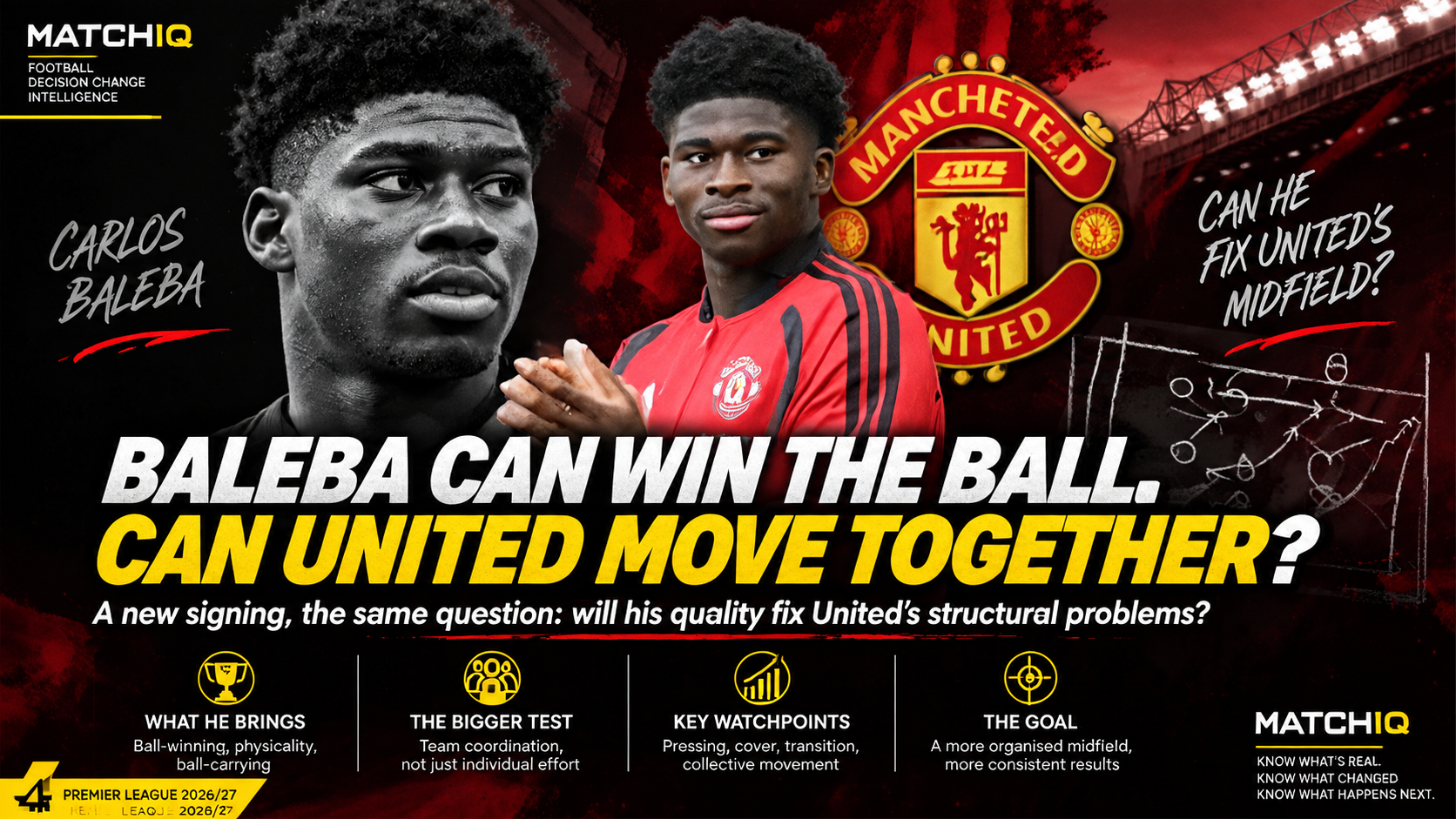
Carlos Baleba has not played a competitive minute for Manchester United yet.
And already, people are wondering whether he can fix their midfield.
You can understand why.
United have won only one of their opening five Premier League matches. Their high-intensity running numbers have been among the worst in the division, and opponents have repeatedly found ways to play through the spaces between their players.
Baleba looks like the sort of midfielder who could make a difference.
He is powerful, quick across the ground, comfortable winning the ball and capable of carrying it forward himself.
But Manchester United’s problem is not simply that they need someone who can reach the ball.
It is what the rest of the team do when that player goes to win it.
That is the question his possible debut against Tottenham should help us investigate.
Baleba gives United something they have been missing
Manchester United signed Baleba from Brighton on 25 August.
The clubs confirmed the transfer without disclosing the fee. The Guardian reported a £65 million initial payment, with a further £5 million in possible add-ons.
For a 22-year-old midfielder, that is a substantial investment.
But the more important evidence comes from what Baleba actually did at Brighton.
The club’s analysis of his 2024/25 season recorded 76 tackles, 44 interceptions and 187 ball recoveries. He led Brighton in all three categories.
Those numbers describe a player who spends a lot of his time disrupting opposition attacks.
He is not just standing in front of the defence waiting for a loose ball.
Baleba can step towards an opponent, challenge for possession and cover ground when the game suddenly changes direction.
He also offers something useful after winning it.
At Brighton, he showed that he could receive possession deep, carry the ball past an opponent and move the team forward without always needing a teammate to make the first progressive pass.
That combination is valuable.
United need midfielders who can both recover possession and stop every attacking move from depending on Bruno Fernandes finding the next answer.
But it is worth remembering that Brighton’s numbers belong to Brighton’s structure.
Winning possession regularly in one team does not automatically mean another team will become better organised.
MATCHIQ has already identified a different problem at United
In our September analysis, we examined Manchester United’s poor high-intensity running figures.
GeniusIQ data reported by Reuters placed United last in the Premier League for high-intensity distance, high-intensity activity time, sprint count and sprinting time.
The obvious explanation was that the players were not working hard enough.
We did not accept that as a proven diagnosis.
Running figures tell us how much movement happened. They do not, on their own, explain whether players lacked fitness, received unclear instructions or were positioned in a way that reduced their need to sprint.
After United’s draw with Fulham, Matheus Cunha pointed towards a lack of energy. Michael Carrick defended his players’ capacity to respond.
The disagreement was interesting because both observations could contain some truth.
United might need to improve their physical output.
They might also need to improve the decisions that tell players when and where to run.
Our 8 October article developed that argument further.
Carrick has already demonstrated that he can simplify a team and give players clearer responsibilities.
What remains unproven is whether those responsibilities survive when opponents change the match.
Against Brighton in the Carabao Cup, United went 2–0 ahead and still lost 3–2.
Different incidents have exposed problems with defending leads, reacting after losing possession and maintaining pressure together.
The latest evidence does not mean every problem has the same cause.
But it does make one question worth carrying into the Tottenham match:
If Baleba supplies more individual defensive energy, will United finally produce more coordinated team actions?
Imagine Baleba winning the first challenge
Tottenham try to build an attack through midfield.
Baleba sees an opponent receiving with his back to goal.
He moves forward and challenges.
That is the sort of situation where his strength can help United.
But three things can happen next.
He wins the ball. Excellent.
Now, can he find a teammate in a useful position, or is everybody too far away for United to turn the recovery into an attack?
He forces the opponent backwards without winning possession.
Does a United forward close the next passing route? Does the rest of midfield move up with him?
Or does Baleba end up chasing the ball while Tottenham simply move it around him?
The third possibility is the most dangerous.
Baleba steps forward, the opponent plays past him, and there is an empty space where he started.
Who protects it?
That is not a criticism of Baleba.
It is the responsibility created whenever a midfielder leaves his position to press.
The best defensive midfielder in the world still needs teammates who understand how to react.
If Baleba jumps towards the ball and nobody covers behind him, his athleticism could even make the team’s problem look more dramatic.
One player moving quickly is not the same as eleven players moving together.
His ball-carrying ability creates another decision
Baleba is not merely a defensive specialist.
At Brighton, he demonstrated the confidence to drive forward with possession.
For United, that could be useful when an opponent presses their midfielders.
Instead of passing backwards whenever the first option disappears, Baleba might carry the ball past the nearest challenger and open up a new attacking route.
That would give Carrick something different.
However, every forward run changes where the player is standing if possession is lost.
When Baleba carries the ball beyond midfield, someone else must be positioned to protect the space behind him.
The team must also decide whether Baleba should be the player holding his position while another midfielder goes forward.
Those are different jobs.
A player can be capable of both, but he cannot occupy both places at the same moment.
That is why the choice of midfield partners matters.
The Guardian has highlighted the selection challenge facing Carrick, with Kobbie Mainoo, Youri Tielemans and Andrey Santos among his options.
Each combination involves a trade-off between defensive coverage, passing and attacking support.
Baleba’s arrival gives United another option.
Carrick still has to decide how the pieces fit together.
The counterargument: perhaps Baleba is exactly what the structure needs
There is a strong reason not to dismiss the potential impact of one signing.
Good organisation and individual ability are not separate worlds.
Sometimes a team understands what it wants to do but lacks a player who can carry out an important part of the plan.
A midfielder who reaches loose balls earlier, wins more challenges and recovers quickly when possession is lost can make everyone else’s job easier.
His teammates may become more confident about pressing higher because they know the space behind them is better protected.
Baleba could also reduce the number of emergency defensive situations United have to survive.
If Carrick’s instructions are already improving, a player with Baleba’s qualities might help those improvements become visible.
That is a serious possibility.
But there is a second limit.
Baleba has been recovering from an ankle injury and has not yet played competitively for United.
Carrick confirmed on 9 October that he had made training progress.
The club has not confirmed a starting place against Tottenham.
Even if he makes his debut, match sharpness and the amount of time he receives will matter.
Judging the success of a major midfield signing from one short appearance would be premature.
Tottenham will provide the first evidence, not the final answer
There is a reason the Tottenham match is interesting.
Roberto De Zerbi’s side have also struggled to turn promising spells into sustained performances.
MATCHIQ has already examined their problems with attacking decisions, game control and defending important moments.
That creates a useful contest between two teams trying to make their football more reliable.
But this should not become another article about which manager is under greater pressure.
For Baleba, we will be watching the actual midfield decisions.
When he steps out to press, who covers?
When United regain possession, can they play forward without immediately losing the ball again?
When Baleba carries the ball, does the midfield keep enough protection behind him?
And when United take the lead, or the opponent begins to dominate, do those habits remain?
If Baleba stays on the bench, those questions do not disappear. The match can still provide evidence about United’s structure, but it cannot be presented as a test of his individual performance.
If he plays only briefly, we should limit our conclusions accordingly.
MATCHIQ Verdict: One Midfielder Can Improve the Tools. Carrick Must Improve the Timing.
Baleba brings demonstrable qualities that United need.
He wins possession, covers ground and can carry the ball forward.
Those are not imaginary solutions.
But United’s recurring difficulties have involved more than the absence of an athletic midfielder.
They have struggled to connect the first press with the players behind it, protect themselves when moves break down and keep performing the same useful actions when the score changes.
Baleba may improve part of that picture.
He cannot personally organise every movement around him.
MATCHIQ’s current judgment is that Baleba can improve United’s individual midfield capacity, but whether the team becomes more reliable depends on how Carrick uses him and how the others respond.
Confidence: Medium.
Confidence is high that Baleba possesses valuable ball-winning and ball-carrying qualities, based on his Brighton record.
Confidence is lower about the size of the improvement he will bring to United, because he has yet to play competitively for the club and the team’s collective response remains untested.
Next Watchpoint
First, establish whether Baleba is selected against Tottenham and how many minutes he plays.
Then examine his pressing decisions, the cover behind him, the options available after ball recoveries and his role when United lose possession.
Over several matches, the stronger test will be whether these positive actions repeat against different opponents and in different scorelines.
More tackles would be encouraging.
A midfield that wins the ball and stays organised afterwards would be much stronger evidence of genuine change.
Sources and Continuity
Manchester United — Carlos Baleba official player profile
Brighton & Hove Albion — Baleba transfer announcement, 25 August 2026
Brighton & Hove Albion — 2024/25 statistical analysis
Premier League — Analysis of Baleba’s Brighton midfield role
Manchester United — Team news ahead of Tottenham
Reuters — Manchester United’s low running output, 21 September 2026
Reuters — Carrick’s latest injury update, 9 October 2026
The Guardian — Baleba’s potential debut, transfer fee and midfield competition
Previously on MATCHIQ
Carrick Made Man United Clearer. Now They Need Repeatable Football
Manchester United Rank Last for High-Intensity Running — Is It Fitness or Structure?
Tottenham Spent £300m to Change the Squad. Five Games Later, the Team Still Has the Same Problems.
Evidence reviewed on 10 October 2026, before Manchester United vs Tottenham. No debut, starting selection, match result or tactical improvement has been assumed.