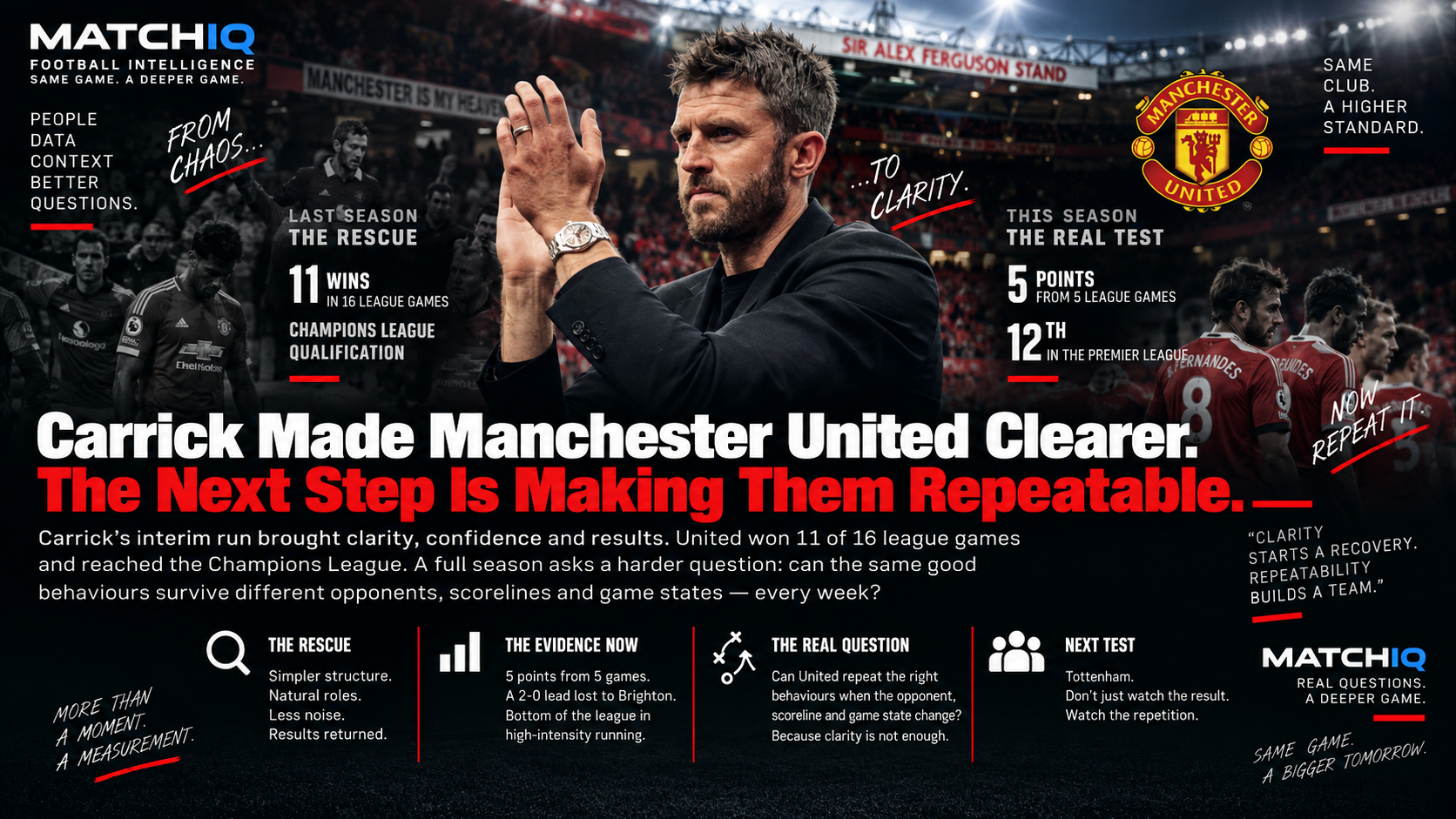
Carrick Made Manchester United Clearer. The Next Step Is Making Them Repeatable.
Michael Carrick’s first job at Manchester United was easier to describe than his job now.
United were chaotic.
He made them clearer.
Put players in more natural positions.
Simplify responsibilities.
Restore confidence.
Reduce the noise.
It worked.
Carrick won 11 of his first 16 league matches as interim manager, took United back into the Champions League and did enough to earn the permanent job.Reuters
That was a successful rescue.
A full season asks a different question.
Can the good things happen again next week?
And the week after that?
And against a completely different opponent?
That is what Manchester United still have not proved.
A rescue job needs clarity
When a team is in crisis, simplicity has enormous value.
Players are thinking too much.
Roles overlap.
Confidence drops.
Every mistake creates another mistake.
So Carrick’s early improvements made sense.
Back four.
Natural roles.
Clearer instructions.
Less tactical noise.
That kind of change can immediately improve a broken team.
You do not need to invent revolutionary football.
Sometimes the first job is simply:
make everybody understand what they are supposed to do again.
Carrick did that well enough to turn a bad season into a Champions League finish.Reuters
But clarity and repeatability are not the same thing.
The same problem keeps returning in different clothes
This is where the previous MATCHIQ pieces start connecting.
Against Hull, United attempted 34 crosses.
The problem was not “crossing is bad”.
The problem was that when the first attacking route failed, United kept returning to the same answer.
Against Ipswich, United scored five.
But the useful question was whether Bruno Fernandes solving moments meant the team structure had actually become reliable.
Against Brighton, United went 2–0 up after ten minutes.
That should have been the easiest game state to manage.
Instead, they lost 3–2.
Sky Sports noted it was the first time in 50 years United had lost at Old Trafford after taking a two-goal lead.Sky Sports
Then came the running data.
United ranked bottom of the Premier League across several high-intensity running measures.
The easy accusation was:
They are lazy.
The better question was:
Do they know when to run, who should jump, and who follows?
Sky’s analysis after the Fulham draw showed United again at the bottom of the league for high-speed running, while Matheus Cunha openly said Fulham had shown more energy.Sky Sports
These look like different problems.
Crossing.
Game control.
Running.
Transitions.
Bruno dependency.
They may actually be different symptoms of the same thing.
United still do not repeat enough of the right behaviours automatically.
Repeatability is what separates an idea from a team
Anyone can have a good game plan.
A real team needs behaviours that survive the game.
At 0–0:
What do we do?
At 1–0 up:
What changes?
When the first press gets beaten:
Who reacts?
When the opponent drops deep:
What is the second attacking route?
When Bruno is marked:
Who takes the next responsibility?
When possession is lost:
Who runs first?
Who covers behind?
That is repeatability.
Not doing the exact same thing every week.
Doing the same principles even when the details change.
United are not there yet.
The first five league matches show why this matters
Manchester United have five points from their opening five Premier League matches and sit 12th.Sky Sports
That is a poor start.
But the result is not the most useful evidence.
The pattern is.
United have shown stretches of good football.
They have also shown how quickly that football can disappear when the match moves into a different state.
That is the difference between:
we know what to do
and
we know what to do repeatedly.
The second one is much harder.
Brighton was the cleanest example
Ten minutes.
2–0.
Home crowd comfortable.
Opponent forced to chase.
This should be the moment when a team’s structure becomes easier to see.
Instead, Brighton created the better chances and eventually won 3–2.Sky Sports
That does not mean Carrick’s whole system failed.
It means United did not turn an advantage into a controlled match.
And that keeps connecting back to the same question.
When the situation changes, do the behaviours survive?
Too often, the answer is still:
not for long enough.
Running is part of the story, not the story
This is where we should avoid repeating the previous articles.
United ranking 20th in high-intensity metrics matters.
But running more is not the solution by itself.
A badly organised team can sprint everywhere and still be terrible.
The useful question is timing.
When the striker presses, does the midfielder follow?
When the full-back jumps, does somebody protect the space?
When possession is lost, does the nearest player react immediately?
When United lead, do they still make unnecessary high-risk runs and open the match?
The number of kilometres is secondary.
The quality of the repeated action is the real test.
Carrick’s original strength now creates a new challenge
This is the interesting paradox.
Carrick earned the permanent job because he simplified Manchester United.
That was exactly what they needed.
Now simplicity alone is no longer enough.
Opponents have had time to study the team.
They know where Bruno wants the ball.
They know when United want to transition.
They know which full-back moves.
They know where the first pressing trigger tends to come from.
A rescue team can surprise opponents.
A permanent team gets analysed.
That changes the job.
Carrick now needs to turn clarity into habits strong enough to survive preparation from the other side.
This does not mean United need a complicated system
That would be the wrong lesson.
Repeatability is not tactical complexity.
Sometimes the best teams are simple.
Everyone just knows:
where the next pass goes,
where the pressure comes from,
where the cover arrives,
and what changes when the score changes.
The problem is not that Manchester United need more ideas.
They may need fewer ideas that work more often.
That is different.
Bruno cannot always be the emergency answer
One of Carrick’s biggest successes has been getting important players back into more natural roles.
Bruno Fernandes benefits from that.
So does United.
But there is a danger.
If every difficult phase eventually becomes:
find Bruno and hope he solves it,
the team has clarity without distribution.
The best version of United needs responsibility to spread.
One player starts the press.
Another controls tempo.
Another progresses.
Another carries the next action.
Bruno can still be the most influential player.
He should not have to become the answer to every broken phase.
This is why Tottenham matters
United host Tottenham next.
The game is not a final judgment on Carrick.
It is one more receipt.
Sky lists United 12th with five points from five matches going into the fixture.Sky Sports
Do not only watch the result.
Watch repetition.
If United press well for ten minutes, does it continue?
If they score first, does the match become calmer?
If Tottenham block the centre, do United immediately return to aimless crossing?
If Bruno is denied space, who becomes the next solution?
If United lose the ball, do the same recovery behaviours appear every time?
Those answers matter more than one Saturday score.
RED TEAM: five league matches are not enough
This needs brakes.
United are early in a permanent-manager season.
Five league matches are a small sample.
Carrick also inherited a squad that was not built entirely around his football.
A full-season job involves more training detail, more rotation, more European matches and more adaptation than an interim rescue.
So this article should not conclude:
Carrick was only a managerial bounce.
The evidence does not support that.
His interim results were too strong to dismiss that easily.Reuters
The more accurate conclusion is:
The rescue was real. The next stage is harder.
MATCHIQ Verdict
Carrick solved Manchester United’s first problem.
He made them clearer.
That mattered.
It restored confidence.
Improved roles.
Reduced chaos.
Earned results.
Now comes the permanent-manager problem.
Can Manchester United repeat the right behaviours when the opponent, scoreline and game state change?
That is where the evidence is still weak.
Hull looked like a crossing problem.
Brighton looked like a control problem.
Fulham and the running data looked like an intensity problem.
They may all belong to the same bigger issue:
the football is not automatic enough yet.
Carrick does not need Manchester United to become more complicated.
He needs them to become more repeatable.
Previous Judgment
Carrick’s early value came from clarity: simpler structure, natural roles and fewer sources of chaos.
New Evidence
United have opened the league season with five points from five matches, exited the Carabao Cup after losing a 2–0 lead to Brighton, and remain bottom of the league in key high-speed running measures.Sky Sports
What Changed
The central question is no longer whether Carrick can simplify United. It is whether those clear behaviours can survive different opponents and different game states every week.
Confidence
HIGH — the rescue phase genuinely improved United.
HIGH — repeatability is currently the bigger unresolved problem.
MEDIUM — running, game control and attacking predictability are symptoms of the same underlying issue.
LOW — Carrick’s interim success was only a short-term bounce.
Next Watch
Tottenham → behaviour after taking the lead → low-block response → first press beaten → Bruno denied space → transition recovery → whether the same correct actions appear repeatedly across 90 minutes.
Sources and language edition
Evidence: Reuters — Carrick’s permanent appointment。 These links support reported facts; MATCHIQ’s interpretation remains its own.
Read this analysis in 中文.