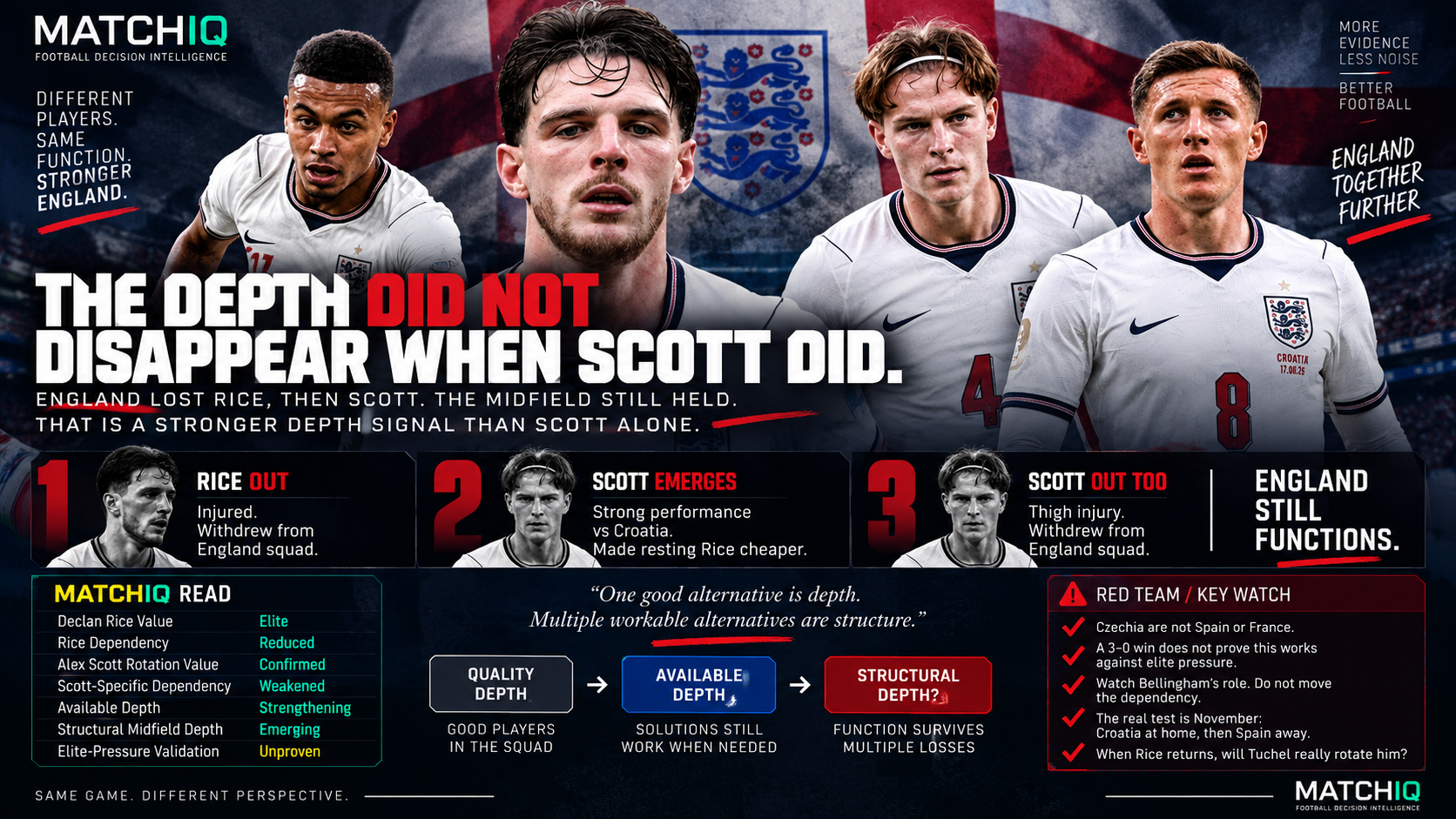
Alex Scott changed the cost of resting Declan Rice.
Then Scott disappeared too.
That is where the England midfield story became more valuable.
Because one good alternative can reduce dependency.
But if the entire solution disappears when that alternative becomes unavailable, then the depth was still player-specific.
England have now produced a second receipt.
Rice was unavailable.
Scott was unavailable.
And the midfield still functioned.
England beat Czechia 3–0 at Wembley.
The important evidence was not simply the score.
It was that England did not have to put Declan Rice back into the structure to make the structure work.
They could not.
He was not there.
And they did not have Scott either.
Yet the midfield did not collapse.
That moves the question again.
Before:
Can Scott make resting Rice cheaper?
Now:
Can England keep Rice’s replacement cost low even when Scott is unavailable too?
Against Czechia, the answer was:
There is now at least some evidence that they can.
That is a stronger depth signal.
Scott Was The First Solution. He Cannot Be The Whole Solution.
The original Scott story mattered because England had discovered a credible alternative.
Rice withdrew.
Scott stepped in.
Alongside Elliot Anderson against Croatia, England produced one of their strongest midfield performances of the window.
Tuchel then openly discussed Scott as someone capable of competing with Rice for responsibility.
That changed England’s rotation economics.
Rice remained elite.
But not using him became less expensive.
Then Scott suffered a thigh injury and withdrew from the squad. Tuchel said the problem was discovered after the Croatia match and could keep him out for several weeks. Reuters
That created the real test.
If Scott was the only player who made Rice rest cheaper, then England had not solved dependency.
They had simply transferred dependency.
From:
Rice dependency
to:
Rice-or-Scott dependency.
Czechia gave England the opportunity to show something better.
England Did Not Replace Scott With “Another Scott”
That is important.
There was no neat one-for-one swap.
Tuchel did not need to find another midfielder who looked exactly like Scott.
England started with Elliot Anderson, Myles Lewis-Skelly, Jude Bellingham, Morgan Rogers and Eberechi Eze occupying different midfield and attacking responsibilities, with Trent Alexander-Arnold also providing progression from the right. England’s official XI confirms the extent of that redistribution. England Football
That matters because real structural depth does not require clones.
It requires functions to survive.
Progression still has to happen.
Press resistance still has to exist.
Transitions still have to be protected.
Somebody still has to receive first.
Somebody still has to move the ball through pressure.
Somebody still has to connect the midfield to the final third.
The names can change.
The functions cannot disappear.
That is the difference between a deep squad and a deep structure.
Elliot Anderson Is Becoming More Important Than The Headline Suggests
Scott attracted the bigger continuity story because his Croatia performance was new.
But Elliot Anderson may now be becoming the more important structural signal.
He survived the first change.
Rice out.
Scott in.
Then he survived the second change.
Scott out.
Different midfield around him.
England still controlled the game.
That does not mean Anderson has “won” a position.
It means he is beginning to look like a continuity piece.
And that matters.
Structural depth often needs one stable point while everything around it changes.
If Anderson can repeatedly provide that stability, England’s midfield rotation becomes easier to manage.
The important test is not whether he becomes untouchable.
It is whether he allows other players not to be.
This Is Better Evidence Than One Scott Performance
Croatia was a powerful receipt.
But it still left one obvious counter-case.
Maybe Scott was simply the answer.
Maybe England had found one special alternative to Rice.
That would still be useful.
But it would remain fragile.
Czechia changed that evidence.
Scott was gone.
The performance did not disappear with him.
That is exactly what you want to see if you are testing structural depth.
One player proves an alternative exists.
The next test asks whether the alternative exists beyond that player.
England have now begun answering yes.
Not conclusively.
But meaningfully.
England’s Midfield Did Not Need One New Owner
This is the deeper change.
For years, Rice’s value came partly from how many different problems he solved at once.
Ball progression.
Defensive coverage.
Second balls.
Physical presence.
Transitions.
Responsibility.
The temptation is always to replace that package with another package.
One player.
Same workload.
Same centrality.
But Tuchel’s current England may be moving toward a different model.
Do not replace the package.
Distribute it.
Anderson takes some responsibility.
Bellingham takes another part.
Lewis-Skelly gives another profile.
Rogers connects higher areas.
Eze offers a different receiving threat.
The result can be less player-specific.
That is what actually reduces dependency.
Depth Is Not A List Of Names
This is where squad discussions usually become too shallow.
People look at England’s options and say:
Rice.
Scott.
Anderson.
Bellingham.
Garner.
Lewis-Skelly.
Therefore:
England have midfield depth.
Not necessarily.
Names are inventory.
Depth is operational.
The better question is:
How many different combinations can preserve the important functions?
That is harder.
A team with six good midfielders can still have one rigid structure.
A team with four players who can redistribute responsibility intelligently may be deeper in practice.
Czechia gave England an early glimpse of that second version.
The Result Helps. The Context Limits It.
Now the Red Team.
England won 3–0.
They controlled the match.
That is useful.
But Czechia are not Spain.
They are not France.
They did not produce the kind of pressure that would fully expose England’s midfield problem.
Guardian described Czechia as offering little serious threat while England controlled proceedings. The Guardian
That matters.
A midfield can look deep when it has time.
The harder test is:
what survives when the opponent takes time away?
Can Anderson still receive cleanly?
Can Lewis-Skelly defend larger transitions?
Does Bellingham have to drop so deep that England lose his attacking value?
Can progression survive an elite press?
Can England protect the centre when the opponent has more technical quality?
Those questions are still open.
So the correct conclusion is not:
Rice dependency solved.
It is:
Structural Midfield Depth — Emerging.
Czechia Was A Better Depth Test Than It Looks
Even with that limitation, the match still had value.
Why?
Because the test was not purely about opponent quality.
It was also about personnel stress.
Rice unavailable.
Scott unavailable.
Multiple changes.
Final game of a long four-match international window.
Tuchel rotated heavily.
Yet England still produced a functional midfield and a comfortable result.
That is useful.
The context was not elite opposition.
But the availability problem was real.
Depth has to survive those moments too.
This Also Changes How We Should Read Scott
Scott’s value does not go down because England survived without him.
Actually, the interpretation becomes cleaner.
Scott was not valuable because England needed him specifically.
He was valuable because he helped prove that England could start redistributing Rice’s responsibility.
That is better.
The player becomes part of a system-level solution rather than becoming the next dependency.
So the old thesis survives:
Scott changed the cost of resting Rice.
But it now sits inside a larger one:
England may be learning how to keep that cost low through more than one route.
That is progress.
Quality Depth Became Available Depth
The previous article stopped at:
Quality Depth ≠ Available Depth.
England had good players.
But Rice and Scott were both unavailable.
So the real test was whether the remaining quality could still become useful.
Against Czechia:
it did.
That means the ladder now becomes:
Quality Depth
↓
Available Depth
↓
Structural Depth?
England have moved another step.
The final question mark remains.
Structural Depth Is When The Function Survives Multiple Losses
This is the threshold.
One starter disappears.
The system works.
The backup disappears.
The system still works.
A different opponent arrives.
The structure adapts.
Responsibilities move.
Performance remains usable.
That is when depth stops belonging to individual players.
It starts belonging to the team.
England are not fully there.
But this Czechia match is the first evidence that the depth may extend beyond Scott himself.
Bellingham’s Role Is An Important Warning Sign
There is one thing to watch carefully.
A team can claim depth while quietly asking its best remaining player to do everything.
If Rice and Scott disappear, and Bellingham simply has to absorb the missing responsibilities, dependency has not really fallen.
It has moved.
So future evaluation has to ask:
Is Bellingham being dragged deeper?
Is his final-third influence reduced?
Is Anderson carrying enough of the first-phase work?
Are other midfielders sharing transition responsibility?
Does England preserve Bellingham’s attacking value while still surviving without Rice?
If yes, that is stronger structural evidence.
If not, England may just be moving the burden from one star to another.
Rotation Only Matters If Tuchel Uses It When Rice Returns
This is another key point.
Depth is not proven by surviving injuries alone.
The real payoff comes later.
Rice returns.
Everyone is available again.
What does Tuchel do?
If Rice immediately goes back to automatic 90-minute responsibility in every important match, then the new options have not changed the decision model very much.
But if Tuchel now trusts himself to:
rest Rice,
rotate Rice,
change the midfield by opponent,
or protect his minutes,
then this international window will have changed England structurally.
That is the real receipt.
One Good Alternative Is Depth. Multiple Workable Alternatives Are Structure.
This is the cleanest way to frame the Decision Change.
Scott proved:
England had another option.
Czechia suggests:
England may have another route even when that option disappears.
That difference matters.
Because a squad becomes resilient when answers survive the loss of individual answers.
That is what England are beginning to build.
MATCHIQ Decision Change
Previous question:
Can England rest Declan Rice without losing too much midfield function?
Scott gave the first positive evidence.
Then Scott became unavailable.
So the question became harder:
Was the solution Alex Scott, or was England actually developing a deeper midfield structure?
Against Czechia, with neither Rice nor Scott available, England still produced a controlled 3–0 win.
The evidence therefore moves.
Before:
Backup Depth.
Now:
Structural Depth — Emerging.
Not confirmed.
But stronger.
Previous State
Declan Rice remained one of England’s most trusted midfielders.
Alex Scott’s breakthrough against Croatia reduced the apparent cost of playing without Rice.
But that improvement was still tied heavily to Scott’s availability.
New Evidence
Rice had already withdrawn from England’s squad before the window.
Scott then withdrew with a thigh injury after the Croatia victory. England Football
Against Czechia, England started Elliot Anderson, Myles Lewis-Skelly, Jude Bellingham, Morgan Rogers and Eberechi Eze among the midfield/attacking structure, with Scott and Rice absent. England Football
England won 3–0 and controlled the match throughout. The Guardian
What Changed
The depth signal no longer belongs only to Alex Scott.
England have now produced evidence that midfield function can survive:
Rice unavailable
and then:
Scott unavailable too.
The question therefore moves from:
Who backs up Rice?
to:
How many structures can England use without Rice?
MATCHIQ Read
Declan Rice Value — Elite
Rice Dependency — Reduced
Alex Scott Rotation Value — Confirmed
Scott-Specific Dependency — Weakened
Elliot Anderson Continuity Value — Rising
Available Depth — Strengthening
Structural Midfield Depth — Emerging
Elite-Pressure Validation — Unproven
Confidence
Available Depth:Medium-High
England have now produced useful results with multiple midfield configurations.
Structural Depth:Medium
The Scott solution survived Scott’s absence.
That matters.
Elite-Pressure Validation:Low
Czechia did not provide the level of midfield pressure required to settle the question.
Counter-Case
Czechia offered limited resistance.
England also still had Bellingham and Anderson available.
A 3–0 home win against this opponent does not prove England can reproduce the same midfield stability against Spain or France.
And if Bellingham has to absorb too much of Rice’s old responsibility, the dependency may simply have moved.
So:
Available Depth ≠ Structural Depth Confirmed.
Not yet.
Next Watch
November.
England host Croatia.
Then travel to Spain.
The Spain match is the real receipt.
Watch:
Does Anderson remain the continuity piece?
Can England progress against elite pressure?
Does Bellingham stay high enough to preserve his attacking value?
Can another midfielder protect transitions?
Does Rice return directly to automatic responsibility?
Does Tuchel actually rotate him now that more alternatives exist?
That is where structural depth gets tested.
Future Receipt
Current claim:
Alex Scott first showed England could lower the cost of resting Declan Rice.
England’s 3–0 win over Czechia without either Rice or Scott now provides stronger evidence that this midfield depth may extend beyond one backup player.
What strengthens it:
England maintain control against higher-level opposition using different midfield combinations, without overloading Rice or moving all responsibility onto Bellingham.
What weakens it:
Against stronger teams, England immediately become dependent on Rice’s return or lose control without him.
What changes the read completely:
England repeatedly preserve midfield function across different opponents, personnel combinations and game states without requiring one automatic central reference.
At that point:
Structural Midfield Depth — Emerging
becomes:
Structural Midfield Depth — Confirmed.
Status:
Rice Dependency — Reduced
Scott Rotation Value — Confirmed
Available Depth — Strengthening
Structural Depth — Emerging
Elite Validation — Pending