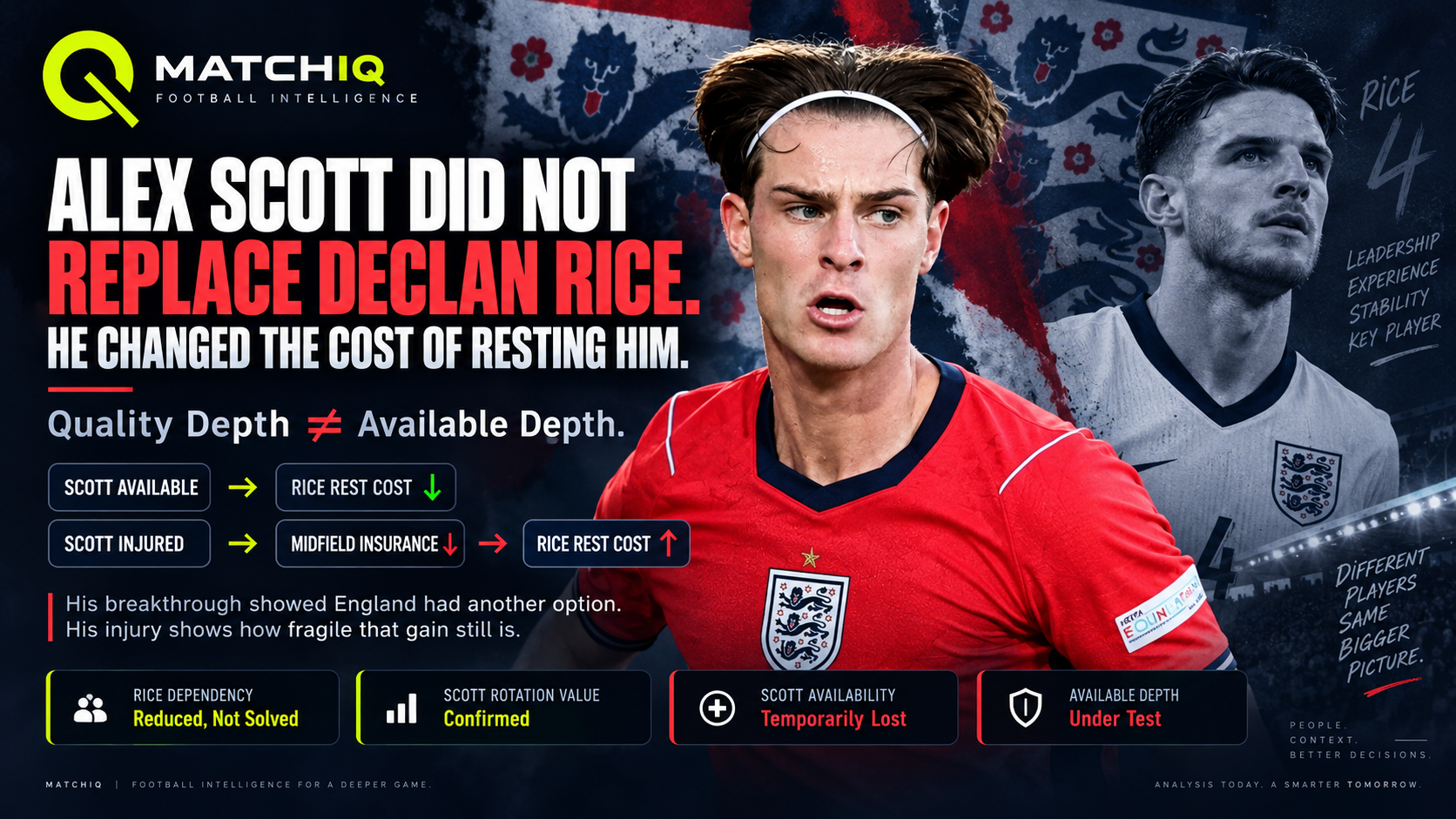
Alex Scott did not replace Declan Rice.
That was never the point.
England did not suddenly discover that a 22-year-old Bournemouth midfielder was better than one of the most important midfielders in the national team.
Something more useful happened.
Rice was unavailable.
England still needed control.
Scott started alongside Elliot Anderson against Croatia.
England won 7–0.
And for one night, the cost of not having Declan Rice became smaller.
That was the signal.
Now Scott is injured too.
And suddenly the same idea becomes more interesting.
Because depth is not only about how good the alternative is.
It is about whether the alternative is actually available.
Rice’s Absence Created The Test
Declan Rice withdrew from England’s September-October Nations League squad because of injury.
That immediately changed Thomas Tuchel’s midfield problem.
England were not simply choosing between several equally attractive combinations.
One of their highest-trust midfield references was gone.
That matters because Rice does more than occupy a position.
He absorbs responsibility.
Ball progression.
Defensive coverage.
Second balls.
Transitions.
Physical volume.
Game-state management.
When a player carries that many responsibilities, resting or losing him is expensive.
The obvious solution is always:
Use Rice whenever possible.
But that creates its own dependency.
If every important match needs Rice because the alternative is significantly worse, then England do not really possess rotation.
They possess a starter and a drop-off.
Scott’s opportunity changed that calculation.
Croatia Did Not Prove Scott Was Better Than Rice
This boundary needs to stay locked.
England beat Croatia 7–0.
Scott made his first senior international start.
He played 70 minutes.
The result was extraordinary.
But it was still one match.
One game state.
One midfield partnership.
One opponent having an historically bad night.
So the evidence does not support:
Alex Scott should replace Declan Rice.
It does not support:
Rice’s England role is under immediate threat.
And it definitely does not support:
England have solved central midfield.
The useful evidence sits somewhere else.
England removed Rice from the equation.
And the midfield did not collapse.
That matters.
Scott Changed The Replacement Cost
This is where the difference becomes important.
A squad does not need the replacement to be better than the starter.
It needs the replacement to preserve enough function that resting the starter stops feeling dangerous.
That is what Scott began to show.
If England can rest Rice and still retain:
control,
progression,
press resistance,
defensive activity,
and enough structural stability,
then Rice becomes easier to protect.
That does not reduce Rice’s value.
It changes the cost of not using him.
This is the distinction:
Player Value ≠ Replacement Cost.
Rice can remain the better player.
Scott can still make resting him cheaper.
Both statements can be true.
Tuchel’s Reaction Made The Signal Stronger
After the Croatia match, Tuchel did not treat Scott’s performance as a ceremonial young-player moment.
He openly discussed Scott as someone capable of challenging Rice for a midfield place.
That language matters.
Not because it proves hierarchy has changed.
It has not.
But because it moves Scott from:
developmental option
toward:
credible senior alternative.
That is a meaningful difference.
A manager praising a player is weak evidence.
A manager giving him responsibility while a senior starter is unavailable is stronger.
A manager then discussing genuine competition is stronger again.
The trust ladder had moved.
Then Availability Changed The Equation Again
Scott subsequently withdrew from the England squad with a thigh injury.
Tuchel said Scott had not shown obvious warning signs before the Croatia game and had even felt capable of completing the match, but the subsequent scan revealed an injury that could keep him out for several weeks.
That does not erase the Croatia performance.
It changes what England can do with the evidence.
The option was real.
The option is temporarily unavailable.
And that exposes another part of squad depth that often gets ignored.
Quality Depth is not the same as Available Depth.
A brilliant backup in the treatment room does not reduce the starter’s workload.
A credible rotation option who cannot be selected cannot lower selection dependency.
That is the new receipt.
This Is Why Depth Is More Fragile Than It Looks
Squad lists can create an illusion.
You look at England’s midfield options and see names.
Rice.
Anderson.
Scott.
Bellingham.
Garner.
Others around the squad.
It looks deep.
But operational depth is not a list.
It is:
How many trusted solutions are actually available for the next decision?
That changes constantly.
Form.
Injury.
Suspension.
Tactical fit.
Game state.
Minutes already accumulated.
All of these change the real depth chart.
So Scott’s injury is not only bad news for Scott.
It is new information about England’s rotation structure.
The insurance became thinner.
England Have Not Returned To Square One
This is the strongest counter-case.
Scott being injured does not automatically mean England are completely dependent on Rice again.
Elliot Anderson remains important.
Jude Bellingham gives Tuchel another way to configure midfield.
James Garner is in the squad.
Other combinations remain possible.
So the correct conclusion is not:
Scott out → Rice dependency restored.
That would be too strong.
The better conclusion is:
Scott’s breakthrough reduced England’s Rice dependency, but his injury shows that reduction is not yet structurally secure.
England found one cheaper alternative.
They have not yet proved they have several.
That distinction matters.
Rotation Insurance Is Only Real When It Survives One Injury
This is where the idea becomes more useful.
If a team says it has depth, then losing one rotation option should not destroy the rotation model.
Otherwise the “depth” may simply be one good alternative.
True structural depth looks different.
Starter unavailable?
Solution A.
Solution A unavailable?
Solution B.
Different opponent?
Different solution again.
That is when dependency begins falling at system level rather than player level.
England are not there yet.
Scott gave them evidence of an alternative.
His injury now tests whether the alternative structure exists beyond Scott himself.
The Czechia Match Becomes More Interesting Because Of This
England’s next Nations League match against Czechia now has a different intelligence value.
Do not only watch whether England win.
Watch the midfield decision.
Rice is unavailable.
Scott is unavailable.
So who absorbs the responsibility?
Does Anderson remain the stable reference?
Does Tuchel move another player deeper?
Does James Garner receive meaningful responsibility?
Does Bellingham’s role change?
Does England maintain control without either Rice or Scott?
That match can tell us whether the Croatia evidence belonged mainly to Alex Scott.
Or whether England are beginning to build a broader rotation structure.
That is a much better question.
There Is A Larger Workload Question Here Too
Rice’s original withdrawal matters beyond selection.
Modern international football creates a constant conflict.
England want their best players.
Clubs want their best players.
The calendar keeps compressing recovery.
The easiest answer is always:
pick the strongest available XI.
But if national teams cannot create credible alternatives, then their most important players become almost impossible to rest.
That is why Scott’s emergence mattered.
He lowered the perceived competitive cost of protection.
Not because he became Rice.
Because England discovered that one function could potentially be redistributed.
That is real squad development.
Scott’s Injury Does Not Reverse The Thesis
This is important.
The new injury does not prove the previous conclusion was wrong.
Actually, it helps define it more precisely.
Previous read:
Scott reduced the cost of resting Rice.
Current read:
Scott reduced that cost while available. England have not yet proved they can keep the cost low without him.
That is not reversal.
That is refinement.
And good intelligence should get narrower as evidence improves.
MATCHIQ Decision Change
Before Scott’s Croatia start, England’s central-midfield problem looked familiar.
Rice was unavailable.
The replacement cost was uncertain.
Then Scott started.
England controlled the match.
Tuchel’s confidence in the player increased.
The decision changed.
Rice’s absence no longer automatically implied a major midfield downgrade.
That made rotation cheaper.
Then Scott suffered a thigh injury.
Now the question moves again.
Before:
Can Alex Scott help England rest Declan Rice?
Evidence says:
Yes, potentially.
Now:
Can England keep Rice’s rest cost low when Scott is unavailable too?
That is the harder test.
Previous State
Declan Rice remained one of England’s highest-trust midfielders.
His absence carried significant structural and competitive cost.
Scott was an emerging senior option, but had not yet started for England.
New Evidence
Rice withdrew from the Nations League squad through injury.
Scott started alongside Elliot Anderson against Croatia.
England won 7–0.
Scott played 70 minutes.
Tuchel subsequently said Scott had shown the ability to compete for Rice’s midfield position.
Scott then withdrew from the England squad with a thigh injury and could miss several weeks.
What Changed
Scott’s Croatia performance confirmed that England possessed at least one credible alternative route when Rice was unavailable.
His injury now reveals that the value of that alternative depends on availability.
The question moves from:
Do England have quality depth?
to:
Do England have enough available quality depth to keep Rice dependency low?
MATCHIQ Read
Declan Rice Value — Elite
Rice Dependency — Reduced, Not Solved
Alex Scott Rotation Value — Confirmed Early Signal
Alex Scott Availability — Temporarily Lost
Elliot Anderson Responsibility — Increasing
Midfield Insurance — Weakened
Available Depth — Under Test
Confidence
High that Scott changed England’s rotation economics.
His first senior start, England’s control against Croatia and Tuchel’s subsequent comments all support that.
Medium on whether England have structurally reduced Rice dependency.
One alternative has now been removed temporarily.
The next midfield configuration matters.
Counter-Case
England still have multiple midfield options.
Scott’s injury does not mean Tuchel must immediately return to Rice whenever Rice is fit.
And a 7–0 victory is an unusually favourable environment from which to judge a new midfield combination.
So:
Scott’s breakthrough ≠ England have solved Rice succession.
And:
Scott’s injury ≠ England are completely dependent on Rice again.
Both extremes are wrong.
Next Watch
England vs Czechia.
Do not only watch the result.
Watch who carries the midfield load.
Who progresses the ball?
Who protects transitions?
Who becomes the first receiver?
Who manages the game state?
Does Anderson become the continuity piece?
Does another midfielder emerge?
Then look toward November.
If Scott remains unavailable:
Does Rice immediately return to near-automatic responsibility?
Or has Tuchel found another route?
That is the next receipt.
Future Receipt
Current claim:
Alex Scott did not replace Declan Rice.
He reduced the competitive cost of resting him by proving England could preserve midfield function without Rice.
Scott’s injury now shows that this improvement remains dependent on the availability of the alternative.
What strengthens the claim:
Scott returns and continues receiving meaningful senior responsibility, while England remain comfortable rotating Rice.
What weakens the claim:
Scott’s Croatia performance becomes isolated and England immediately return to heavy Rice dependency whenever results matter.
What changes the read completely:
England demonstrate multiple credible midfield configurations that preserve control without Rice, even when Scott is unavailable.
At that point, the story stops being:
Scott changed Rice’s rest cost.
It becomes:
England structurally reduced their Rice dependency.
Status:
Rice Dependency — Reduced
Scott Rotation Value — Confirmed
Scott Availability — Lost Temporarily
Available Depth — Under Test