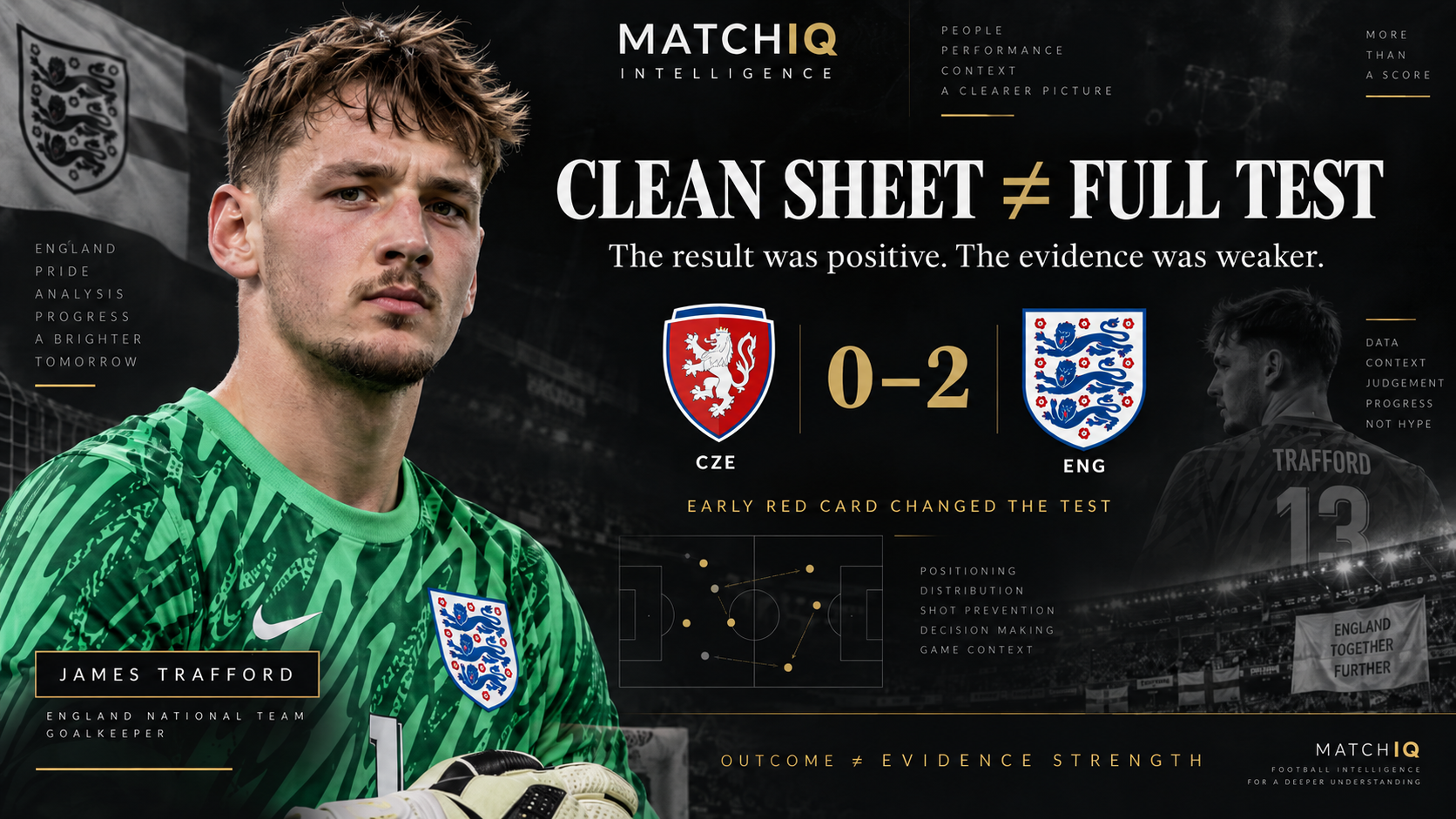
The clean sheet is real. But Czechia’s red card in the 24th minute changed the test James Trafford was being asked to pass. The result was positive. The evidence was not as strong as the scoreline suggests.
England won 2–0.
James Trafford kept a clean sheet.
Look only at the result and the story appears simple:
England start Trafford again → Trafford records a shutout → pressure on Jordan Pickford increases.
But that is exactly where the analysis needs to slow down.
A scoreline tells us what happened.
The more useful question is:
How much did it actually prove?
The answer is more complicated.
Trafford completed the job in front of him.
But Czechia’s early red card changed the nature of the examination.
A clean sheet is not automatically a strong goalkeeper test
Pavel Šulc was sent off in the 24th minute.
From that moment, the game state changed.
Czechia were down to ten men.
England could control more possession.
The hosts had to spend more of the match protecting their shape and surviving without the ball rather than consistently exposing Trafford to a normal 11-v-11 attacking test.
Before the red card, Czechia had shown some threat in transition.
England were not completely comfortable.
After it, Trafford’s task gradually shifted from:
Can you handle a complete senior international attacking test?
to:
Can you stay concentrated, deal with limited danger and complete the work you are expected to complete?
That is still goalkeeper work.
It simply tests different things.
So:
Clean sheet = positive evidence.
But:
Clean sheet ≠ strong evidence that England’s No.1 question has been answered.
The result improved. The sample quality weakened.
Goalkeeper evaluation is unusually vulnerable to result bias.
Concede three goals and the performance looks bad.
Keep a clean sheet and the performance looks good.
But proper goalkeeper analysis cannot stop at:
Goals Against.
It also has to ask:
- How many genuinely dangerous shots did he face?
- What was the quality of those chances?
- Could the opponent consistently enter dangerous areas?
- Was he tested in one-v-one situations?
- Did he have to command his box under pressure?
- Was his distribution tested by an aggressive press?
- Did the game state reduce the difficulty of the test?
That final question matters here.
Trafford came away with the cleaner result without receiving the fuller examination.
That is not criticism.
It is evidence weighting.
Spain may actually have told us more
A few days earlier, England lost 3–2 to Spain.
Read only the scoreline and Trafford’s record was:
Three goals conceded.
Against Czechia:
Clean sheet.
Traditional result-based analysis makes the Czechia performance look obviously superior.
But ask a different question:
Which match gave England more information about Trafford?
The answer may be Spain.
Spain represented a much higher-level attacking test.
England had to deal with speed, technical quality, movement, space manipulation and elite finishing.
Trafford operated in a far more demanding environment.
Nor should all three goals simply be filed under “goalkeeper failure”.
The broader England performance created situations in which Trafford was being evaluated under genuine pressure rather than protected by game state.
That gave evaluators more information about his:
shot-stopping, positioning, decision-making, pressure response and adaptation to senior international football.
So the two matches should not be read as:
Three conceded = bad.
Clean sheet = good.
A better summary is:
Spain
Poorer result. Stronger test.
Czechia
Better result. Weaker test after the red card.
Both matter.
But they tell us different things.
MATCHIQ Reality Check: what happened to the hypothesis?
Our previous question was not:
Will Trafford keep a clean sheet next time?
It was:
Is Trafford beginning to provide enough evidence to make England reconsider the long-term goalkeeper hierarchy?
After Czechia, we should not upgrade that hypothesis to:
Confirmed.
The current state is more measured.
BEFORE
Pickford remained England’s established No.1.
Trafford was receiving genuine senior-level evaluation.
AFTER SPAIN
Trafford faced a high-quality opponent and did not necessarily lose ground simply because England conceded three.
The test was difficult and England’s problems could not reasonably be reduced to the goalkeeper alone.
Hypothesis strengthened.
AFTER CZECHIA
Trafford kept the clean sheet.
He avoided a major error.
A second consecutive start gave England another full-match sample.
But Czechia’s 24th-minute red card significantly reduced the amount of pressure he had to absorb.
Positive evidence added.
But:
No major decision change yet.
Tuchel’s own framing matters
Thomas Tuchel has already made the hierarchy relatively clear.
Pickford’s performances have not, in his view, created an obvious reason to throw the No.1 position open.
The value of giving Trafford these matches is therefore partly about answering another question:
What if England need him?
What if Pickford is unavailable?
What if England need an alternative?
What if Trafford’s club performances continue to push his case upward?
Can he step directly into senior international football and function?
That means Trafford may not yet be fighting the question:
“Have I replaced Pickford?”
He may first be answering:
“If England need to change, am I already a trustworthy replacement?”
Those are not the same question.
Why the Czechia clean sheet still matters
Reducing the weight of evidence does not mean dismissing the performance.
Those are two different things.
Trafford did not create a new problem.
He completed the clean sheet.
He gained another 90 minutes of senior international experience.
And low-activity matches can test a goalkeeper in their own way.
Concentration matters.
Decision-making after long periods without action matters.
Handling the few moments that do arrive matters.
For a goalkeeper trying to build trust:
avoiding a new question can itself be useful evidence.
So this was not:
Meaningless.
It was:
Useful, but easy to overinterpret.
That distinction matters.
The counterargument: Trafford may already be closing the gap
There is a legitimate opposing case.
Trafford is building momentum at club level.
Tuchel did not simply hand him ceremonial minutes.
He started him against Spain and then kept him in the team against Czechia.
Consecutive senior starts are themselves a signal of trust.
If England only wanted a reserve goalkeeper to experience the environment, there were less demanding ways to do it.
So it is reasonable to conclude:
Trafford has moved beyond being only a future prospect.
He is becoming a credible senior option.
That part of the case is increasingly difficult to dismiss.
But there is still a line we should not cross too quickly:
Trusted alternative ≠ new No.1.
For now, Tuchel still appears to treat those as separate levels.
What should we watch next?
The next important evidence is not simply another clean sheet.
MATCHIQ should track something more specific.
1. Who starts the next high-stakes match?
Rotation against weaker opposition and selection in a genuinely difficult fixture are different coaching signals.
2. Does Trafford continue to face high-quality opposition?
Low-pressure games can build experience.
They cannot fully establish a goalkeeper at international level.
3. Does Pickford move from automatic starter to active selection decision?
That would represent a genuine hierarchy change.
4. Can Trafford sustain his club form?
Two England matches remain a small sample.
Goalkeeper hierarchies are normally changed by months of dependable evidence, not a single night.
MATCHIQ Decision
Czechia 0–2 England belongs in Trafford’s positive column.
It should not become evidence that:
James Trafford has already proved he should be England’s No.1.
The more accurate state is:
Trafford’s credibility continues to rise.
England’s alternative goalkeeper option is becoming clearer.
But the Pickford → Trafford hierarchy has not yet changed.
Spain gave us the stronger examination.
Czechia gave us the better result.
The mistake would be treating those as the same thing.
Trafford passed the test he was given.
The problem is that Czechia’s early red card changed the test.
The clean sheet belongs in the record.
So does the context.
Because if MATCHIQ records only the evidence that supports a hypothesis and removes the context that weakens it—
we are no longer analysing the game.
We are simply writing a story around the scoreline.
MATCHIQ VERDICT
RESULT: Positive
EVIDENCE QUALITY: Limited by game state
HYPOTHESIS: Strengthened slightly
DECISION CHANGE: None yet
NEXT VALIDATION: Trafford under full-strength, high-pressure opposition
The clean sheet goes into the record.
The context has to go into the record with it.