MATCHIQ | Match Intelligence / Club Intelligence | 11 October 2026
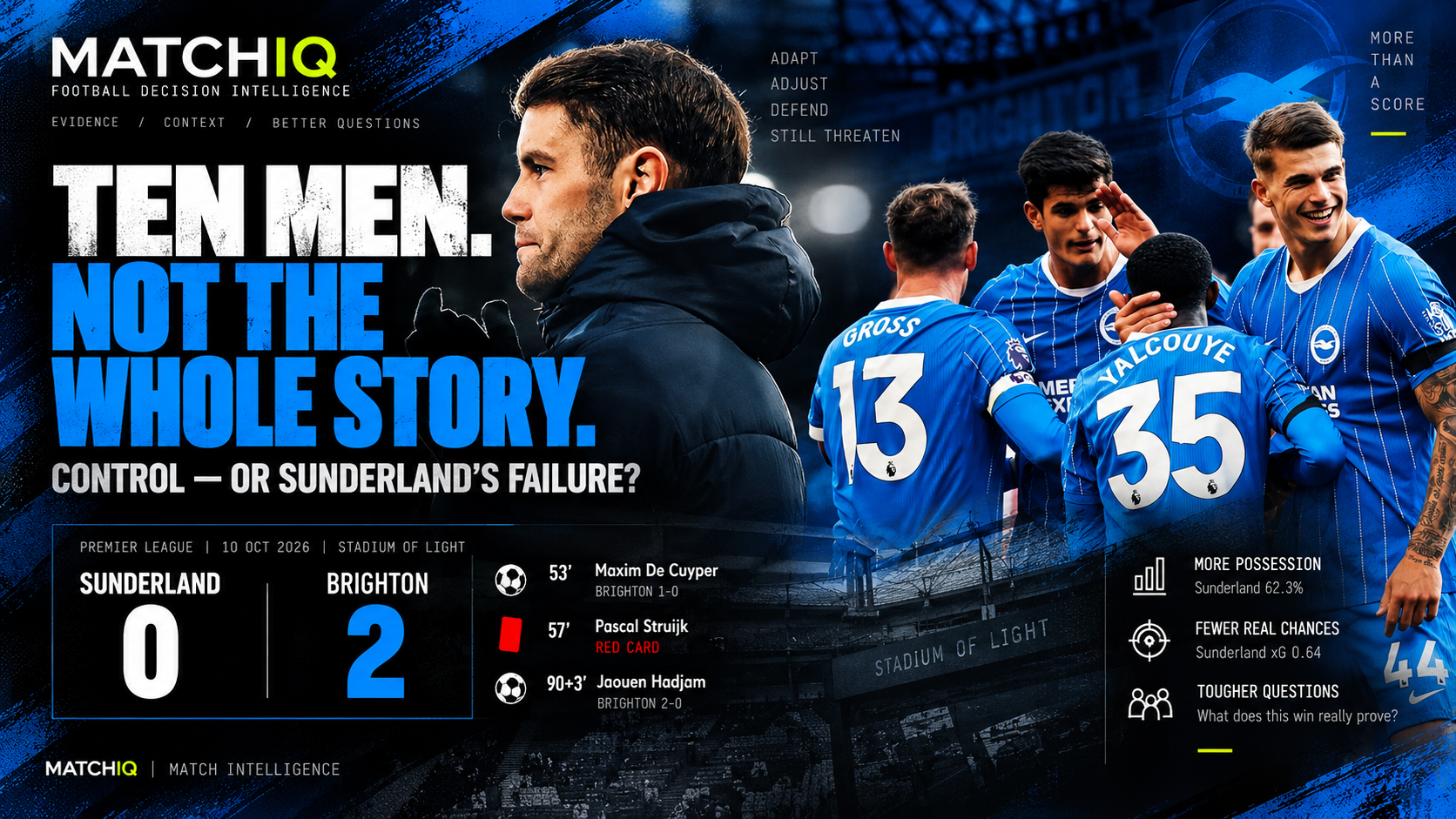
Premier League | Sunderland 0–2 Brighton | 10 October 2026
Brighton played more than half an hour with ten men, kept a clean sheet and scored again in stoppage time.
On the surface, their 2–0 win at Sunderland looks like a convincing example of tactical resilience.
But there is another question worth asking.
Did Brighton manage the disadvantage exceptionally well, or did Sunderland fail to turn an extra player into enough genuine attacking danger?
The evidence suggests both explanations matter.
The Red Card Changed Brighton’s Job
Maxim De Cuyper gave Brighton the lead in the 53rd minute, finishing after Pascal Groß found him inside the Sunderland penalty area.
Four minutes later, Pascal Struijk was sent off following a VAR review of his challenge on Wilson Isidor.
Brighton were now protecting a one-goal lead with ten players.
That changed Fabian Hürzeler’s immediate problem.
Instead of simply continuing to attack, Brighton needed to decide how much attacking presence they could sacrifice to protect their defensive structure.
In the 60th minute, Lewis Dunk replaced forward Charalampos Kostoulas.
A defender came on for a striker.
That is the clearest tactical selection signal from the match.
Hürzeler prioritised restoring defensive personnel rather than keeping the same number of attacking players on the pitch.
The substitution does not, by itself, establish Brighton’s exact shape throughout the remaining minutes. But it does show how the manager responded to the immediate risk.
Sunderland Had the Ball. Did They Have the Chances?
According to Sky Sports, the full-match statistics were:
| Metric | Sunderland | Brighton |
|---|---|---|
| Possession | 62.3% | 37.7% |
| Shots | 12 | 13 |
| Shots on target | 3 | 4 |
| Expected goals (xG) | 0.64 | 1.12 |
Sunderland controlled more possession but finished with fewer shots, fewer attempts on target and a lower expected-goals total.
Expected goals estimates the quality of shooting chances based on the circumstances in which those shots are taken.
It does not measure how much of the ball a team has.
That distinction matters here.
Sunderland’s possession advantage did not translate into superior chance production over the full match.
However, those figures cover all 90 minutes.
They cannot tell us exactly how much xG Sunderland generated after Struijk’s dismissal.
Any claim that Brighton completely shut down Sunderland after the red card would require more detailed time-specific evidence.
The Decision That Matters Most
Three minutes after the dismissal, Brighton removed a forward and introduced Dunk.
That reduced the number of attackers available but provided another established defensive option.
For a team protecting a narrow lead with ten men, it was a clear trade-off.
Keeping the original attacking personnel might have preserved more options in possession. But it would also have created a different defensive burden.
Hürzeler chose to change the balance.
In the 68th minute, João Costinha and Malick Yalcouyé were introduced for Olivier Boscagli and De Cuyper.
These substitutions further changed the personnel available to Brighton.
What can be established is the sequence of decisions and the eventual outcome: Sunderland did not score, and Brighton retained enough attacking capacity to threaten again.
What cannot yet be established from substitution records alone is whether Brighton maintained one exact defensive formation or consistently protected every zone in the same way.
Why the Second Goal Matters
In the 88th minute, Brighton introduced Georginio Rutter and Jaouen Hadjam.
Five minutes later, the substitutes combined for the second goal.
Rutter held up the ball during the counterattack before finding Hadjam, who finished from inside the area.
It was a meaningful example of how Brighton could still attack while a player down.
The team had reduced its attacking personnel earlier in the half, but it had not surrendered the possibility of advancing the ball into dangerous spaces.
That is important.
A side defending a lead needs more than clearances. Having an outlet can prevent the opposition from committing everyone forward without risk.
Still, one successful late counterattack is not proof that Brighton controlled the entire half.
It establishes that they retained the ability to punish an opening.
The Strongest Counter-Argument: Sunderland’s Attack
There is a danger in giving Brighton all the credit.
Sunderland were without injured striker Brian Brobbey.
Wilson Isidor led the attack and did produce dangerous moments. His first-half effort was deflected onto the post, and his run behind Brighton’s defence led to Struijk’s dismissal.
The red card itself is evidence that Brighton were vulnerable to a direct attacking action.
Sunderland were not entirely incapable of creating danger.
But they struggled to translate possession and a numerical advantage into enough high-quality opportunities.
Manager Régis Le Bris acknowledged his team’s lack of efficiency after the match.
That supports a competing explanation: Brighton responded effectively, but Sunderland’s attacking limitations also made the defensive task more manageable.
Both factors can be true.
The current evidence does not allow us to assign a precise share of responsibility to either one.
MATCHIQ Verdict: Successful Risk Management, Not Proof of Complete Control
Brighton’s most useful achievement was not simply winning with 37.7% possession.
It was how they responded after the match changed.
Hürzeler replaced an attacker with Dunk soon after losing Struijk. Brighton protected their lead and later scored through two late substitutes.
That is evidence of successful in-game risk management.
But Sunderland’s low full-match xG, missing attacking personnel and limited chance production mean we should resist claiming that Brighton have proved they can neutralise any opponent with ten players.
MATCHIQ’s updated judgment: Brighton successfully adapted to numerical disadvantage in this match. The result does not establish that the same approach would work against a more effective attack.
Confidence Assessment
High confidence: Hürzeler made a clear personnel adjustment to address the defensive risk.
Low-to-moderate confidence: Brighton exercised complete control after the dismissal. Time-specific chance data and a detailed positional review are still needed.
Moderate confidence: Sunderland’s attacking inefficiency contributed materially to the result. Their full-match chance numbers and the manager’s comments support that interpretation, without establishing a precise contribution.
Next Watchpoint: Can Brighton Repeat the Decision Quality?
MATCHIQ has previously examined Brighton’s aggressive pressing and how effectively high recoveries become attacking opportunities.
This match raised a different question.
When the original personnel structure is disrupted, can the team redistribute defensive responsibility without losing every attacking outlet?
Three areas now deserve attention.
Personnel decisions: Can Hürzeler make equally effective adjustments when facing different opponents and game situations?
Defensive protection: Will Brighton continue to limit dangerous chances against teams better equipped to exploit the centre and wide areas?
Attacking outlets: Can they preserve reliable routes forward when a game forces them to sacrifice attacking personnel?
Brighton face Kauno Žalgiris in European competition on 15 October and Crystal Palace in the Premier League on 18 October.
Those fixtures will not reproduce the same ten-versus-eleven conditions automatically, but they offer further evidence about Brighton’s adaptability and defensive organisation.
Final Assessment
Brighton’s win at Sunderland was a successful example of match management.
The manager reacted quickly to a major setback, the team protected its lead, and fresh substitutes completed a late counterattack.
Sunderland’s failure to capitalise on the extra player is also part of the explanation.
The important finding is not that Brighton have perfected playing with ten men. It is that they made decisions which worked under these particular conditions.
The next test is whether that decision-making remains effective when the opposition presents a more demanding attacking problem.
Sources and Evidence
- Brighton & Hove Albion — Official Match Centre, 10 October 2026.
https://www.brightonandhovealbion.com/match-centre-table?gameId=2645254 - Sky Sports — Sunderland 0–2 Brighton Match Report.
https://www.skysports.com/football/news/13592772/sunderland-0-2-brighton-seagulls-stay-third-in-premier-league-after-third-straight-league-win - Sky Sports — Match Statistics.
https://www.skysports.com/football/sunderland-vs-brighton/stats/8844143676209950232 - Sky Sports — Team Sheets and Substitutions.
https://www.skysports.com/football/sunderland-vs-brighton/teams/8844143676209950232 - Brighton & Hove Albion — Official Fixtures.
https://www.brightonandhovealbion.com/fixtures-first-team-men
Methodology Note: Possession, shooting and xG figures are full-match totals from Sky Sports. They should not be interpreted as isolated measurements of the period after the red card. Tactical conclusions are distinguished from confirmed match events.