MATCHIQ | Player Intelligence | 11 October 2026
Chelsea 5–1 Bournemouth | Premier League | 10 October 2026
Alex Scott’s injury gave Bournemouth a midfield problem. It also gave 20-year-old Alex Tóth a potential opportunity.
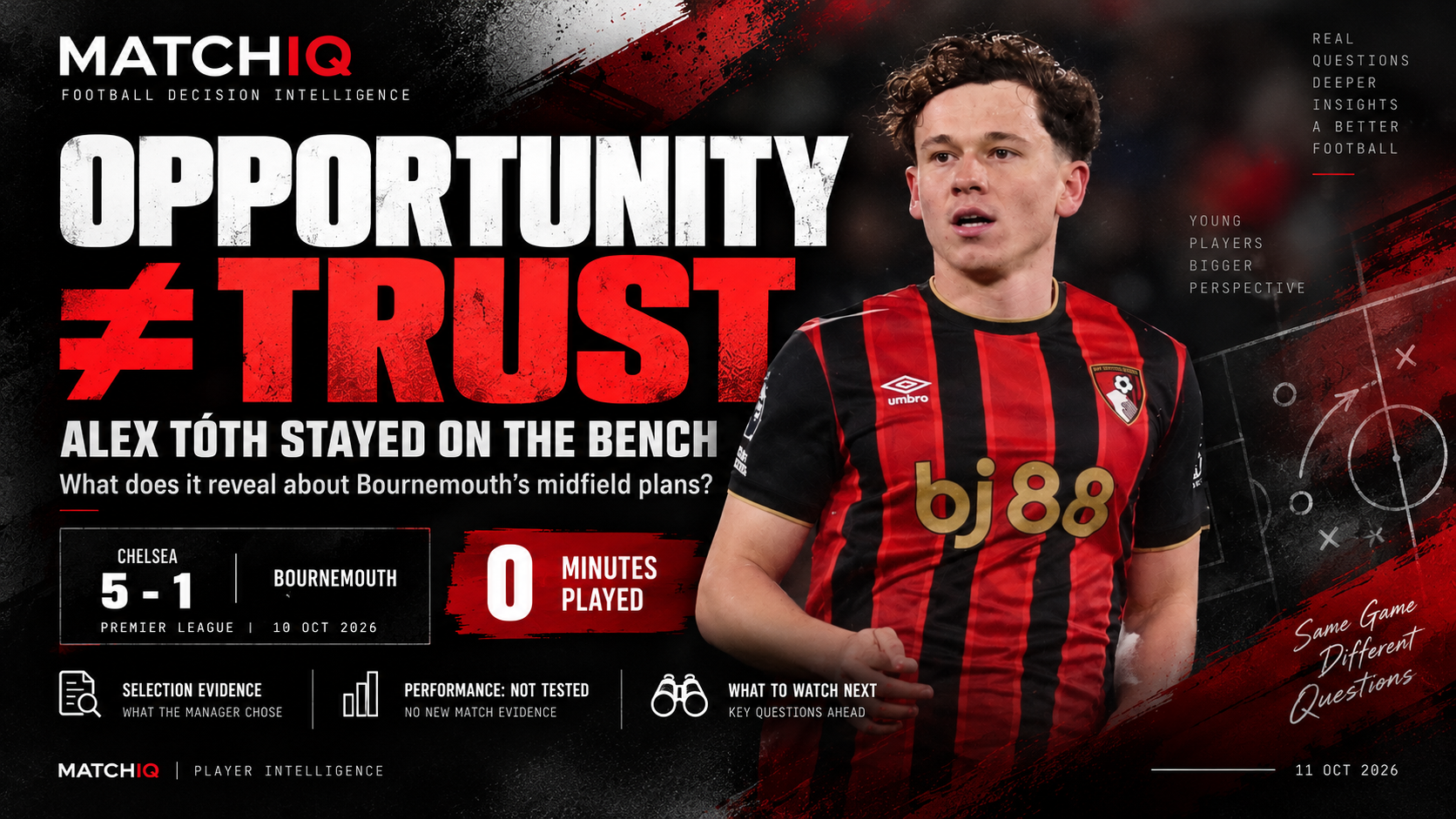
But against Chelsea, Tóth never left the bench.
Bournemouth lost 5–1 at Stamford Bridge, with Jordan Henderson and João Pedro scoring twice each and Morgan Rogers adding another. Tóth was named among the substitutes but did not feature.
That decision does not establish whether he is ready for Premier League football. It does provide an early indication of how Bournemouth are managing Scott’s absence.
The first question is no longer whether Tóth has an opening. It is where he currently sits among the available solutions.
What Bournemouth Actually Chose
Bournemouth began with Tyler Adams and Ryan Christie in midfield. David Brooks, Rayan and Marcus Tavernier supported Evanilson further forward.
When the match changed, Bournemouth made adjustments without introducing Tóth.
Brooks was replaced by Gannon Doak at half-time. Lewis Cook later came on for Christie, while Juanlu Sánchez, Álvaro Rodríguez and Álex Soler were also introduced.
Tóth remained unused.
That is the strongest evidence from the match: when Bournemouth needed to manage Scott’s absence and respond to Chelsea, the manager chose other options.
It does not mean those players were all direct alternatives to Tóth. Their responsibilities differed. But it shows that Bournemouth did not yet consider using him necessary in this particular match.
Why the Match Context Matters
Chelsea scored twice inside the first three minutes, through Henderson and Rogers.
João Pedro extended the lead immediately after half-time. Evanilson pulled one back in the 51st minute, before another João Pedro goal and a Henderson free-kick completed the 5–1 result.
Bournemouth therefore spent almost the entire game chasing a deficit.
That matters when interpreting the substitutes.
A manager trying to recover a match may prioritise immediate attacking changes, familiar combinations or experience over giving a developing midfielder additional minutes.
The decision not to introduce Tóth may have reflected that match situation rather than a fixed judgment about his ability.
We do not have enough evidence to separate those explanations.
The Strongest Argument Against Tóth
There is nevertheless a legitimate concern.
Tóth had played only 17 Premier League minutes across the first five league games, according to the playing-time record cited in MATCHIQ’s 9 October assessment.
Scott’s injury removed an established midfield option. Yet Tóth still did not feature in the first league match without him.
For a young player trying to earn a larger role, that is a relevant selection signal.
If the same pattern continues across different opponents and match situations, the evidence would increasingly suggest that Tóth is not currently among the manager’s preferred midfield solutions.
One bench appearance cannot establish that conclusion. Repeated decisions could.
The Counter-Case: Not Playing Is Not Failing
The opposing interpretation deserves equal attention.
Tóth did not lose possession, fail to track a runner or struggle against Chelsea’s pressure. He did not play.
There is therefore no new match-performance evidence that his ability is insufficient.
The manager may also be following a development plan that prioritises gradual integration rather than immediately exposing a young midfielder to a difficult Premier League situation.
That explanation is plausible, but it remains unconfirmed.
The correct distinction is between selection evidence and performance evidence. Bournemouth’s team selection tells us what happened. It does not, by itself, reveal everything behind the decision.
MATCHIQ Verdict: The Opportunity Has Not Yet Become Trust
Our 9 October assessment identified four areas to examine if Tóth played: receiving under pressure, progressing possession, recovering defensively and sustaining his role.
None could be tested against Chelsea.
Instead, the new evidence concerns selection.
MATCHIQ’s updated judgment is that Tóth remains a development option rather than an established replacement for Scott.
Confidence: Moderate on his current selection status; low on any conclusion about his Premier League readiness.
The next test is whether his role changes when Bournemouth face a different type of opponent or experience a less extreme match situation.
Three observations would matter:
- Whether Tóth receives meaningful minutes while Scott remains unavailable.
- Whether those minutes come in central midfield rather than in an emergency tactical reshuffle.
- Whether he is trusted when the score is close and the match is still competitive.
Those observations would tell us more about the manager’s trust than another unused substitute appearance alone.
Scott’s injury opened a possible route into the team. The Chelsea match showed that Tóth has not yet been chosen to take it.
The next evidence should come from his role, not from speculation about his potential.
Decision history: 9 Oct — original selection question → 11 Oct — evidence check: Tóth stayed on the bench; his playing ability was not tested. Follow MATCHIQ Receipts · 中文版.
Sources
- Chelsea FC — Match report: Chelsea 5–1 Bournemouth, 10 October 2026.
- Sky Sports — Chelsea 5–1 Bournemouth: Match Report, 10 October 2026.
- MATCHIQ — Bournemouth Lost Alex Scott. Alex Tóth Has an Opening — But Can He Do the Same Job?, 9 October 2026.