MATCHIQ | Match Intelligence | 10 October 2026
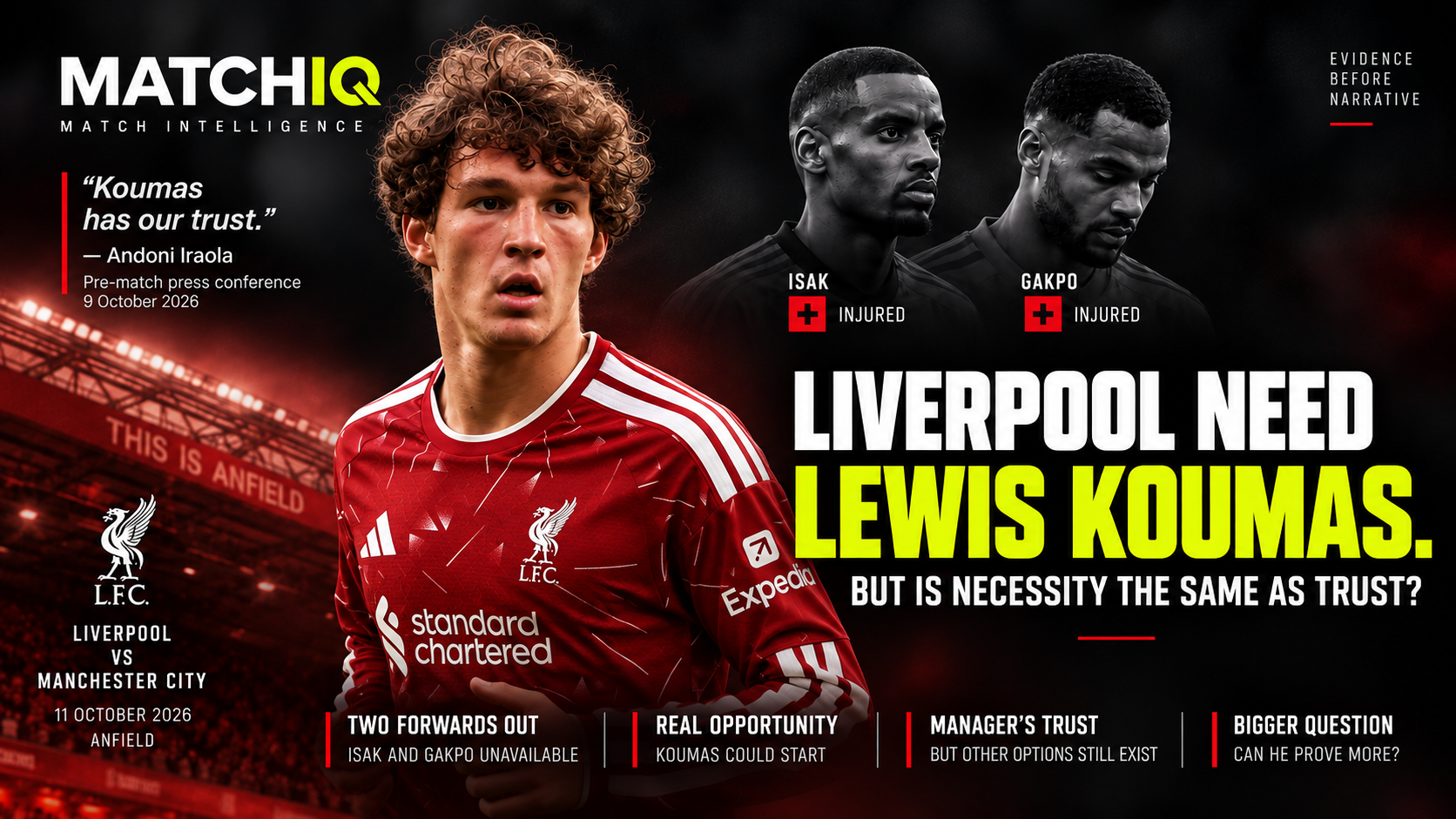
Andoni Iraola says he trusts Lewis Koumas.
Liverpool might now have to find out exactly how much.
Alexander Isak is injured. Cody Gakpo is injured. Hugo Ekitike remains unavailable.
That leaves Liverpool short of established attacking options before Manchester City visit Anfield on 11 October.
For Koumas, the opportunity is obvious.
But there is a difference between a manager choosing you because he believes you can solve a problem and choosing you because his preferred players are unavailable.
The question is not whether Koumas deserves a chance. It is what that chance can actually prove.
The Injuries Have Changed Liverpool’s Decision
Liverpool confirmed on 9 October that Isak and Gakpo would miss the Manchester City game.
Isak has a thigh injury. Gakpo is dealing with an ankle problem. Iraola does not expect either absence to be long-term, but neither player will be available on Sunday.
Ekitike’s longer-term injury adds to the shortage.
That matters because Liverpool have lost more than two names from their team sheet.
Isak has been their main central scoring option. Gakpo has offered goals, experience and the ability to play across the attack.
Their absence changes what Iraola needs from the players who remain.
In his pre-match press conference, Iraola acknowledged that Koumas was probably his only available specialist No.9.
But he also made another point: Liverpool have alternatives.
Bradley Barcola has experience in different attacking positions. Other wide players can move centrally.
That leaves the manager with a genuine choice.
Does he keep a recognised striker in the middle?
Or does he use a different kind of forward and change how Liverpool attack?
Koumas may be the most natural replacement by position. That does not automatically make him the best solution for this particular game.
Liverpool Were Already Learning to Trust Him
This story did not begin with Isak’s injury.
In September, MATCHIQ examined why Koumas appeared to be gaining Iraola’s confidence despite not producing spectacular attacking numbers.
The evidence was in his work without the ball.
During pre-season, Koumas explained how Iraola had corrected his pressing decisions.
The lesson was important.
Running towards a defender is not always good pressing.
If one attacker charges forward while his teammates remain in position, the opponent can pass around him.
A useful press requires the forward to recognise when to move, which passing route to block and whether teammates are ready to follow.
Koumas was learning that responsibility.
On 15 September, he started Liverpool’s Carabao Cup victory over Tottenham.
Liverpool made ten changes, won 3–1 and supporters voted Koumas Player of the Match.
Afterwards, Iraola praised his understanding of the team’s demands and the energy he brought to the performance.
That was meaningful evidence of growing trust.
But a heavily rotated cup match could not establish his place in Liverpool’s strongest team.
The next piece of evidence arrived five days later.
Against Bournemouth, Liverpool were protecting a 1–0 lead when Iraola replaced Isak with Koumas in the 81st minute.
That was a Premier League match with the result still at stake.
Koumas was not simply entering a game Liverpool had already won comfortably.
His appearance offered a small but important answer to the question MATCHIQ had raised.
Iraola had already been willing to use him in a tight league game.
Still, nine minutes of responsibility is not the same as leading Liverpool’s attack against Manchester City.
That remains unproven.
Why Manchester City Is a Different Test
City arrive at Anfield with five wins from their opening five Premier League matches.
Liverpool, unbeaten in their first five, have won twice and drawn three times.
This is not an easy environment for a young forward to establish himself.
If Koumas starts, he will face responsibilities that go well beyond finding a chance to score.
When City have possession, Liverpool’s first line of pressure must work together.
Koumas cannot simply chase whichever defender receives the ball.
He needs to recognise when the team is ready to press and when chasing would leave too much space behind him.
When Liverpool regain possession, another question appears.
Can he give his teammates somewhere useful to pass?
A striker sometimes needs to run behind the defence. At other moments, he must stay close enough to receive the ball and help his team move forward.
If Liverpool are under pressure for several minutes, a forward who can keep possession for a few seconds may be more valuable than one who attempts a difficult shot.
That is the part of Koumas’ development worth watching.
His pace, energy and willingness to press are already known.
What we need is stronger evidence that those qualities remain useful when the opposition are good enough to punish mistakes immediately.
One match can provide evidence.
It cannot settle his long-term place.
The Counterargument: An Injury Crisis Is Still an Opportunity
There is a danger of making the distinction between necessity and trust too complicated.
Footballers rarely receive opportunities under perfect circumstances.
A senior player gets injured. Someone else starts. A youngster performs well enough to remain in the team.
That is a normal way for careers to develop.
Koumas does not need to apologise if injuries create his next opportunity.
And Iraola’s recent comments should not be dismissed.
On 9 October, he told reporters:
“Koumas has our trust.”
He also said the forward had already demonstrated that he could handle important minutes.
Those remarks fit the earlier evidence from training, Tottenham and Bournemouth.
This is not a manager discovering a player because two attackers are injured.
He has been working with Koumas for months.
The strongest argument in Koumas’ favour is that the injuries have arrived after he had already made progress.
But the limit remains.
If Koumas plays well against City, we can say he handled that particular responsibility.
We cannot immediately say he has moved ahead of Isak or Gakpo in the attacking hierarchy.
Those are different conclusions.
MATCHIQ Verdict: The Trust Is Real. Its Limits Are Not Yet Known.
Liverpool’s injury problems have increased Koumas’ chance of playing an important role against Manchester City.
The evidence also shows that Iraola’s confidence in him existed before those injuries.
His cup start, his late introduction against Bournemouth and the manager’s public comments all support that reading.
MATCHIQ’s current judgment is that Koumas has earned genuine tactical trust, but has not yet established himself as a preferred Premier League attacking option when Liverpool’s senior forwards are available.
Confidence: Medium.
The manager’s words and previous selections support the first part of that judgment. The evidence is still insufficient to establish the second.
The next test begins with Iraola’s team selection.
If Koumas starts, we must examine the responsibility he receives rather than treating the starting place as the final answer.
If he stays on the bench, that does not automatically mean the manager has lost confidence. Barcola or another attacking combination may simply offer a better tactical solution.
The more revealing moments may come during the game.
If Liverpool are level after an hour, will Iraola keep trusting Koumas?
If Liverpool fall behind, will he look to Koumas for a solution?
And when Isak and Gakpo return, will Koumas still receive meaningful minutes?
That final question matters most.
Being needed because others are injured can open the door. Being chosen when everyone is available tells us how far through it a player has progressed.
Koumas has reached the door.
Manchester City may show us whether Iraola is ready to open it wider.
Evidence and Continuity Record
Liverpool FC, 9 October 2026 — Injury confirmation:
https://www.liverpoolfc.com/news/lfc-fitness-update-alexander-isak-cody-gakpo-federico-chiesa-and-jeremy-jacquet
Liverpool FC, 9 October 2026 — Iraola on attacking options:
https://www.liverpoolfc.com/news/andoni-iraola-attack-team-man-city-bradley-barcola
BBC Sport, 9 October 2026 — Iraola’s comments on Koumas:
https://www.aol.com/articles/iraola-injuries-koumas-man-city-133722000.html
Liverpool FC, 15 September 2026 — Tottenham cup performance:
https://www.liverpoolfc.com/news/who-was-liverpools-player-match-v-tottenham-0
Liverpool FC, 20 September 2026 — Bournemouth match report:
https://www.liverpoolfc.com/news/alexander-isak-scores-earn-liverpool-victory-bournemouth
Previously on MATCHIQ, 17 September 2026:
Lewis Koumas didn’t win Iraola’s trust with goals — it was something less obvious
Next Review: Liverpool vs Manchester City, 11 October 2026, followed by a review when senior attacking options return.
Information verified through 10 October 2026. The starting XI and match outcome are not yet known.