MATCHIQ | Match Intelligence | 10 October 2026
David Moyes has spent months trying to make Everton a better football team.
Now the club’s owners are considering handing control to somebody else.
That’s quite a contrast.
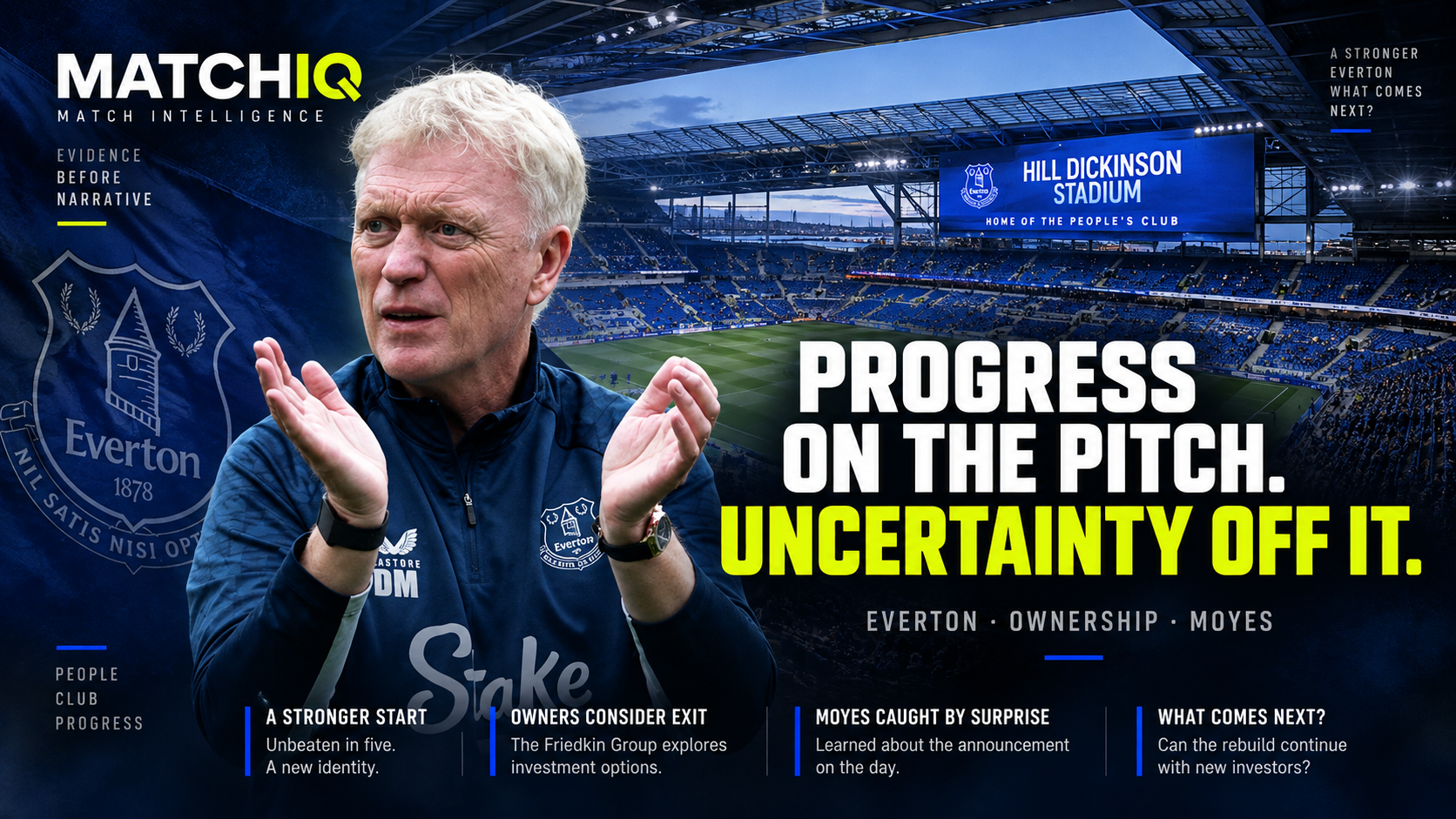
Everton are unbeaten in their first five Premier League matches. Moyes has made them more aggressive without losing their defensive organisation. Their financial position has also improved, and they are finally playing at Hill Dickinson Stadium.
Yet on 9 October, The Friedkin Group announced it was exploring new investment options, including the potential sale of a controlling stake.
Moyes said he learned about the announcement that morning, at the same time as everyone else.
Everton’s problem is not that the progress has suddenly disappeared. It’s that the people responsible for taking the next step may change before that progress becomes something bigger.
The Owners Have Not Announced a Completed Sale
The Friedkin Group bought Everton in December 2024, ending Farhad Moshiri’s ownership.
At the time, Everton needed stability.
The club had endured financial difficulties, points deductions and seasons spent worrying about relegation. The new stadium was still part of a demanding financial transition.
The owners’ first task was to make the club more secure.
On Friday, The Friedkin Group said that foundation was now in place and that it was time to consider Everton’s next chapter.
It has appointed investment bank Moelis & Company to advise on the process.
That matters, but the wording matters even more.
The owners are exploring investment options. Selling control is one of those options.
No completed sale has been announced. No successful buyer has been identified publicly. There is no verified timetable for a change of control.
Treating the announcement as proof that Everton already have a new owner would be wrong.
But dismissing it as nothing would also be wrong.
A club does not publicly announce that it may surrender control without creating questions about who will make its next major decisions.
Everton Have Improved. That Does Not Mean the Job Is Finished.
There is measurable progress away from the pitch.
Everton’s 2024/25 accounts recorded revenue of £196.7 million, a club record.
The reported annual loss fell from £53.2 million to £8.6 million.
Those are substantial improvements.
However, the smaller loss included a £49.2 million gain from a transaction involving Everton Women and Goodison Park-related companies.
That was not ordinary recurring football income. It would therefore be misleading to treat the headline reduction in losses as proof that Everton can now comfortably finance every future ambition.
The club has a stronger foundation. It still needs to generate enough sustainable revenue to compete.
The new stadium is important because it offers opportunities to earn more from matchdays, hospitality and commercial activity. But a new stadium also brings operating costs.
Financial stability and financial freedom are not the same thing.
The distinction matters on the pitch too.
On 9 October, MATCHIQ examined Everton’s unusually aggressive pressing under Moyes.
Across their opening five league games, Everton had recorded 1,145 pressures in the opposition half and 11 shots following recoveries high up the pitch.
They had also won twice, drawn three times and conceded only three goals.
That suggested a team becoming harder to play against while finding more attacking opportunities through its defensive work.
But we did not conclude that Moyes had completely reinvented Everton.
Five matches are not enough for that judgment. The team still needs to turn those recoveries into more consistent attacking chances.
That remains the football challenge.
The ownership announcement introduces a different one.
Will Everton have the same support to improve the squad that must carry out Moyes’ approach over an entire season?
We do not yet know.
Moyes’ Reaction Reveals the Gap Between Two Ambitions
Moyes returned to Everton in January 2025 hoping to move the club beyond survival and towards regular European contention.
He said on Friday that he had expected the new owners to stay far longer.
He also acknowledged a difficult summer transfer window and said he had begun to notice reasons for concern.
That is significant because it is the manager’s assessment of his working environment.
It is not, by itself, proof that the owners have stopped financing the team.
We have no confirmed evidence that Everton’s January transfer budget has been frozen. There is no official announcement that recruitment has been suspended or that Moyes’ position is under review.
Still, the difference in priorities deserves attention.
For the owners, stabilising the club and delivering the stadium may have completed the first stage of their investment.
For Moyes, those achievements were supposed to provide the starting point for something more ambitious.
He needs players who can sustain Everton’s intensity, improve their attacking efficiency and provide cover when important starters are unavailable.
That requires recruitment decisions, contract planning and an agreed level of spending.
A manager can improve the way his current players press.
He cannot personally guarantee that the club will provide the next player his system needs.
This is where a potential ownership change becomes relevant to football.
Not because tomorrow’s training session will suddenly change.
Because the decisions made over the next transfer windows may determine whether the improvement can continue.
The Strongest Counterargument: Selling Could Help Everton
There is a reasonable case for The Friedkin Group’s approach.
Buying a financially troubled club, stabilising its finances, helping complete a new stadium and then seeking further investment is not automatically a failure.
It can be a deliberate business decision.
The next stage of Everton’s development may require greater investment than the current owners want to provide alone.
A new investor could bring more resources.
A new controlling shareholder could also maintain the current management structure while increasing the club’s ability to strengthen the squad.
The Friedkin Group has explicitly said it intends to support Everton during the process and will consider parties it believes can build on the progress already made.
That commitment should be acknowledged.
Equally, an ownership change can create uncertainty if different people want different things from the football department.
A buyer might support Moyes. Another might prefer a different manager, recruitment strategy or spending model.
At this stage, those are possible outcomes, not established plans.
We should not claim that the sale process will damage Everton simply because change is being discussed.
Nor should we assume a wealthy new owner would automatically make the team better.
Both conclusions would go beyond the evidence.
MATCHIQ Verdict: The Progress Is Real. The Long-Term Commitment Is the Unknown.
Everton have made progress under The Friedkin Group and David Moyes.
Their finances have improved, the stadium transition is complete and the team have started the season unbeaten while showing evidence of a more aggressive playing approach.
The owners are now considering whether someone else should control the club’s next stage.
MATCHIQ’s judgment is that Everton are not facing a proven football crisis. They are facing a new uncertainty over who will fund and direct the next phase of their rebuild.
That is an important difference.
Confidence: Medium.
The official investment process, financial results and Moyes’ reaction are confirmed. There is not yet sufficient evidence to determine whether a potential transaction will reduce, preserve or increase the resources available to the team.
The immediate football test comes against Hull City on 11 October.
Can Everton adapt their pressing when their opponents play more directly? Can they keep creating chances without leaving themselves exposed?
Those questions remain relevant regardless of who owns the club.
The larger test will come through actual decisions.
Does the club continue backing its recruitment plans? Is there evidence of changed transfer priorities as January approaches? Does any proposed investor explain how Everton’s football ambitions will be financed?
And if control changes, is Moyes still working towards the same objective with the same support?
Until those decisions become visible, the sale announcement should not be mistaken for either collapse or progress.
Everton have spent years trying to reach a point where their main conversation is about football rather than survival.
They are finally closer to that position.
The next owners’ challenge is to make sure the football progress does not have to start again every time the people in charge change.
Sources and Continuity
Everton FC — Official club statement, 9 October 2026:
https://www.evertonfc.com/news/2026/october/09/club-statement/
Sky Sports — David Moyes’ response, 9 October 2026:
https://www.skysports.com/football/news/13596920/david-moyes-everton-manager-admits-surprise-at-seeing-the-club-being-put-up-for-sale-by-the-friedkin-group
Premier League — Everton 2024/25 annual report summary, 31 March 2026:
https://www.premierleague.com/ar/news/4623567
Everton FC — Annual Report and Accounts 2024/25:
https://images.gc.evertonfcservices.co.uk/d570b570-2cf1-11f1-a494-13d6f36c2b98.pdf
Previously on MATCHIQ — Moyes and Everton’s pressing, 9 October 2026:
https://matchiqfootball.com/2026/10/09/everton-david-moyes-high-pressing-2026/
Next Watchpoint: The formal investment or ownership process, recruitment decisions ahead of January 2027, and the continuing relationship between Moyes and Everton’s decision-makers.
Information verified through 10 October 2026. No sale completion, agreed buyer, frozen transfer budget or managerial change is presented as confirmed.