MATCHIQ | Club Intelligence | 9 October 2026
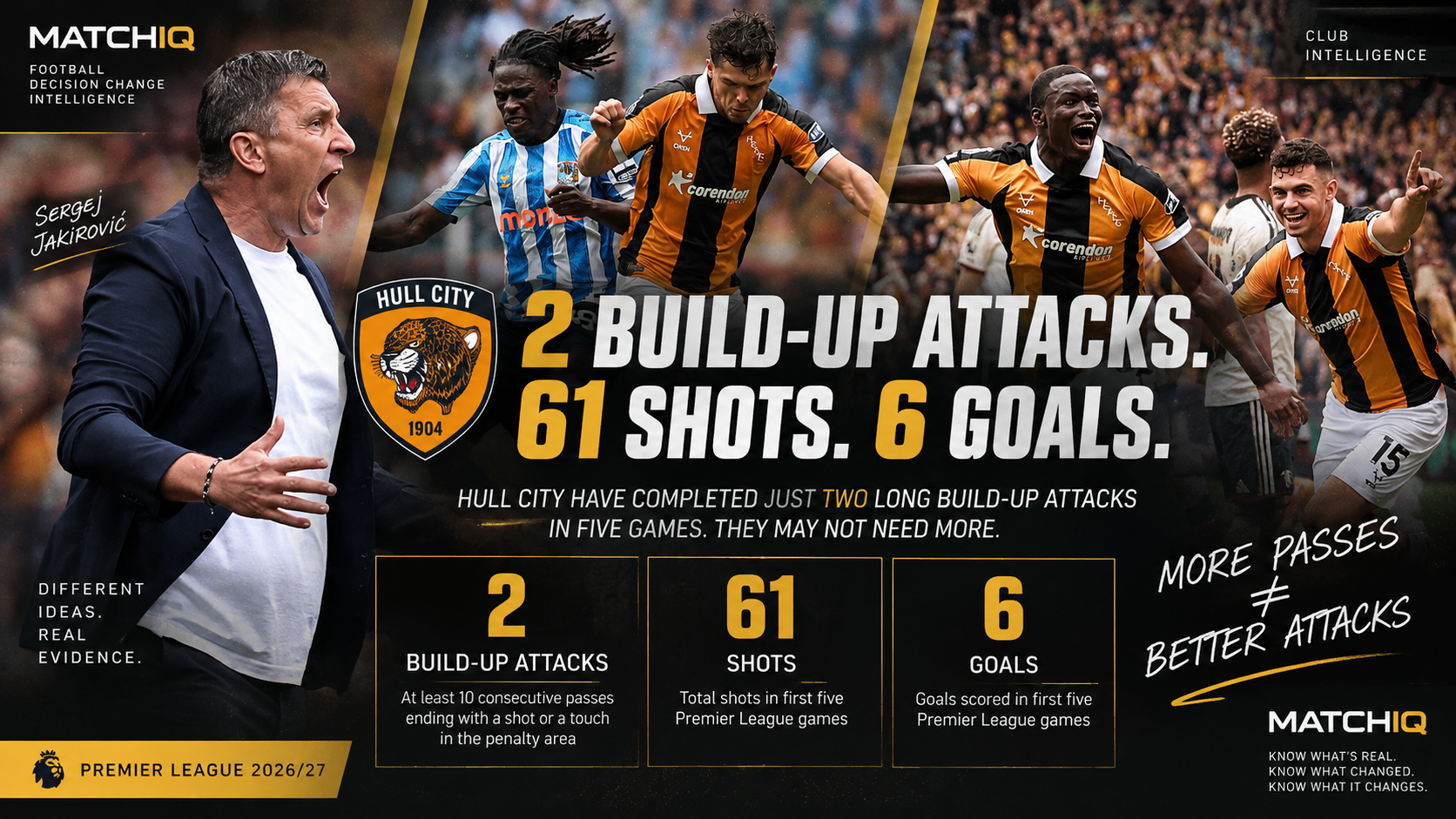
Hull City have completed just two long build-up attacks in their opening five Premier League games.
Yet they have taken 61 shots, scored six goals and collected eight points.
Sergej Jakirović’s newly promoted side have made a competitive start without playing the kind of possession-heavy football many teams now favour.
Hull are getting the ball forward early. They are not spending long periods passing between defenders just to work their way up the pitch.
That raises a useful question.
Do Hull need to build longer attacks, or do they simply need to make their direct attacks better?
Two Build-Up Attacks Does Not Mean Two Attacks
The statistic needs a clear definition.
Opta counts a build-up attack when a team completes at least ten passes in one open-play move before finishing with either a shot or a touch in the opposition penalty area.
Hull have completed only two such sequences.
That does not mean they have attacked twice.
It does not mean they have made only two long passes.
It means they rarely need ten consecutive passes to reach an attacking position.
Their 61 shots demonstrate that they are finding other ways to threaten goal.
A team can reach the penalty area through three quick passes, a forward ball into space or a recovery after a long clearance.
None of those attacks is automatically worse because it contains fewer passes.
Hull Prefer Getting Forward Early
Jakirović’s approach is relatively simple.
When Hull have an opportunity to play forward, they often take it.
Rather than keeping the ball near their own penalty area, they look for a striker, a runner or an area where teammates can compete for possession.
Imagine a defender playing a forward ball towards the striker.
The striker challenges for it.
A midfielder collects the loose ball.
Hull are suddenly attacking in the opposition half.
That can be quicker than building through several lines of pressure with short passes.
But it requires good timing.
If the striker has no support, the ball may come straight back.
If midfielders are slow to react, Hull lose the opportunity.
Direct football is not simply about kicking the ball long.
The pass gets the ball forward. The next action determines whether the attack works.
The Results Show Hull Can Compete
Hull started their league campaign by beating Manchester United 2–0 and Coventry City 1–0.
They followed those wins with a goalless draw against Aston Villa and a 2–2 draw at Chelsea.
Their first league defeat came at Newcastle, where they lost 2–1.
Eight points from five matches is a useful return for a promoted club.
There is another detail worth noting.
Hull had just 28% possession against Manchester United and 31% against Coventry.
They won both games.
Against Aston Villa, they had 26% possession and kept a clean sheet.
These performances demonstrate that Hull can stay competitive without dominating the ball.
They do not prove direct passing alone produced the results.
Defending, finishing and individual performances matter too.
The narrower conclusion is stronger.
Hull do not need most of the possession to compete.
Sixty-One Shots Do Not Mean Sixty-One Good Chances
This is where the analysis becomes more demanding.
Hull have taken 61 shots in five matches.
That is evidence that they are reaching shooting positions.
It is not proof that their chances are consistently good.
A rushed shot from outside the box counts the same as a close-range attempt.
But the two have very different chances of becoming goals.
If Hull regularly get forward quickly but end attacks with difficult shots, their approach may generate activity without enough quality.
If their direct passes repeatedly create close-range opportunities, the argument for keeping the approach becomes stronger.
We need to examine where Hull shoot from, how much defensive pressure they face and whether another pass could have produced a better chance.
The headline statistic cannot answer those questions.
The Second Ball Can Decide Everything
One of the most important parts of direct football happens after the first forward pass.
A striker may challenge a defender without winning the ball cleanly.
The ball falls into midfield.
Who gets there first?
That loose ball is commonly called the second ball.
For Hull, winning it can turn a contested pass into a useful attack.
Losing it can leave them defending again.
That makes the movement of the midfielders essential.
They need to get close enough to support the striker while remaining ready to defend if possession changes.
This is why direct football still requires coordination.
It may involve fewer passes, but that does not mean it involves fewer decisions.
The Trade-Off Hull Must Manage
Getting the ball forward early can reduce one risk.
Hull’s defenders spend less time trying to pass around opponents close to their own goal.
That gives high-pressing teams fewer opportunities to force mistakes in that part of the pitch.
But direct football creates another risk.
If Hull lose the first challenge and the second ball, possession returns to the opposition.
If that happens repeatedly, they may spend too much time defending.
Their midfield must be ready to compete for loose balls, and their defensive shape must remain organised.
The approach works best when Hull can move the game forward without immediately giving up control.
That balance is more important than the length of the passing sequence.
The Counterargument: Hull May Become Predictable
The strongest argument against Hull’s approach concerns what happens when opponents adapt.
A rival might stop pressing Hull’s defenders so aggressively.
Instead, they could prepare for the forward pass.
Defenders could stay closer to Hull’s striker.
Midfielders could position themselves to collect the second ball.
With less space available, the direct approach may become harder to execute.
Hull would then need another solution.
A longer passing sequence can help move opponents out of position and create space that was not available at the start of an attack.
Hull do not need to become a possession-heavy side.
But being able to slow down and build patiently when required would make them less predictable.
The danger isn’t playing directly. It’s having no alternative when direct play stops working.
Everton Will Provide a Useful Test
Hull face Everton at the MKM Stadium on 11 October.
The tactical contrast is clear.
Everton lead the Premier League for applying pressure in the opposition half and final third.
They want to disrupt their opponents before the ball moves into midfield.
Hull prefer to move the ball forward before opponents can establish sustained pressure near their penalty area.
That creates an interesting contest.
Can Hull bypass Everton’s first line of pressure?
Can their forwards compete for early passes?
Will their midfielders collect the second balls?
And if Everton anticipate those passes, can Hull build attacks another way?
The final result will matter, but it will not settle which style is superior.
A Hull win would not prove direct football is always better.
An Everton win would not prove Hull should abandon their approach.
What matters is whether Hull’s decisions help them create useful attacks against this particular opponent.
What MATCHIQ Will Watch
Four observations will guide the next assessment.
First: Do Hull’s early forward passes actually help them progress?
Playing forward quickly has little value if opponents recover possession immediately.
Second: Who wins the second balls?
Hull need support around the first challenge to turn direct passes into sustained attacks.
Third: What quality of chances do they create?
The location and difficulty of shots will tell us more than the number alone.
Fourth: Can they change approach when needed?
If Everton block the direct route, can Hull keep possession and create space through shorter combinations?
Those questions are more useful than asking Hull to complete more passes simply to improve a statistic.
MATCHIQ Verdict: Direct Football Is a Choice, Not a Defect
Hull’s first five Premier League games challenge the idea that effective attacking football always requires long passing sequences.
Two build-up attacks, 61 shots, six goals and eight points show that their direct approach can coexist with competitive results.
But five games cannot prove it will work throughout the season.
The approach still needs to produce good chances, reliable second-ball recoveries and enough defensive protection.
It must also survive opponents learning how to stop it.
Hull do not need to copy teams that pass the ball for longer.
They need to show that their shorter route to goal keeps working — and that they have another route when it doesn’t.