MATCHIQ | Club Intelligence | 9 October 2026
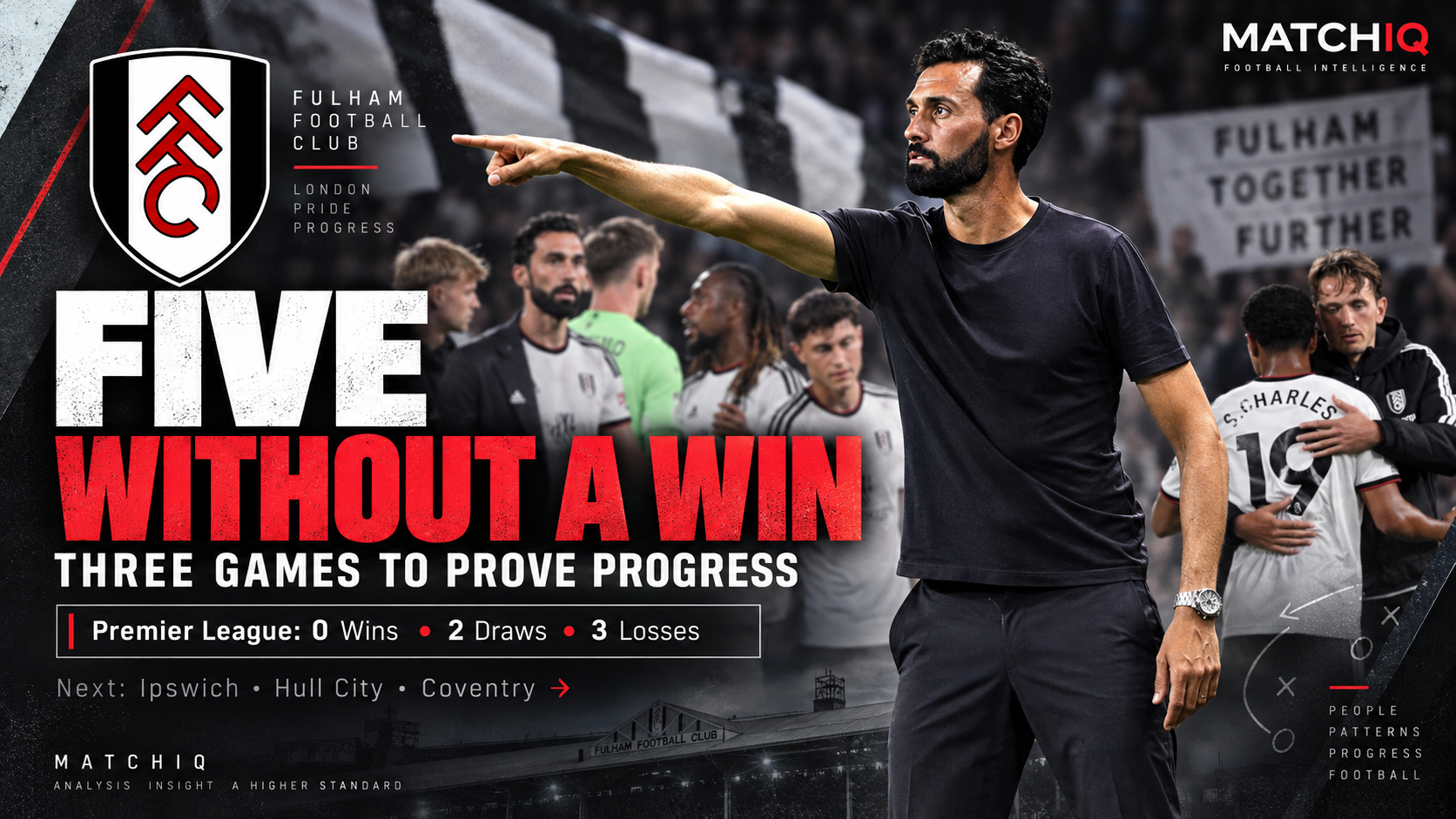
Fulham have played five Premier League matches under Álvaro Arbeloa.
They have not won any of them.
Three defeats, two draws, five goals scored and eight conceded. Two points from a possible 15.
Yet their last two league results were a goalless draw at Liverpool and a 1–1 draw against Manchester United.
That makes Fulham’s start more complicated than the league table suggests.
They have taken points from two major clubs after losing their first three matches.
Now the fixture list changes.
Ipswich Town, Hull City and Coventry City are next — all promoted to the Premier League this season.
The next three games will test whether Fulham’s poor start was largely about the opposition, or whether there are deeper problems Arbeloa still needs to solve.
Five Matches, Two Different Stories
Fulham began with three consecutive defeats.
Chelsea won 3–2 at Craven Cottage. Sunderland beat them 1–0. Crystal Palace then left west London with a 3–2 victory.
Five goals conceded against Chelsea and Palace were enough to expose problems at the back.
Fulham also scored four goals in those two home defeats. They were not completely incapable of attacking.
But creating goals and winning matches are different achievements.
Then came the improvement.
Fulham kept Liverpool scoreless at Anfield before holding Manchester United to a 1–1 draw.
Against Liverpool, they had 44% possession. Against United, just 42%.
Those games offered evidence that Fulham could remain competitive without having most of the ball.
But they did not establish whether the team could take control of matches when opponents offered them more possession and territory.
That is the missing part of the picture.
The Difficult Fixtures Explain Something — Not Everything
Fulham’s opening schedule was demanding.
Chelsea, Crystal Palace, Liverpool and Manchester United all entered the season with European commitments. Sunderland had also qualified for Europe.
That matters.
A new manager facing five opponents accustomed to competing at a high level has little time to establish his approach.
It would be unreasonable to judge Arbeloa entirely by the absence of a league win.
But the schedule cannot explain every result.
Fulham lost to Sunderland and Crystal Palace before earning points against Liverpool and United.
The fact that they performed better against the bigger names does not mean those opponents were easier.
It means that opponent reputation alone is a poor explanation of Fulham’s results.
What matters is how each match was played.
Fulham may find it easier to defend when an opponent takes responsibility for attacking. They can stay organised, protect the centre and wait for opportunities to move forward.
A match in which Fulham must do more of the attacking asks a different question.
Can they create openings without needing the opponent to leave large spaces behind?
The opening five league games do not answer that convincingly.
The Cup Results Make the Picture More Interesting
There is another reason not to describe Arbeloa’s Fulham as a team that simply cannot win.
They have already won twice in the League Cup.
Fulham beat AFC Wimbledon 3–0 and West Ham 3–2.
The West Ham victory is particularly important because it came away from home against a side relegated from the Premier League last season.
Those results show that Fulham can finish chances and win competitive matches.
But cup results cannot automatically be carried over into the league.
Opponents may use different lineups, take different risks and approach cup ties differently.
The useful question is whether Fulham can reproduce the positive elements of those victories against Premier League opposition.
The upcoming fixtures provide an opportunity to find out.
Why Ipswich Is the First Real Test
Fulham travel to Ipswich on 10 October.
Ipswich may be newly promoted, but they are not an opponent Fulham can simply expect to beat.
They won their opening two Premier League matches, including a 5–2 victory away to Manchester United.
Their recent results have been less encouraging, with defeats against Liverpool, Crystal Palace and Everton.
The defensive record creates an opportunity for Fulham.
Ipswich have conceded 14 goals in their first five league games.
But Fulham’s own five league goals do not establish that they are capable of taking full advantage.
The key test is how Fulham attack.
Will they move the ball quickly enough to find space before Ipswich reorganise?
Can their forwards receive passes in dangerous positions rather than being forced away from goal?
And if Fulham score first, can they control what happens next?
A first league victory would be valuable.
The quality of the performance would tell us whether it represents progress.
Hull Will Test Fulham’s Ability to Take Responsibility
The next match is at home against Hull City on 17 October.
Hull have already taken points from several established Premier League clubs.
They defeated Manchester United, drew with Aston Villa and Chelsea, and beat Coventry City.
This is not the profile of a team that can be dismissed simply because it was promoted.
For Fulham, the home setting matters.
At Craven Cottage, they may be expected to attack more often, particularly if Hull are prepared to defend and wait for opportunities.
That could become uncomfortable.
Fulham have already shown they can work without dominating possession.
They have not yet proved that they can consistently break down an organised Premier League defence.
Against Hull, MATCHIQ will pay particular attention to whether Fulham can create clear chances through their own attacking movement.
Are midfielders finding forwards in dangerous positions?
Do wide players create space for teammates?
Can Fulham keep pressure on Hull without leaving themselves vulnerable to counterattacks?
Those details matter more than simply recording a higher possession percentage.
Coventry Offers a Third, Different Test
Fulham then travel to Coventry City on 24 October.
Coventry have found their Premier League return difficult.
They lost their opening four matches before recording their first win against Nottingham Forest.
Home form remains a particular concern.
For Fulham, this fixture offers another chance to demonstrate improvement against a team still adjusting to the division.
But Coventry’s own circumstances make the match difficult to predict from league positions alone.
A newly promoted side fighting for points can be dangerous, especially at home.
Fulham cannot assume Coventry will allow them to control the match.
The task will be to combine the organisation shown against Liverpool and United with the attacking efficiency needed to win.
That is the combination Arbeloa has not yet demonstrated consistently in the league.
Three Games Won’t Prove Everything
There is an important counterargument.
Even if Fulham win all three matches, that will not prove the team has solved every problem.
The opposition will differ from the clubs faced earlier in the season.
And even if Fulham fail to win, that alone will not prove Arbeloa’s approach is fundamentally wrong.
Individual mistakes, injuries and match circumstances can affect results.
A three-game sample is still small.
That is why the assessment cannot rely entirely on league points.
We need to examine whether Fulham are producing better chances, limiting their opponents’ dangerous attacks and responding more effectively when matches change.
The next three fixtures are a test, not a final verdict.
What MATCHIQ Will Measure
There are four useful questions.
First: Can Fulham create better chances?
Not simply more shots. Better opportunities, from positions where scoring is realistic.
Second: Can they control matches with more possession?
Holding Liverpool to a draw is valuable. Breaking down an opponent that sits deeper requires different skills.
Third: Can they defend without relying on constant pressure from the opposition?
A team that attacks more must also protect itself when possession is lost.
Fourth: Is the improvement repeatable?
One good performance can happen. Three games provide a better opportunity to see whether a change is becoming consistent.
The first results will begin to answer those questions.
MATCHIQ Verdict: The Fixture List Is Changing. Now Fulham Must Show What They Can Change.
Fulham’s first five league matches have produced poor results.
But the unbeaten draws against Liverpool and Manchester United suggest the team is not without strengths.
The two League Cup victories also show that winning matches is not beyond this group.
The uncertainty lies in whether Fulham can take greater responsibility for attacking and still remain defensively organised.
That question becomes more important against Ipswich, Hull and Coventry.
None should be treated as an automatic victory.
But together, they offer Arbeloa an opportunity to demonstrate that Fulham are developing a more complete way to play.
A difficult schedule can help explain a poor start. It cannot remain the explanation once the schedule changes.
The next three games won’t settle Fulham’s season.
They will show us whether the team is beginning to move forward.