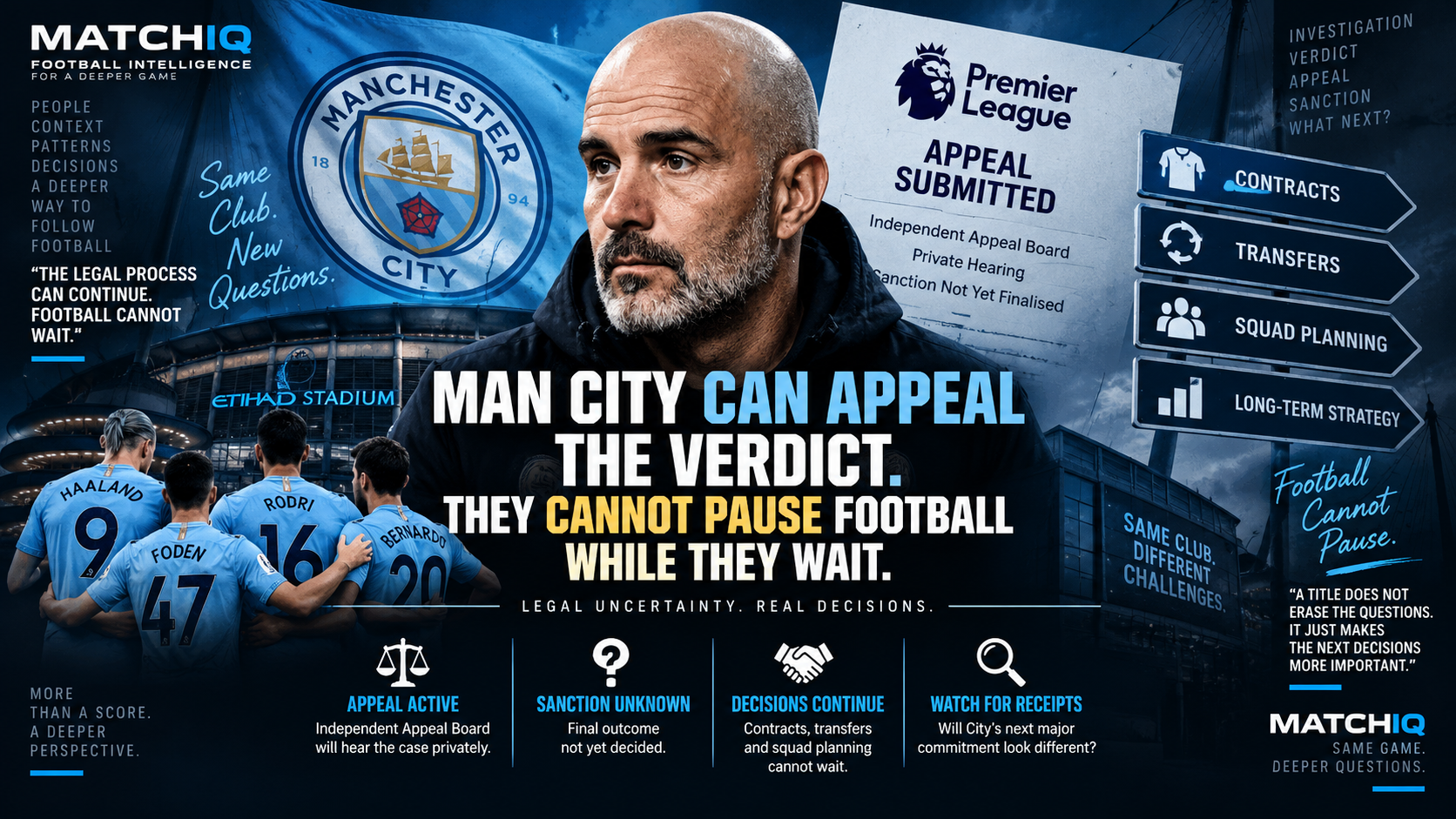
They can challenge the evidence.
They can wait for an appeal.
What they cannot do is pause football.
Contracts keep getting shorter.
Players keep getting older.
Transfer windows still arrive.
A squad still has to be built.
That is why the most useful Manchester City question is no longer:
How many points might they lose?
Nobody publicly knows the final answer yet.
The better question is:
Does the uncertainty start changing what City actually do?
That is something we can observe.
The case has moved again
Manchester City have formally appealed the independent commission decision that found the club guilty of serious Premier League financial-rule breaches over nine seasons, as well as most of the cooperation charges considered by the commission.
City continue to reject the findings and say the opinion contains material errors of law, principle and fact.
The Premier League has confirmed that the appeal will be heard privately by an independent Appeal Board.
The sanction has not yet been settled publicly.
So the state has changed.
Previously:
Finding uncertain.
Then:
Adverse finding confirmed.
Now:
Appeal active. Final football cost still unknown.
That is important.
But it still does not tell us what Manchester City will do differently.
The legal department can wait for the next hearing
The football department cannot.
Imagine City have a player whose contract needs extending.
They still need an answer.
Three years?
Five years?
What guaranteed salary?
What bonuses?
What exit protection?
Now imagine a major transfer becomes available.
City cannot simply say:
Come back when the appeal is finished.
The player may join somebody else.
The market does not pause because your legal process is unresolved.
The same applies to:
academy pathways,
squad age,
succession planning,
wage structure,
player sales,
and recruitment.
This is where the legal story becomes football intelligence.
Not when somebody guesses a points deduction.
When uncertainty starts changing decisions.
City’s next big commitment may tell us more than the next headline
Suppose City make another major signing.
Large fee.
Long contract.
High guaranteed salary.
Very little flexibility.
That would tell us something.
Not that City know they will win the appeal.
We could not claim that.
But it would suggest the club is still comfortable making large, irreversible football commitments despite the regulatory uncertainty.
Now imagine the opposite.
Shorter contracts.
More conditional pay.
More emphasis on resale value.
More flexible deals.
Slower renewals.
Greater hesitation over expensive older players.
That would also tell us something.
Again, not proof.
But behaviour.
And behaviour is more useful than speculation.
This is what the previous MATCHIQ judgment was waiting for
Our previous City analysis stopped deliberately before saying:
The ruling has changed Manchester City’s football strategy.
There was no evidence for that.
There still is not enough evidence.
The better hypothesis was:
The regulatory risk has become more concrete. Now watch the next major contract or transfer and see whether City behave differently.
That remains the right test.
Previous MATCHIQ Intelligence:
Manchester City’s Uncertainty Hasn’t Ended — It Has Moved. Now the Real Question Is the Sanction.
The appeal does not replace that judgment.
It sharpens it.
City now know they are fighting a formal adverse ruling.
But they still do not know the final sporting consequence.
That is exactly the environment in which risk should start appearing in decision-making — if it matters internally.
The biggest mistake would be assuming City are already scared
This is where the story can easily become fiction.
There is currently no strong public evidence that Manchester City have:
frozen their transfer budget,
stopped major renewals,
abandoned a major target,
reduced contract lengths across the squad,
or completely changed long-term squad planning.
So MATCHIQ should not write:
The verdict has thrown City into chaos.
That is not evidence.
The accurate statement is:
The conditions around City’s decisions have changed.
Whether the decisions themselves change is still under test.
That difference matters.
City have already lived with uncertainty for years
This is the strongest counter-case.
This investigation did not begin last week.
Manchester City have spent years operating while major allegations and legal uncertainty sat above the club.
During that period they still:
signed players,
renewed contracts,
built squads,
and competed for trophies.
That means City may already have internal models for several possible outcomes.
The public may experience the commission ruling as a sudden shock.
City’s executives may not.
Public shock does not automatically mean internal surprise.
If the club had already priced adverse outcomes into its planning, the latest ruling may change much less internally than it appears externally.
That possibility has to stay on the table.
The fallout is getting wider
The case is also beginning to create questions beyond the Premier League sanction itself.
Reuters reported that the UK Treasury Committee asked HMRC to examine possible tax implications following the commission’s findings.
Sports lawyers have also raised the possibility of further litigation or compensation claims from parties who believe they were affected.
That does not mean those claims will succeed.
It does not mean City face a specific extra bill.
But it does mean one thing:
The number of uncertainties is increasing, not decreasing.
Premier League sanction.
Appeal.
Potential outside claims.
Possible tax questions.
City still have to run a football club through all of it.
That is why football behaviour becomes useful evidence.
Do not turn sanction rumours into analysis
From here, there will be endless numbers.
Ten points.
Thirty points.
Relegation.
Titles removed.
Massive fines.
Some possible sanctions exist within the Premier League’s disciplinary framework, and Reuters has reported that a wide range of outcomes has been discussed publicly.
But the Premier League has not yet published a final sanction.
So MATCHIQ should not build an article around guessing the number.
Because the number is outside our evidence.
Instead:
watch City.
Watchpoint 1: the next major contract
This may be the cleanest receipt.
If City renew a major player on familiar long-term terms, the message is simple:
the club is still willing to commit.
If contract design becomes noticeably more defensive, then regulatory uncertainty may finally be entering football planning.
Do not infer it from one clause.
Look for repetition.
One contract can be player-specific.
A pattern is different.
Watchpoint 2: the next expensive transfer
Transfers are even harder to reverse.
Once City commit a large fee, wages and years to a player, much of that cost is locked in.
So the next major deal matters.
Do City still behave like a club optimising purely for football upside?
Or does flexibility suddenly become more valuable?
That will tell us more than another anonymous prediction about sanctions.
Watchpoint 3: players and agents
This may eventually become the strongest evidence.
The case becomes a direct squad-building problem when a player or agent says:
This uncertainty affected my decision.
A renewal delayed.
A target chooses somewhere else.
A player requests protection.
An agent asks for a specific clause because of sporting-status risk.
The moment something like that becomes clearly documented, the story changes.
It moves from:
regulatory risk
to:
football behaviour.
We are not there yet.
The Liverpool match does not solve this
City go to Anfield while the appeal is active.
The atmosphere will be intense, and the case is already part of the wider conversation around the match.
But do not confuse the two stories.
If City beat Liverpool, the financial risk does not disappear.
If they lose, the legal case has not suddenly damaged the squad.
One football result tells us almost nothing about this thesis.
This is a management and planning question.
The receipts arrive in contracts, transfers and player decisions.
Not in one Sunday scoreline.
RED TEAM: maybe nothing changes
This is the most important counter-case.
Maybe Manchester City simply continue operating normally.
Maybe they make major signings.
Maybe they renew core players.
Maybe agents keep bringing elite targets to the club.
Maybe long-term commitments remain aggressive.
If that happens, MATCHIQ should update the judgment.
Not invent a hidden effect.
The correct conclusion would increasingly become:
The legal uncertainty is enormous publicly, but City’s football operation has remained remarkably insulated from it.
That would be meaningful evidence too.
A hypothesis has to be allowed to fail.
MATCHIQ Verdict
Manchester City have appealed.
The sanction remains unresolved.
The legal process can continue.
Football cannot wait.
That is why the next useful evidence will probably not come from another lawyer, pundit or points-deduction rumour.
It will come from City themselves.
A contract.
A transfer.
A player decision.
A major commitment.
Then ask one question:
Does this look different from how Manchester City normally behave?
If no:
the football operation may still be insulated.
If yes:
the legal uncertainty has finally entered the pitch-side decision system.
That is the receipt worth waiting for.
Previous Judgment
The adverse finding made regulatory risk real, but its impact on football operations remained unproven.
New Evidence
City have formally appealed the commission decision. The appeal will be private, the sanction remains unresolved publicly, and wider legal and tax questions are also emerging around the case.
What Changed
City are no longer planning around a hypothetical adverse finding. They are making football decisions while actively appealing one.
Confidence
HIGH — regulatory uncertainty is real and unresolved.
MEDIUM — it will eventually affect football decision-making.
LOW — there is already clear evidence that City have changed contracts, transfers or squad strategy because of it.
Next Watch
major renewal → major transfer → guaranteed commitments → contract flexibility → player/agent comments → whether City’s next irreversible football decision looks materially different from the past.
Sources and language edition
Evidence: Premier League ruling; Man City appeal。MATCHIQ independently interprets the reported facts.
Read this analysis in 中文.