The press is no longer the question
Liverpool do not need Manchester City to prove that Andoni Iraola has made them a more aggressive pressing team.
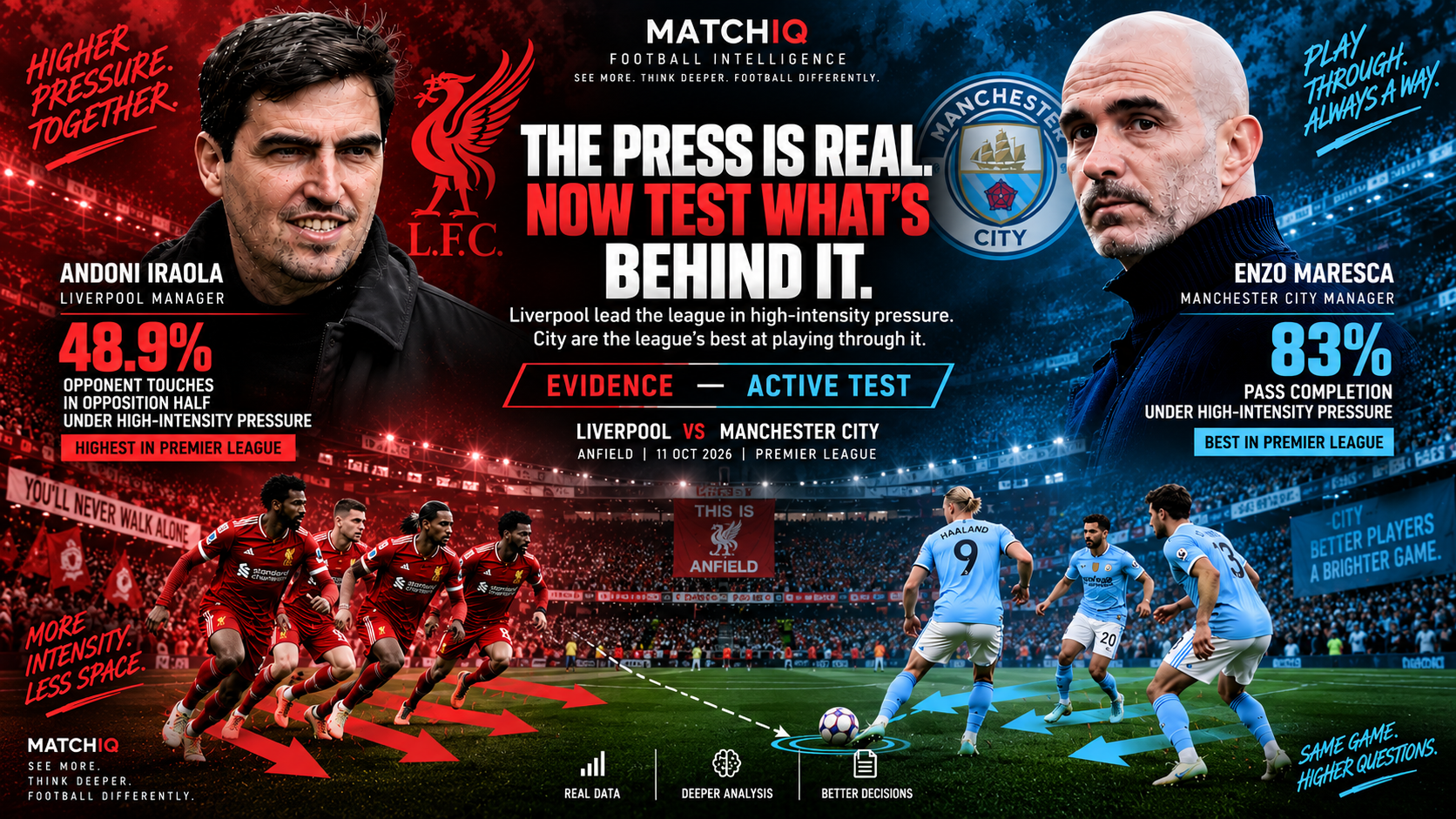
Five league matches into the season, Liverpool have set the Premier League benchmark for high pressure. They have applied high-intensity pressure to 48.9 per cent of opponents’ touches in the opposition half, the highest rate in the division. Opta data also places them third for fewest passes allowed per defensive action, at 9.1. Liverpool FC
That matters because the first stage of Iraola’s Liverpool project is becoming visible.
The team runs more. It presses earlier. Opponents have less time to establish long possession sequences.
But MATCHIQ’s question has never been whether Liverpool can initiate pressure.
It is what remains when that pressure does not win the ball.
The unresolved problem begins after the first line
Earlier in the season, Liverpool showed a tendency to become stretched when their first wave failed.
Against Fulham, Sky Sports highlighted moments when Liverpool’s attackers continued pressing while the defence retreated, opening significant midfield space. A successful pass out from goalkeeper Bernd Leno could remove several Liverpool players from the defensive phase at once. Sky Sports
That distinction matters.
A press can be aggressive without being secure.
The first player jumps. The next line must close. The defensive line must decide whether to squeeze or protect depth. The far-side players must control exits. Second balls must belong to Liverpool often enough that the opponent cannot turn one successful escape into an attack.
If those relationships fail, more pressing can actually create more space.
That was the early concern.
The evidence since then has improved. Liverpool recorded three consecutive league clean sheets across games against Ipswich, Fulham and Bournemouth, with an average xGA of 0.75 across those matches. Liverpool FC
So this is no longer a case for simply repeating the original criticism.
It needs a better test.
Manchester City provide one.
City change the quality of the evidence
City have completed 83 per cent of their Premier League passes attempted under high-intensity pressure this season — the best rate in the competition. Liverpool, meanwhile, lead the league for the proportion of opposition-half touches they subject to high-intensity pressure. Liverpool FC
Those two numbers create the real tactical collision at Anfield on October 11.
Not:
Can Liverpool press?
But:
What happens when Liverpool press a team capable of surviving the first action?
That is a much higher-quality question.
Against weaker pressure resistance, the first wave can make the rest of the structure irrelevant. A rushed clearance, poor touch or forced turnover ends the sequence before Liverpool’s protection is tested.
City can potentially extend the sequence.
One clean pass can force Liverpool into the part of the defensive phase MATCHIQ has been waiting to evaluate.
Liverpool do not need to win every press
There is an important distinction here.
Successful pressing against City does not require Liverpool to recover the ball every time.
Sometimes the press succeeds by forcing City long.
Sometimes it succeeds by pushing the next pass backwards.
Sometimes City can technically complete a pressured pass while gaining no useful territory.
That is why City’s 83 per cent figure should not be treated as proof that they automatically “beat” pressure every time. Pass completion measures resistance, not necessarily progression.
The real evidence will come one action later.
When City escape the first pressure:
- Is Liverpool’s midfield still connected?
- Can the nearest player delay the next pass?
- Does the back line step or retreat together?
- Who controls the second ball?
- Is there a free central receiver?
- Can City turn one escape into a transition against exposed defenders?
That is where this match becomes useful.
The counter-case: Liverpool may already be fixing it
There is another possibility.
Liverpool’s recent defensive improvement may not simply be favourable outcomes. The structure may actually be becoming more coherent.
Iraola has already made pragmatic selection decisions in pursuit of greater solidity, while recent analysis has noted that opponents are finding it increasingly difficult to settle on the ball against Liverpool. At the same time, counter-attacking exposure remains one of the areas still identified for improvement. Sky Sports
If Liverpool can pressure City without repeatedly separating their forwards from their midfield and defence, the old concern should lose weight.
That would matter more than a high pressing-recovery count.
It would mean the system is beginning to survive the moments when the ideal first action fails.
MATCHIQ Verdict
Manchester City are not just Liverpool’s biggest opponent so far.
They are the best evidence test so far.
Liverpool have already produced enough data to establish that the new press is real.
What remains unresolved is whether the structure behind it is becoming equally real.
If City repeatedly break the first line and find open midfield space, an old concern becomes harder to dismiss as early-season adaptation.
If Liverpool can lose the first duel, recover their shape, control the second action and force City away from dangerous progression, the opposite happens.
The previous thesis weakens.
That is what makes Sunday useful.
Not because one match can prove Iraola’s system works.
But because for the first time, Liverpool’s press is facing an opponent capable of testing what happens after it works imperfectly.
And that is where the next answer is waiting.