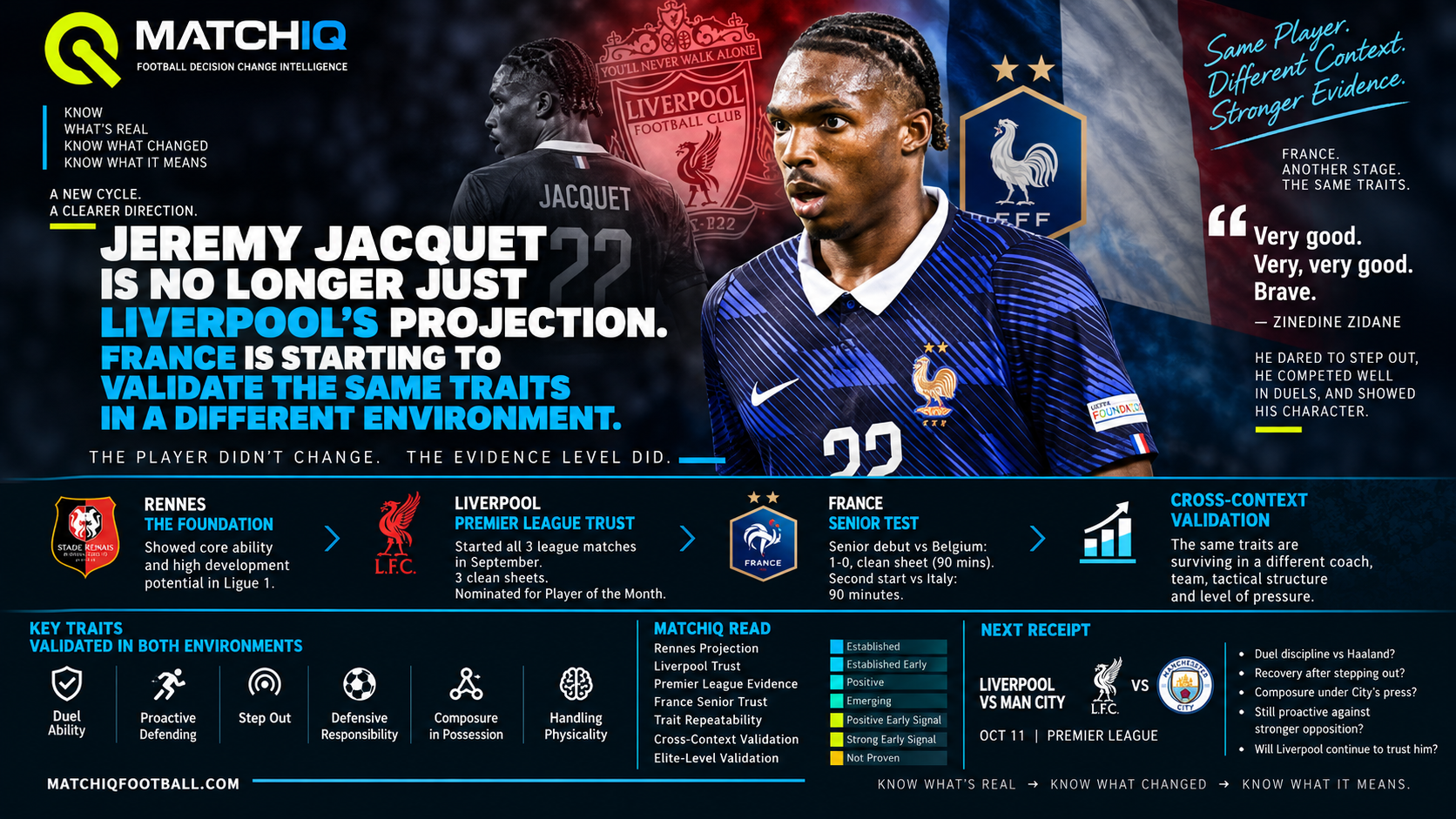
Jeremy Jacquet did not suddenly become a better centre-back because France selected him.
The player did not change.
The evidence level did.
That is the more useful story.
Liverpool signed Jacquet from Rennes because they believed his existing traits could survive a harder environment.
Premier League football started testing that projection.
France have now started testing it again.
Different coach.
Different teammates.
Different tactical structure.
Different pressure.
And so far, some of the same traits are surviving.
That is more valuable than another clean sheet.
It is the beginning of Cross-Context Validation.
Liverpool Bought A Projection
When Liverpool signed Jacquet, they were not buying certainty.
He had senior experience.
He had played for Rennes.
He had spent time at Clermont Foot.
He had already moved through France’s youth pathway.
But Premier League trust is another level.
Liverpool were still making a projection:
These traits should travel.
His physical profile.
His willingness to defend forward.
His comfort stepping out.
His ability to compete in duels.
His composure with the ball.
His capacity to survive larger spaces.
The transfer itself did not prove any of those things would work at Anfield.
It only told us Liverpool believed they might.
That is what projection means.
Then The Premier League Started Producing Receipts
September changed the evidence.
Jacquet played every minute of Liverpool’s three Premier League matches.
Three games.
Three clean sheets.
He became part of a defence that went through the month without conceding.
He was then nominated for Premier League Player of the Month.
That matters.
Not because awards decide player quality.
They do not.
But because the evidence was no longer hidden inside scouting reports or transfer logic.
It had moved into competitive senior football.
Liverpool were not merely developing him.
They were trusting him.
That is a different stage.
Trust Matters More Than The Transfer Fee
Young defenders often arrive with big reputations.
Then disappear behind senior players.
Or get protected through easier cup games.
Or get sent on loan.
That is normal.
Jacquet’s case moved differently.
Before the international break, he was already ever-present for Liverpool.
That tells us something important.
A club can like a young defender.
A coach can praise him.
A recruitment team can believe in him.
But starting him every week creates a different evidence category.
That is:
Operational Trust.
The player is not simply part of the future.
He is being used inside the present.
France Then Changed The Context
This is where the case became much more interesting.
Jacquet entered his first France senior camp.
That alone is recognition.
But recognition is weak evidence compared with responsibility.
Zidane did not simply call him up.
He started him against Belgium.
Jacquet played all 90 minutes.
France won 1–0.
Clean sheet.
Four days later:
Italy.
Another start.
Another 90 minutes.
Different opponent.
Different game.
Different defensive questions.
And Zidane’s reaction afterwards was unusually specific.
He called Jacquet:
“Very good. Very, very good. Brave.”
More importantly, he explained why.
Jacquet was willing to step out.
He was aggressive enough to leave the line.
He competed well in duels.
That is where the cross-context signal starts to appear.
The Same Traits Are Being Seen Twice
This is the important part.
Liverpool are not valuing one version of Jacquet while France are valuing another.
At least so far, the evidence is beginning to overlap.
Liverpool:
Trust him inside a high defensive line.
Trust him to defend space.
Trust him in repeated Premier League duels.
Trust him alongside Virgil van Dijk.
France:
Trust him to start immediately.
Trust him to defend proactively.
Trust him to step out.
Trust him in senior international duels.
Same player.
Different environment.
Similar traits surviving.
That is stronger evidence than either environment alone.
This Is Cross-Context Validation
A player can look good because the context helps him.
That happens constantly.
A centre-back may look elite inside a dominant club because the team controls territory.
Another may look impressive in a deep block because his job is simple:
defend the box.
Clear the ball.
Win headers.
But when a player shows the same underlying strengths in different systems, the evidence becomes stronger.
Not complete.
Stronger.
That is Cross-Context Validation.
You are no longer only asking:
Does Jacquet fit Liverpool?
You can start asking:
Are the underlying traits robust enough to travel?
That is a much more valuable question.
The Clean Sheet Is Not The Main Receipt
France kept a clean sheet against Belgium.
Liverpool kept three league clean sheets in September.
Those outcomes matter.
But clean sheets are team outcomes.
They can mislead.
A defender can play badly and keep a clean sheet.
A defender can play well and concede twice.
So MATCHIQ should not make the lazy leap:
Clean Sheet = Defender Validated
The stronger receipt is behaviour.
Did he step out at the right time?
Did he survive the duel?
Did he protect space behind?
Did he stay composed when pressed?
Did his coach continue trusting him after the first test?
Against Italy, Zidane answered part of that question by selecting him again.
That second start matters more than the first clean sheet.
Repeat Selection Is Stronger Than Debut Excitement
International debuts create noise.
Young player.
Big shirt.
Emotional moment.
One good performance.
Everyone immediately asks:
Is he the future?
Too early.
The second selection is more useful.
Because it tells us:
The first exposure did not scare the coach away.
Zidane saw Belgium.
Then still trusted Jacquet against Italy.
That does not prove ownership.
But it moves him from:
Debutant
toward:
Repeatable Senior Option.
That is a real trajectory change.
Zidane’s Praise Also Matters Because It Was Trait-Specific
Generic praise is cheap.
“Good game.”
“Very happy.”
“Great young player.”
None of that changes much.
Zidane’s comments were more useful because they pointed to behaviours.
Bravery.
Stepping out.
Duels.
Those are centre-back traits that can be tracked.
Now Liverpool and France give us two environments where those same behaviours can be tested again.
That is exactly how a player-intelligence database should work.
Not:
Did he play well?
But:
Which trait survived?
Liverpool’s September Evidence Gives France More Meaning
France did not discover Jacquet from nowhere.
Liverpool had already increased the test level.
Three Premier League matches in September.
Three clean sheets.
Every minute played.
Player of the Month nomination.
So when France selected him, the national team were not testing an untouched prospect.
They were testing a player whose club trajectory had already accelerated.
That matters.
Because international recognition becomes more valuable when it confirms something club football had already begun suggesting.
One environment creates a hypothesis.
The second environment tests whether the hypothesis travels.
France Also Gives Liverpool More Information
The validation works in both directions.
Liverpool can now see Jacquet functioning outside Liverpool.
Without Van Dijk beside him.
Without Liverpool’s normal pressing structure.
Without the same automatisms.
Without the same build-up relationships.
That information matters.
Because some young defenders are highly system-dependent.
Remove the familiar structure and the performance collapses.
Jacquet’s first France evidence does not show that.
Again:
Small sample.
But positive signal.
This Does Not Mean Liverpool’s Projection Is “Confirmed”
Now the Red Team.
Two France caps are tiny.
One clean sheet against Belgium and one draw with Italy do not prove elite-level quality.
France themselves are extremely talented.
Their collective structure can protect defenders too.
Liverpool are also currently defending well as a team.
Good environments can make individual evidence look cleaner.
So the correct conclusion is not:
Liverpool were right. Jacquet is elite.
Too early.
The correct conclusion is:
Liverpool’s original projection has now survived another context.
That raises confidence.
It does not end the evaluation.
France Did Not Use Him Against Belgium Again
That matters too.
France’s latest 4–1 win over Belgium did not add another Jacquet appearance.
So the international sample remains small.
Two senior starts.
Two full matches.
That is enough to create a signal.
Not enough to establish role ownership.
This keeps the status disciplined:
France Senior Trust — Emerging
Not:
France Starting Centre-Back — Established
That distinction matters.
The Player Did Not Change. The Evidence Level Did.
This is the simplest way to frame the whole case.
Jacquet was talented at Rennes.
Liverpool believed the traits would scale.
Liverpool then trusted him in the Premier League.
France then trusted him at senior international level.
Every stage raises the evidence difficulty.
Rennes senior football.
↓
Liverpool Premier League football.
↓
France senior football.
Same player.
Harder context.
More confidence.
That is what trajectory analysis should look like.
Youth Trajectory Is Not About Predicting Stardom
This is why Jacquet is a useful Youth Trajectory case.
The question is not:
Will Jeremy Jacquet become world class?
That is too far away.
The better question is:
Which parts of the original projection are surviving as the test level rises?
That can actually be measured.
Liverpool trust.
France trust.
Repeat starts.
Duel behaviour.
Proactive defending.
Composure.
Role difficulty.
These are receipts.
“Future superstar” is not.
Manchester City Is The Next Test For A Reason
Liverpool host Manchester City next.
That is a much harder club-level receipt.
If Jacquet starts, do not reduce the evaluation to:
Did Liverpool keep a clean sheet?
Watch the actual defensive problem.
Manchester City can test him in several ways.
Haaland can create a physical reference.
City can drag centre-backs away from their preferred zones.
Their midfield can attack the space behind an aggressive step-out.
Their press can test Jacquet’s possession decisions.
Their movement can punish one bad defensive read.
That makes the game valuable.
Not because one match proves everything.
Because the context becomes harder again.
Haaland Would Be A Particularly Useful Receipt
If Jacquet is directly involved against Haaland, the test becomes even cleaner.
Not:
Can Jacquet dominate Haaland for 90 minutes?
That is unrealistic.
The better questions:
Does he maintain duel discipline?
Does he avoid becoming over-aggressive?
Can he recover after stepping out?
Does he understand when not to engage?
Can he defend the space around Haaland rather than only the body?
Can he stay composed after losing a duel?
That is elite-opposition evidence.
MATCHIQ Decision Change
When Liverpool signed Jacquet, the core question was:
Will his Rennes traits survive the Premier League?
September began answering that positively.
Liverpool gave him consistent minutes.
The defence produced three league clean sheets.
His individual defensive work gained recognition.
Then France raised the test again.
Two senior starts.
Two full matches.
A clean sheet on debut.
And Zidane highlighted the same kinds of behaviours that made Jacquet attractive in the first place.
So the question changes.
Before:
Is Liverpool’s projection working?
Now:
Are the same traits beginning to survive across different elite environments?
That is a higher-level question.
Previous State
Jacquet arrived from Rennes as a high-upside young centre-back.
Liverpool believed his physicality, proactive defending and composure could translate upward.
Premier League validation was still limited.
France senior validation did not exist.
New Evidence
Liverpool used Jacquet for every Premier League minute in September.
Liverpool kept three clean sheets in three league matches.
Jacquet was nominated for Premier League Player of the Month.
France then handed him his senior debut against Belgium.
He played all 90 minutes in a 1–0 win.
Four days later, he again played 90 minutes against Italy.
Zidane praised his bravery, willingness to step out and duel performance.
What Changed
The evidence is no longer only club-specific.
Jacquet is beginning to show similar traits in different high-level contexts.
That moves the case from:
Projection
toward:
Cross-Context Validation.
MATCHIQ Read
Rennes Projection — Established
Liverpool Trust — Established Early
Premier League Evidence — Positive
France Senior Trust — Emerging
Trait Repeatability — Positive Early Signal
Cross-Context Validation — Strong Early Signal
Elite-Level Validation — Not Proven
Role Ownership — Not Yet
Confidence
Liverpool Trust — High
His minutes and September role support that strongly.
France Senior Trust — Medium
Two starts and two full matches matter, but the sample remains small.
Cross-Context Validation — Medium-High
The same underlying behaviours are beginning to appear in both environments.
Elite-Level Validation — Low-Medium
The next tests need to be harder and repeated.
Counter-Case
Liverpool are currently functioning well defensively as a collective.
France also have elite talent around Jacquet.
Both environments may be helping him.
Two international matches are too small a sample to separate player quality from contextual protection.
And one clean sheet cannot be assigned to one centre-back.
So:
Cross-Context Validation ≠ Elite Validation.
Not yet.
Next Watch
Liverpool vs Manchester City.
If Jacquet starts:
Do not just watch the score.
Watch:
duel discipline against Haaland.
recovery after stepping out.
defending larger spaces.
decision-making under City’s press.
whether he remains proactive against stronger opposition.
whether Liverpool still trust him when the risk level rises.
Then watch France.
Does Zidane select him again?
Does he start again?
Does he receive the same responsibilities?
Those are the next receipts.
Future Receipt
Current claim:
Jeremy Jacquet is no longer only a Liverpool projection.
France have started providing independent evidence that some of the same underlying traits can survive in another senior environment.
What strengthens it:
Jacquet continues starting for Liverpool against elite opposition, receives repeat France responsibility and displays the same proactive defensive behaviours across both contexts.
What weakens it:
His role shrinks sharply when opposition quality increases, or France stop trusting him once more established defenders return.
What changes the read completely:
The same traits remain visible against elite club opposition and across several France windows.
At that point, the story stops being:
Cross-Context Validation.
It becomes:
Elite-Level Validation.
Status:
Projection — Surviving
Club Trust — Established Early
France Trust — Emerging
Cross-Context Validation — Strong Early Signal
Elite Validation — Pending