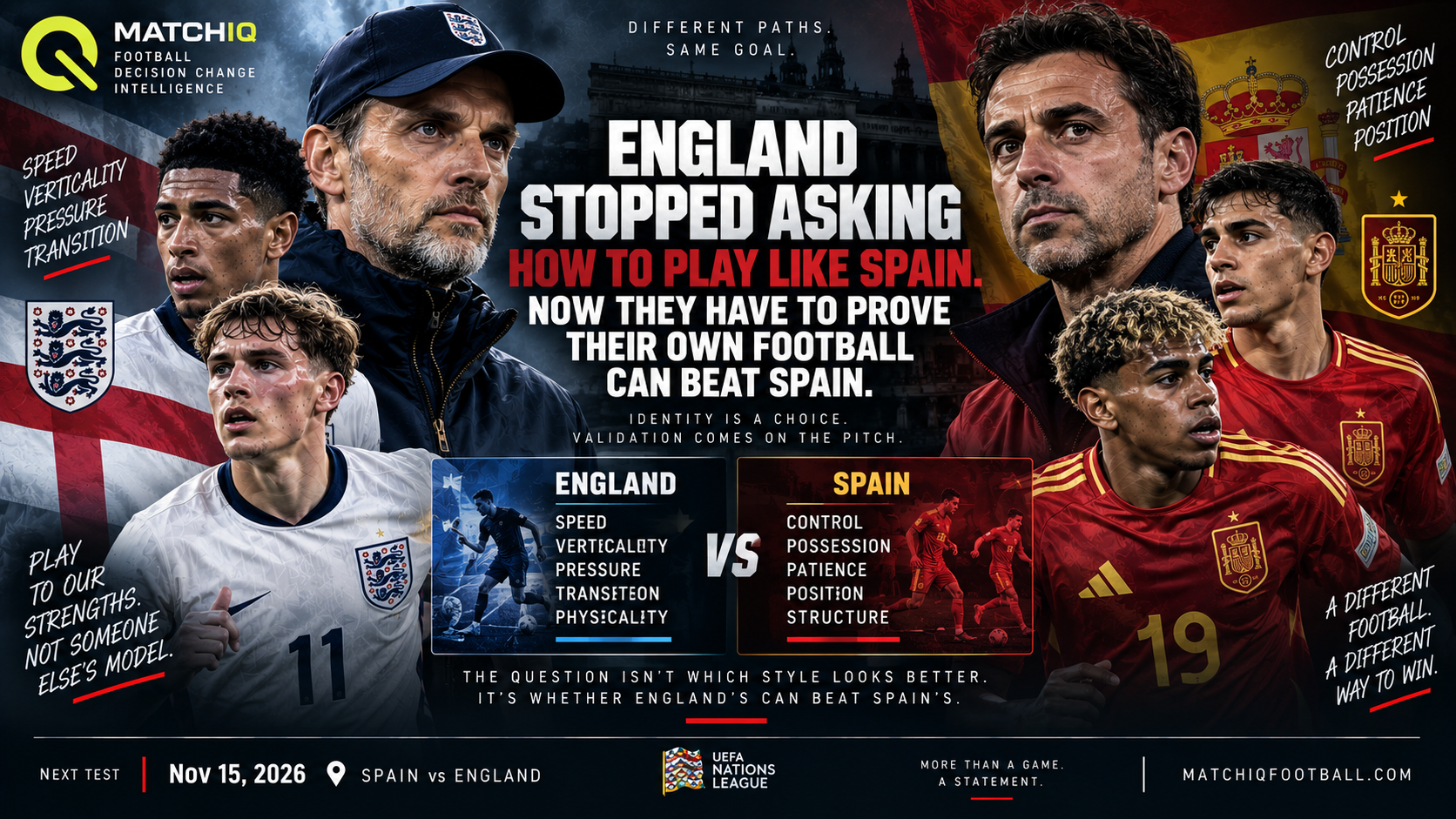
England may finally be asking the right question.
Not:
How do we become more like Spain?
But:
What happens if we stop trying?
Anthony Gordon gave the clearest public version of that argument before England faced Spain at Wembley.
England, he said, should lean into what comes naturally:
speed.
directness.
aggression.
pressure.
Not copy the possession-heavy football associated with Spain.
Thomas Tuchel publicly acknowledged the same tension, saying that the possession style associated with Spain, Argentina and Brazil is not naturally England’s footballing DNA. Reuters
Then Gordon scored the kind of goal that turned the debate into evidence.
England won the ball deep.
Jude Bellingham drove forward.
Gordon ran beyond the defence.
Seconds later, the ball was in Spain’s net.
England had just demonstrated exactly what Gordon meant.
And for four minutes, it looked powerful enough to change the game.
They turned 0–1 into 2–1.
Then Spain came back and won 3–2. Reuters
That is why England’s identity question is no longer theoretical.
They have shown their football can hurt Spain.
They have not yet shown it can beat them.
Identity is not the same thing as style preference
Every national team wants an identity.
That word is easy to use because it sounds decisive.
But identity only matters if it changes decisions.
Who gets selected?
Where does the ball go after recovery?
How quickly does the team attack space?
What happens when possession becomes uncomfortable?
How much control are you willing to sacrifice for speed?
England’s emerging answer looks different from Spain’s.
Spain want to control the game through the ball.
England appear increasingly comfortable trying to control the game through damage.
Recover.
Accelerate.
Attack the space before it closes.
Use runners.
Use physical power.
Create high-value moments before the opponent can restore shape.
That is not automatically better football.
It is not automatically worse.
It is simply a different route to the same objective.
The important question is whether England can make that route complete enough to survive elite opposition.
Wembley showed the upside
The Spain match gave England the best evidence yet for the argument.
Gordon’s equaliser came from exactly the kind of attack England want to own.
Ball recovery.
Immediate verticality.
Bellingham carrying through space.
Gordon attacking behind.
No unnecessary circulation.
No attempt to recreate Spain’s positional patience.
Just one advantage recognised quickly and attacked aggressively. Reuters
Four minutes later, Harry Kane put England ahead.
For a short period, Spain had been dragged into England’s game.
That matters.
Because identity is valuable when it makes the opponent uncomfortable.
England did that.
Spain’s possession structure was disrupted.
Their defensive rest shape was attacked.
Their midfield had to run backwards.
England created the kind of game Spain would rather avoid.
That is real evidence.
But Spain won the part that matters more
The final score remains the problem.
Spain recovered.
England did not.
Gordon himself identified the important difference after the game: once Spain went 3–2 ahead, their ability to control possession became obvious. England had enough speed and transition threat to change the match, but not enough control to recover it a second time. Reuters
That is the gap.
England may already know how they want to attack Spain.
They still have to prove they know how to manage the moments between those attacks.
That is why this cannot become a lazy argument about:
Possession vs direct football.
England do not need more possession just because Spain have more possession.
But England do need answers when the transition disappears.
That is different.
Direct football can be an identity. It cannot be the only solution.
There is a danger in overcorrecting.
For years, England have been criticised for not controlling elite matches well enough.
Now that they have a clearer vertical threat, the temptation is to turn that into ideology.
Be direct.
Play fast.
Press aggressively.
Attack immediately.
Fine.
But what happens when the opponent refuses to give you transition space?
What happens when Spain drop five metres deeper?
What happens when the first forward pass is blocked?
What happens when England are leading and no longer need to attack every open lane?
A strong identity is not one behaviour repeated forever.
It is a hierarchy of behaviours.
England’s first principle may be:
Go forward when the advantage exists.
The second still needs definition.
If the vertical route closes, what comes next?
That is where tournament football gets difficult.
Croatia showed how devastating England can be when the game opens
The 7–0 win in Croatia strengthened the identity argument.
England’s pace, runs and verticality repeatedly destroyed Croatia.
Kane later said Croatia could not live with England’s pace and movement, while Bellingham, Gordon, Saka and others repeatedly attacked space quickly. Reuters
That performance matters.
Not because 7–0 proves England are ready to win a tournament.
It does not.
It matters because the same principles appeared again.
England were not simply waiting for one star to invent something.
They were attacking through collective movement.
Fast progression.
Runs beyond the ball.
Immediate punishment after mistakes.
That is a recognisable pattern.
Identity begins when the same behaviour appears in different matches.
Czechia gave England another kind of receipt
Three days later, England beat Czechia 3–0.
This time the game did not need to become chaotic.
Tuchel praised England’s fluidity, focus and control, saying they dominated throughout despite it being their fourth match in a demanding international window. Reuters
That matters because it adds a second layer.
England were not only dangerous when the game became open.
They were also able to control a weaker opponent.
So the evidence is improving.
But the hierarchy of proof still matters.
Beating Croatia 7–0 tells us England can destroy a game.
Beating Czechia 3–0 tells us they can control one.
Losing 3–2 to Spain tells us they still have not proven they can combine both against the benchmark.
That is the next level.
This is not about copying Spain less. It is about needing Spain less.
The wrong conclusion would be:
Spain play possession football. England should do the opposite.
That turns identity into rebellion.
The stronger conclusion is:
England should use the style that maximises England.
If that means more direct attacks, fine.
If that means faster transitions, fine.
If that means less sterile possession, also fine.
But the objective is not to look different from Spain.
The objective is to become less dependent on Spain’s model as the definition of elite football.
That is the real change.
England do not need to prove they can complete Spain’s passes.
They need to prove their own decision model can survive the same level of opposition.
The red-team case
The strongest counterargument is obvious.
England may not have found an identity at all.
They may simply have found a very dangerous transition weapon.
Those are not the same thing.
Transitions depend on game state.
You need space.
You often need an opponent to commit numbers.
You often need a turnover in a useful zone.
Elite teams can reduce those opportunities.
Spain already showed they can do that.
Once Spain restored control, England struggled to create the same kind of repeated damage that had produced the first comeback. Reuters
So the current evidence supports:
Transition Threat — CONFIRMED
It does not yet support:
Complete Football Identity — PROVEN
That distinction has to stay.
England’s biggest problem may still be what happens after they go ahead
There is another layer.
At Wembley, England did the hard part.
They turned the match.
From 0–1 down to 2–1 up.
That should have created a new decision state.
Do they keep attacking?
Do they slow the game?
Do they protect space?
Do they force Spain to become impatient?
Do they keep the same pressing risk?
England did not control that phase well enough.
Spain recovered.
So this identity discussion is not only about attack.
It is about game-state governance.
A tournament winner needs to know:
when to accelerate;
when to sustain pressure;
when to keep the ball;
when to deny transition;
when to slow the emotional temperature of the match.
England’s new football may already answer the first two.
The rest still need proof.
Spain are the perfect benchmark because England chose not to imitate them
The Nations League gives England a clean test.
Spain host England on 15 November in the final group-stage round. UEFA lists the match as Spain vs England in Group A3, with Spain currently leading the group and England second after four matches. UEFA.com
That fixture matters for more than qualification.
It is now an identity test.
England have already seen what Spain represent.
Possession.
Control.
Position.
Patience.
Recovery after disruption.
England are building something different.
Speed.
Verticality.
Pressure.
Transitions.
Physicality.
The November match asks whether those principles can coexist with enough control to win.
The question is no longer which football looks better
That debate is useless.
Possession is not automatically intelligent.
Direct football is not automatically primitive.
The only meaningful question is:
What does the style allow the team to do?
Spain use possession to reduce randomness.
England appear increasingly willing to use speed to increase it.
Spain want to control where the match happens.
England want to attack before control can be rebuilt.
Both can work.
The difference is that Spain have already validated their model at the highest level.
England have not.
That is why 15 November matters.
MATCHIQ Decision
England’s identity direction is becoming clearer.
Gordon has articulated it.
Tuchel has acknowledged it.
The Spain match produced a real transition receipt.
Croatia showed how destructive it can become when the game opens.
Czechia showed England can still dominate a more controlled match. Reuters
But England have not solved the final problem.
They know how to make Spain uncomfortable.
They do not yet know whether their preferred football can control enough of the match to beat Spain.
That means the decision state has moved from:
Identity Search
to:
Identity Validation.
England do not need to become Spain.
Now they need to prove that is a strength, not an excuse.
MATCHIQ VERDICT
England may have stopped asking how to play like Spain.
Now they have to prove England’s football can beat Spain’s.
Identity Direction — CLEARER
Transition Threat — CONFIRMED
Controlled Possession Layer — DEVELOPING
Game-State Control — STILL QUESTIONABLE
Elite Validation — PENDING
Next Watch: Spain vs England|15 Nov
First transition → response after taking the lead → possession under pressure → second solution when space disappears → final 20-minute control.