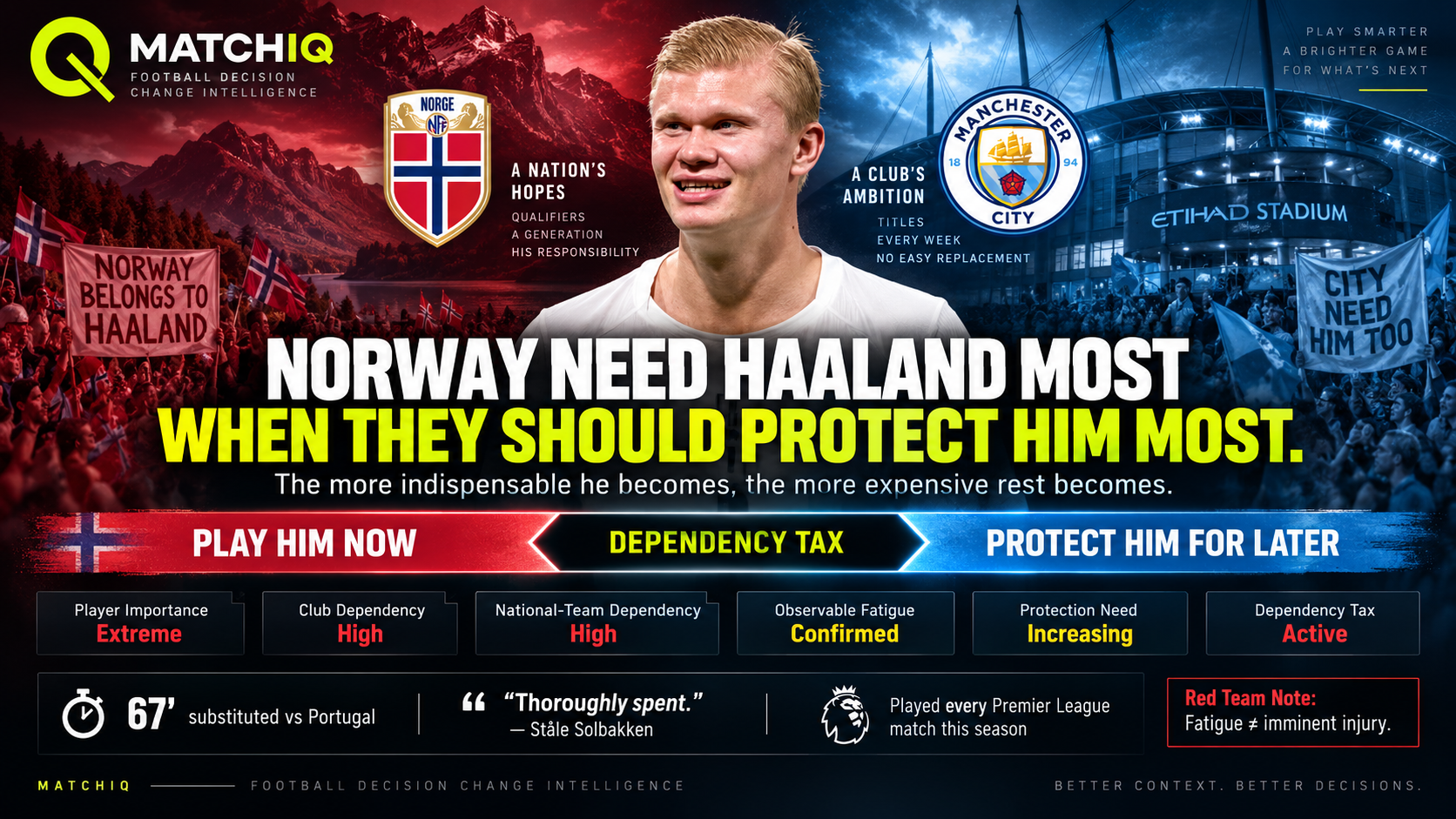
Erling Haaland lasted 67 minutes against Portugal.
Then Ståle Solbakken explained why.
He was not tactically removed.
He was not being protected for a comfortable game state.
He was, in his manager’s words:
“thoroughly spent.”
That should change the question around Haaland.
Not:
Can Norway afford to rest him?
The harder question is:
Can Norway afford not to?
Because the more important Haaland becomes, the more expensive every minute of protection becomes.
And that creates a problem.
Dependency makes rest more necessary.
It also makes rest harder to choose.
That is the Dependency Tax.
Haaland’s Importance Is Exactly What Makes This Difficult
There is no mystery about why Norway keep using him.
He is Erling Haaland.
At the World Cup, he scored twice against Brazil to send Norway into their first quarter-final. His importance is not theoretical. Norway have already seen what happens when their best player decides their biggest games.
So when Norway face a competitive match, the decision is obvious.
Play Haaland.
When the next competitive match arrives?
Play Haaland again.
When he looks tired but the result still matters?
That is where the problem begins.
Because the stronger the dependency becomes, the greater the short-term cost of protecting him.
Rest a squad player and the structure survives.
Rest your primary match-winner and the expected loss can be much larger.
That creates a rational reason to keep playing him.
And eventually, rational short-term decisions can create an irrational long-term outcome.
This Is Not A “Norway Are Misusing Haaland” Article
That conclusion would be too easy.
Norway have competitive objectives.
Manchester City have competitive objectives.
Neither environment operates in a vacuum.
Solbakken clearly knows the workload is high. He publicly described the strain and noted that some Norway players had only six or seven days of holiday before the new season began. He also pointed out exactly why Haaland sits near the top of the workload problem: Manchester City compete everywhere, and Haaland is their main man.
So this is not:
bad coach vs tired player.
It is a structural conflict.
Club needs him.
Country needs him.
Player wants to play.
Calendar keeps moving.
Everyone can make a reasonable decision individually.
The combined result can still be unreasonable.
That Is The Dependency Tax
The concept is simple.
The more replaceable a player is, the easier it is to protect him.
If the alternative costs very little, rest becomes cheap.
If the alternative costs a lot, rest becomes expensive.
Haaland sits at the extreme end.
For Norway:
Haaland plays
→ maximum attacking threat.
Haaland rests
→ Norway voluntarily remove their most decisive scorer.
That is the tax.
Protection has a competitive price.
And because that price is visible immediately, while fatigue risk accumulates gradually, the short-term decision usually wins.
Play him now.
Deal with the cost later.
Until “later” arrives.
The Warning Is No Longer Theoretical
This is why Solbakken’s wording matters.
“Thoroughly spent” is not an abstract sports-science projection.
It is an observable condition.
Haaland had already played Norway’s three previous matches in the window. His World Cup run had shortened his off-season, and he returned to a Manchester City schedule in which he has featured in every Premier League match so far.
The fatigue signal has also come from Haaland himself.
After scoring twice against Denmark, he posted:
“So tired. New match in 70 hours.”
That does not prove injury is coming.
It does not prove performance collapse is coming.
But it changes the evidence level.
This is no longer:
Could workload become a problem?
It is:
Workload is already becoming visible in the player.
That is a different decision environment.
The Real Risk Is Not One Bad Match
This is where workload discussions often become too shallow.
People look for immediate output.
Did Haaland score?
Did City win?
Did Norway win?
If yes, workload concerns disappear for another week.
But workload risk does not need to show itself as a sudden bad performance.
The more important risks are cumulative:
recovery quality.
explosiveness.
repeat sprint capacity.
decision sharpness.
injury exposure.
ability to reproduce maximum actions late in matches.
You can still score while becoming less protected.
That is why goals are a poor workload-management metric.
A player can remain productive while the protection margin underneath him keeps shrinking.
Norway’s Best Asset Can Become Norway’s Biggest Constraint
This is the paradox.
Haaland gives Norway a higher ceiling.
But dependence on Haaland can also reduce Norway’s freedom.
Every game starts producing the same calculation:
Is this match important enough to use him?
For a player this decisive, the answer is almost always yes.
And that is exactly the problem.
If every match is important enough,
then no match becomes cheap enough to rest him.
That creates a system in which protection is always postponed.
Not because nobody understands the risk.
Because the opportunity cost is too high.
This Is Why Squad Depth Is Really A Welfare Issue Too
Depth is usually discussed as tactical insurance.
Someone gets injured.
Who replaces him?
But depth also determines whether a coach can protect the starter before injury arrives.
That distinction matters.
If Norway had a replacement who preserved enough of Haaland’s function, then resting him becomes cheaper.
They do not need another Haaland.
That is unrealistic.
They need enough attacking structure without him that one match of protection does not feel like surrendering the result.
That is the same logic MATCHIQ has already tracked elsewhere:
replacement does not require cloning the player.
Sometimes you reduce dependency by redistributing the function.
For Norway, that means the real Haaland problem is not only Haaland.
It is also:
How much football can Norway still produce when he is not there?
NISO Identified The Most Important Governance Problem
The Norwegian players’ union made a stronger point than simply saying the calendar is crowded.
It argued that protecting players cannot depend on the players themselves asking to stop.
That matters.
Because elite players are structurally bad at being their own workload regulators.
They want to play.
They want to help teammates.
They want to represent the country.
They want the biggest matches.
So if the system waits for Haaland to say:
“Do not pick me.”
the system has already transferred responsibility to the person with the strongest incentive to keep saying yes.
That is bad governance.
Workload protection has to exist above the individual decision.
Club.
Country.
Medical teams.
Competition calendar.
Those layers need to absorb some of the decision cost.
Otherwise “player choice” becomes an excuse for collective non-choice.
But Coordination Is Harder Than It Sounds
Here is the Red Team.
It is easy to say:
Manchester City and Norway should coordinate.
Fine.
Who gives up the minutes?
City?
Norway?
Which competition matters less?
Which manager absorbs the competitive downside?
If Norway rest him and lose, Norway pay the immediate cost.
If City rest him and drop league points, City pay it.
The benefit of protection is shared.
The cost of protection is local.
That is why coordination is difficult.
Everyone benefits if Haaland stays healthy.
But whoever rests him first absorbs the visible sacrifice.
That is another form of the Dependency Tax.
There Is Also A Player-Specific Counter-Case
Not every high workload automatically produces injury.
Elite players can tolerate extraordinary schedules.
Haaland’s physical profile, medical management and recovery protocols are not publicly visible in full.
So we cannot jump from:
he is exhausted
to:
he is about to break down.
That would be speculation.
The correct claim is narrower.
The evidence now shows:
his workload is sufficiently high that fatigue has become publicly observable and explicitly acknowledged by his national-team manager.
That is enough to change the risk calculation.
It is not enough to predict the outcome.
The Wrong Question Is “Should Haaland Rest?”
Of course he should rest.
Every player should.
That answer tells us almost nothing.
The useful question is:
Who is willing to pay for the rest?
That is where the real decision sits.
Because Haaland’s rest has a price.
Maybe Norway lose attacking threat.
Maybe City lose their best finisher for a match.
Maybe another player has to absorb responsibility.
Maybe the structure has to change.
The protection decision only becomes real when somebody accepts that cost.
Without that, “player welfare” stays rhetorical.
Norway Need A Haaland Plan That Includes No Haaland
This sounds contradictory.
It is not.
A team built around an indispensable player needs a credible plan for his absence precisely because he is indispensable.
Otherwise every future decision becomes trapped.
Play him because you need him.
Play him again because you still need him.
Then play him tired because you cannot afford the alternative.
That is dependency.
The solution is not finding another Haaland.
The solution is making the cost of no Haaland smaller.
Different striker movements.
More goals from wide positions.
More midfield arrival.
A different pressing scheme.
A different chance-creation route.
Anything that gives Solbakken a match where resting Haaland does not feel like abandoning Norway’s best chance of winning.
That is how protection becomes operational.
Manchester City Face The Same Problem
City’s version is different.
Their squad has more attacking resources.
But Haaland’s function is still difficult to replace.
Goals.
Box occupation.
Centre-back fixation.
Depth running.
Penalty-area gravity.
So the same decision tax exists.
If he is available, the obvious choice is to use him.
Then another match arrives.
And another.
That is why six days before the next club game sounds like recovery.
For an exhausted player coming out of international duty, it may simply be the next short window before the cycle restarts.
The question is not whether six days sounds generous.
It is whether the accumulated load underneath those six days has actually been reset.
We cannot know that publicly.
But we can track the decisions.
MATCHIQ Decision Change
Before this warning, Haaland’s importance could still be discussed mainly as a competitive advantage.
Norway have one of the most decisive forwards in world football.
Manchester City have one of the most decisive forwards in world football.
Now another side of that value is becoming visible.
The player who gives both teams the most also creates the hardest protection decision.
Because every rest carries an immediate football cost.
So the question changes.
Before:
How much can Haaland give Norway?
Now:
How much are Norway and City willing to give up in order to protect what Haaland can give later?
That is the Dependency Tax.
Previous State
Haaland was Norway’s primary match-winner and Manchester City’s central attacking reference.
His high usage was understandable because his replacement cost was extremely high.
New Evidence
Norway reached the World Cup quarter-finals, shortening Haaland’s off-season.
He returned to play every Manchester City Premier League match so far.
He played Norway’s three matches before Portugal.
Against Portugal, he was substituted after 67 minutes.
Solbakken described him as “thoroughly spent”.
Haaland himself had already publicly referenced exhaustion after the Denmark match.
What Changed
Fatigue is no longer only a future workload risk.
It has become current evidence.
That moves the decision from:
Can we keep using him?
to:
What is the cost of continuing to use him without creating meaningful protection?
MATCHIQ Read
Player Importance — Extreme
Club Dependency — High
National-Team Dependency — High
Observable Fatigue — Confirmed
Protection Need — Increasing
Protection Cost — High
Coordinated Workload Management — Unproven
Dependency Tax — Active
Confidence
High that the workload problem is real.
Solbakken, Haaland and Norway’s players’ union have all provided evidence around fatigue and recovery pressure.
Low on predicting injury or performance decline.
Those outcomes are not established.
Counter-Case
Heavy workload does not automatically mean imminent injury.
Norway and Manchester City may also be managing training and recovery in ways that are not publicly visible.
And both teams have legitimate competitive reasons to continue selecting Haaland.
So the thesis is not:
They are irresponsibly overplaying him.
It is:
Their dependency makes responsible protection unusually expensive.
Next Watch
Do not just watch whether Haaland scores against Liverpool.
Watch the workload decision.
Does he start?
How many minutes?
Is he substituted earlier?
Does City give him any actual rest?
What happens in Norway’s next window?
Does Solbakken reduce his minutes?
Does either side publicly describe a protection plan?
Most importantly:
Does club-country coordination become visible before fatigue becomes absence?
That is the next receipt.
Future Receipt
Current claim:
Haaland’s importance to both Norway and Manchester City has created an active Dependency Tax: the more valuable he becomes, the more expensive meaningful rest becomes.
What strengthens it:
Continued near-automatic selection, heavy minutes and repeated fatigue signals without meaningful recovery periods.
What weakens it:
City and Norway begin deliberately reducing minutes, rotating starts or coordinating recovery before performance or availability forces the decision.
What changes the read completely:
Both environments accept short-term competitive cost in order to protect long-term availability.
At that point, we stop tracking:
Dependency Tax.
We start tracking:
Dependency Management.
Status:
Dependency — High
Fatigue Signal — Confirmed
Protection Need — Rising
Dependency Management — Pending