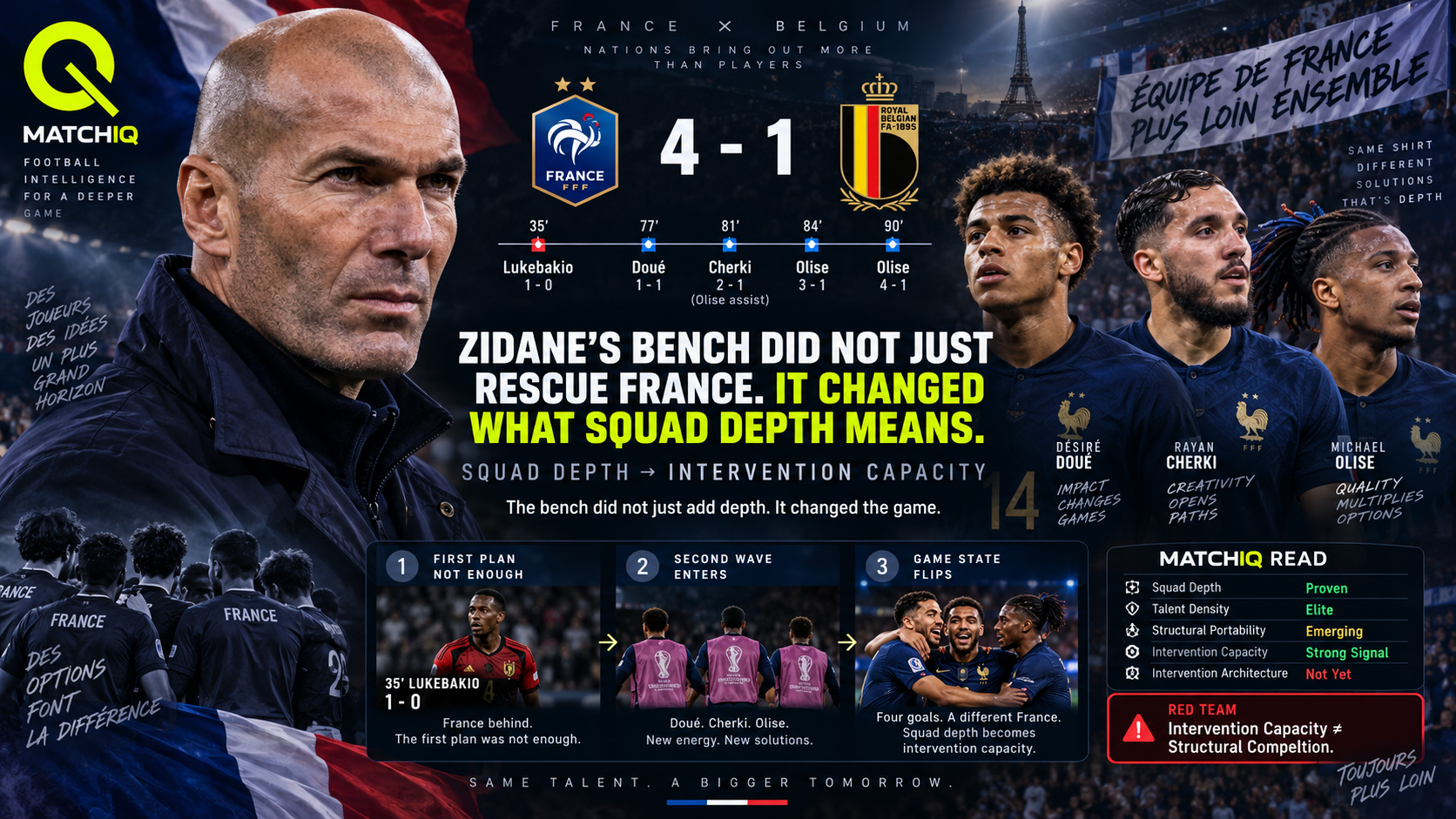
France were losing 1–0 in the 76th minute.
That matters.
Because what happened next can easily be reduced to the oldest France story in the book:
Look at the bench.
Look at the talent.
Look at how many ridiculous footballers they can bring on.
Désiré Doué equalised.
Rayan Cherki put France ahead.
Michael Olise created Cherki’s goal and then scored twice himself.
Four goals.
Fourteen minutes.
All three decisive players had started the match on the bench.
Easy conclusion:
France have incredible squad depth.
We already knew that.
The more interesting thing changed somewhere else.
Zidane’s bench was not passive insurance.
It became an intervention mechanism.
That is different.
And it changes what “depth” should mean.
A Strong Bench Is Not The Same As A Useful Bench
Squad depth is usually described like inventory.
Two good left-backs.
Three elite centre-backs.
Five attacking options.
Another midfielder who would start for most countries.
Fine.
That tells us how many good players a coach owns.
It does not tell us whether those players can change a match.
That requires another layer.
Intervention Capacity.
The difference is simple.
Squad depth says:
If someone is unavailable, I have another good player.
Intervention capacity says:
The game has changed. I have another player who can change it again.
Against Belgium, France showed the second.
That is much more valuable.
For 76 Minutes, The First Plan Had Not Solved Belgium
This part cannot be skipped.
Belgium led through Dodi Lukébakio in the 35th minute.
France did not immediately respond.
They did not spend the next 40 minutes proving that the starting structure was already superior.
They were still behind.
That matters because it stops us from rewriting the game after the comeback.
The final score says 4–1.
The actual match said something more complicated:
France’s first solution was not enough.
Then Zidane changed the problem.
That distinction is critical.
Because if the starting structure had already been fully portable, productive and dominant, France would not have needed the second wave to rescue the result.
The bench did not simply decorate a successful plan.
It changed a failing one.
Doué Changed The Score.
Cherki Changed The Direction.
Olise Changed The Ceiling.
The sequence matters.
Doué entered and equalised in the 77th minute.
Four minutes later, Cherki finished an Olise cross to put France ahead.
Then Olise scored twice.
The important part is not simply that substitutes scored.
It is that different substitutes solved different moments.
Doué restored parity.
Cherki converted the momentum shift.
Olise turned a comeback into a rout.
That is not ordinary depth.
That is a bench functioning as a second tactical wave.
And that is where France become more dangerous.
Not because the bench contains famous names.
Because those names can enter different game states and immediately change the decision landscape.
This Is A Different Type Of Squad Value
Tournament squads are usually evaluated through replacement quality.
What happens if Mbappé is unavailable?
What happens if a midfielder gets suspended?
Who replaces the left-back?
Those questions matter.
But they describe defensive depth.
Protection against loss.
France are beginning to show something more aggressive.
Depth as optionality.
Not:
Who replaces Player A?
But:
Which type of player does this game need now?
Do we need more one-versus-one threat?
More combination play?
A player who receives between the lines?
Someone who attacks tired defenders?
A better final pass?
A different pressing profile?
That turns the bench from backup storage into a decision tool.
And that is a much more advanced use of talent density.
The Previous France Question Has Now Moved
The previous MATCHIQ read was:
Depth — Proven.
Portability — Emerging.
Productivity — Still Under Test.
That remains valid.
This 4–1 does not prove that Zidane’s starting structure is now fully portable.
Actually, the first 76 minutes argue against making that jump too quickly.
But the new evidence adds another dimension.
France now have stronger evidence that:
when the initial structure does not solve the match, Zidane can change the personnel and materially change the problem.
That is not Portability.
It is Intervention Capacity.
Different concept.
Different value.
Portability And Intervention Capacity Are Not The Same Thing
Portability asks:
Can the same football survive different players?
Intervention Capacity asks:
Can different players create a different answer when the same football stops working?
France may eventually have both.
That would be the frightening version.
A portable structure gives Zidane stability.
An intervention bench gives Zidane optionality.
One protects identity.
The other changes game state.
Against Belgium, the second became much more visible.
This Is Why Olise Matters Differently Now
Olise had already produced a late winner against Belgium in the previous meeting.
That was individual rescue.
This time, his impact was broader.
He helped create Cherki’s goal.
Then scored twice himself.
So the role changed.
He was not simply:
the talented substitute who can produce one moment.
He became:
a substitute who changed multiple attacking relationships after entering.
That is a stronger form of evidence.
One moment can be brilliance.
Repeated involvement across the decisive phase starts becoming functional impact.
That is the difference MATCHIQ should record.
But Do Not Turn This Into “Zidane’s Bench Solves Everything”
Now the Red Team.
Belgium were missing Kevin De Bruyne and Youri Tielemans through suspension.
That matters.
France were also still losing with roughly a quarter of an hour remaining.
That matters too.
So this match cannot support:
France have solved every structural problem.
It cannot support:
Zidane’s starting XI no longer matters.
And it definitely cannot support:
any France substitute will automatically change a game.
The comeback was exceptional.
Exceptional events need repetition before they become a system.
There Is An Even Harder Counter-Case
What if the bench did not expose great coaching?
What if it simply exposed absurd talent density?
That is the strongest counter-argument.
Maybe Zidane’s intervention worked because Doué, Cherki and Olise are all individually capable of breaking a match.
Maybe another national team makes the same substitutions and gets nothing.
If so, the real advantage is still talent.
Not coaching.
That possibility has to stay open.
But even then, one managerial question remains:
Can Zidane consistently identify which talent the game needs, and introduce it at the right moment?
Talent becomes tactical power only when selection gives it direction.
That is the part we now need to test.
Depth Becomes More Valuable When It Is Specific
A deep bench is useful.
A specific bench is better.
If Zidane can look at a match and understand:
This game needs Doué’s aggression.
This game needs Cherki between lines.
This game needs Olise’s final action.
This game needs another midfielder.
This game needs a runner.
Then France’s depth stops being a list.
It becomes a menu.
That is the evolution.
The best tournament benches are not simply full of players good enough to start.
They contain different answers.
And the coach knows when each answer matters.
The Scoreline Hides The Best Evidence
4–1 looks comfortable.
The game was not.
France were losing until the 77th minute.
That is exactly why the evidence is valuable.
If France had been 3–0 ahead and Doué, Cherki and Olise came on to score against exhausted defenders, the interpretation would be weaker.
Instead, they entered a live problem.
The result was still unresolved.
Pressure was real.
And the substitutes directly changed it.
That gives the minutes much more evidentiary value.
Low-leverage minutes show availability.
High-leverage minutes show trust.
This was high leverage.
The Bench Is Becoming Part Of The Match Plan
This is the bigger possibility.
Maybe Zidane should not be judged only by the XI he selects.
Maybe France’s advantage is moving toward a 16-player game model.
Start with one structure.
Read the opponent.
Then attack the second half with another set of profiles.
That would fit international football particularly well.
Tournament matches change quickly.
Opponents tire.
Game states become more extreme.
Space appears differently after 60 minutes.
A coach with multiple elite profiles can treat substitutions as tactical phases rather than emergency reactions.
That is where France’s depth could become genuinely different.
But Repetition Is The Next Test
One comeback is evidence.
It is not a doctrine.
For Intervention Capacity to become a stable MATCHIQ conclusion, France need to show it again.
Not necessarily with four substitute goals.
That is unrealistic.
The test is whether substitutions repeatedly improve the specific problem in front of them.
If France cannot progress:
does the new midfielder fix progression?
If they cannot break a low block:
does the new attacker change occupation and combination?
If they are protecting a lead:
does the defensive substitution actually raise control?
If they are losing:
does Zidane’s second wave create better chances rather than simply more attackers?
That is the next layer.
MATCHIQ Decision Change
Before Belgium, France’s depth was already proven.
The unresolved question was whether Zidane could turn that depth into portable structure.
Belgium did not fully answer that.
Instead, it revealed something else.
France’s bench can become an active game-changing resource.
Not just replacement quality.
Not just injury insurance.
Not just famous names waiting for minutes.
An intervention layer.
So the question changes.
Before:
How deep is France?
Answered.
Very.
Then:
Can Zidane make the structure portable?
Still being tested.
Now:
Can Zidane repeatedly use the bench to solve different match problems?
That is the new question.
Previous State
France’s talent density and squad depth were already established.
Structural Portability was emerging but not proven.
Chance-creation productivity remained under test.
New Evidence
Belgium led France 1–0 from the 35th minute.
France were still behind until the 77th.
Désiré Doué equalised.
Rayan Cherki scored four minutes later from a Michael Olise cross.
Olise then scored twice.
Doué, Cherki and Olise had all started on the bench.
France scored four goals in 14 minutes and won 4–1.
What Changed
France’s bench is no longer only evidence of depth.
It has produced strong evidence of:
Intervention Capacity.
The distinction matters.
Depth is passive availability.
Intervention Capacity is active problem-solving.
MATCHIQ Read
Squad Depth — Proven
Talent Density — Elite
Structural Portability — Emerging
Intervention Capacity — Strong Signal
Substitution Impact — High
Starting-Plan Productivity — Still Under Test
Individual Talent Dependency — Still Relevant
Confidence
Medium-High on Intervention Capacity as a real signal.
The Belgium comeback is strong evidence because the substitutes entered a live, losing game and directly changed it.
Medium-Low on repeatability.
One extraordinary 14-minute sequence is not enough to call this a stable system.
Counter-Case
Belgium were without Kevin De Bruyne and Youri Tielemans.
France also failed to solve the match with their initial plan for more than 75 minutes.
The comeback may therefore say as much about elite individual talent as it does about Zidane’s intervention model.
So:
Intervention Capacity ≠ Structural Completion.
Not yet.
Next Watch
Do not just watch who Zidane starts.
Watch who he holds back.
Then ask:
When does he use them?
What problem exists at that moment?
What changes after they enter?
Does the substitution improve:
progression?
chance quality?
pressing?
width?
between-line access?
transition control?
That is how we find out whether this bench is merely deep or genuinely designed for intervention.
Future Receipt
Current claim:
Zidane has strong early evidence that France’s squad depth can function as Intervention Capacity — a second wave capable of changing live game states.
What strengthens it:
France repeatedly use different substitutes to solve specific tactical problems in meaningful game states.
What weakens it:
Substitute impact becomes mostly isolated individual brilliance without repeatable structural improvement.
What changes the read completely:
Zidane consistently designs matches around both the starting XI and a second tactical wave, with substitutions predictably improving the problem they are chosen to solve.
At that point, France will no longer simply have:
Squad Depth.
They will have:
Intervention Architecture.
Status:
Depth — Proven
Portability — Emerging
Intervention Capacity — Strong Signal
Intervention Architecture — Not Yet