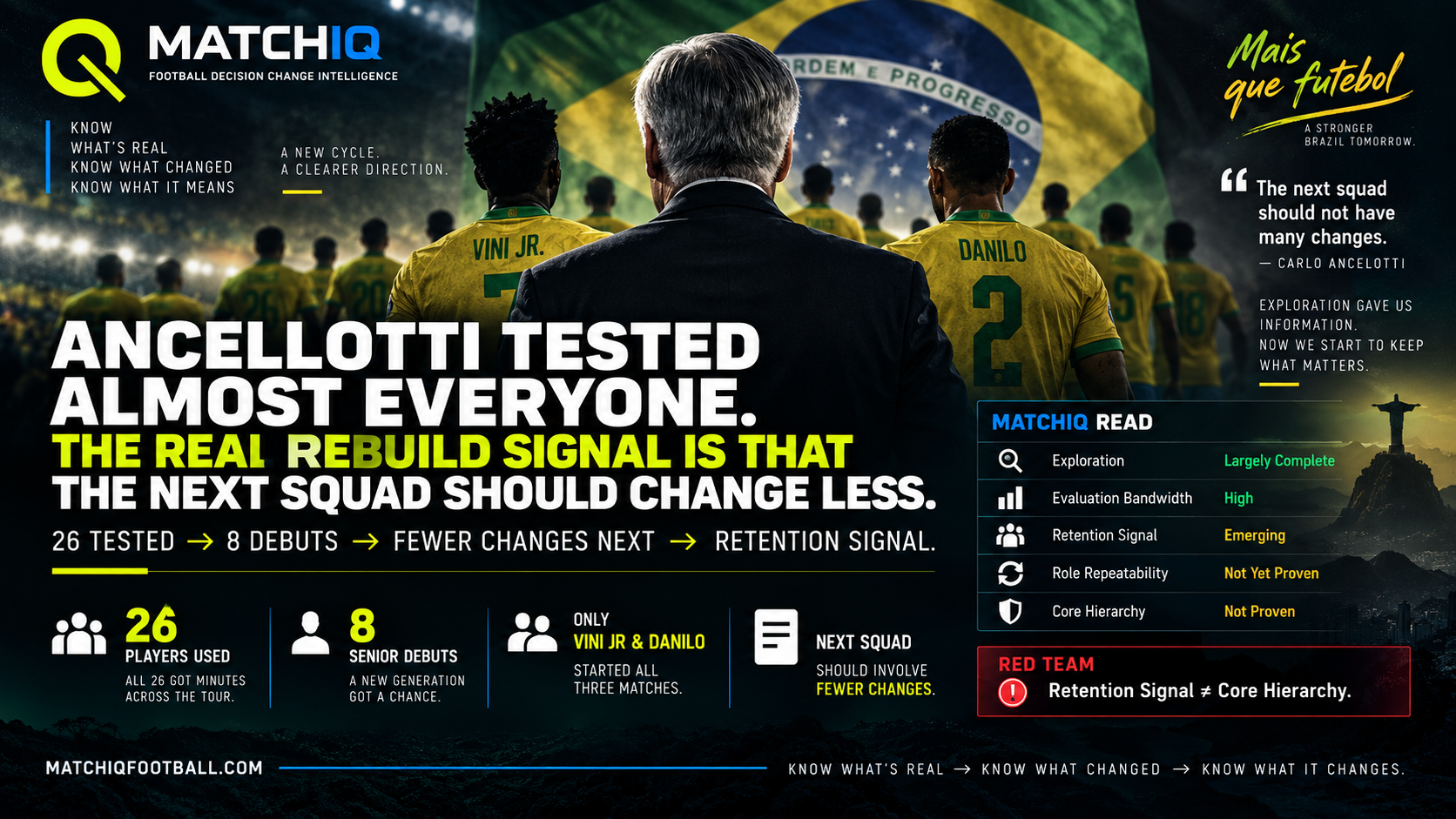
Brazil used 26 players.
All 26 got minutes.
Eight made their senior international debuts.
The starting XI changed repeatedly.
Only Vinícius Jr and Danilo started all three matches.
The obvious conclusion is:
Brazil are still experimenting.
Yes.
But that is no longer the most interesting part.
Because Carlo Ancelotti has now said something more important.
The next Brazil squad should change less.
That changes the question.
The first post-World Cup tour was about exploration.
The next one begins to become about retention.
And that is where rebuilds start becoming real.
Testing Everyone Is Easy To Romanticise
New cycle.
New generation.
Fresh faces.
Everyone gets a chance.
That sounds progressive.
But experimentation is only valuable if it eventually produces fewer questions.
Otherwise it becomes activity without direction.
Ancelotti’s first post-World Cup squad contained 26 players.
Eight had never previously been called into the senior national team.
Brazil deliberately used this period to widen the evaluation pool.
That was the point.
Ancelotti had already said the priority was building a new generation for the next Copa América and World Cup cycle.
He also made clear that this was not about putting young players through one decisive exam.
It was about observing them.
Understanding them.
Seeing what they could provide.
That distinction matters.
The first phase was not:
Who has already earned the shirt?
It was:
Who deserves to stay in the conversation?
That Phase Now Looks Different
After three matches, Ancelotti has more information.
Brazil drew Australia 1–1.
Then beat Australia 4–2.
Then beat India 4–0.
Different opponents.
Different line-ups.
Different game states.
Different roles.
The important part is not simply that Brazil won twice.
It is that Ancelotti used almost the entire squad.
Every player entered the evidence pool.
Some got first starts.
Some debuted from the bench.
Some played multiple roles.
Some produced goals.
Some simply gave the coaching staff more information.
And now the coach says the next squad should not change very much.
That is the shift.
Exploration Only Matters If Retention Begins
This is the core idea.
A rebuild cannot stay in exploration forever.
At some point, the coach has to stop asking:
Who else should I try?
and start asking:
Who have I seen enough from to keep?
Those are very different stages.
Exploration expands uncertainty.
Retention reduces it.
The first phase is about possible answers.
The second is about preserving the answers that earned another look.
That is why the next Brazil squad matters more than another debut.
If Ancelotti keeps many of the same players, then the first tour did more than generate minutes.
It generated preference.
That is the beginning of hierarchy.
This Is Not Selection Convergence Yet
The language needs to stay disciplined.
Italy under Mancini are in a similar-looking but different phase.
Italy expanded a 34-player pool and are still collecting evidence before contraction.
Brazil’s signal is different.
Brazil have already run a full tour where all 26 players were used.
Now Ancelotti is publicly saying the next squad will likely change less.
That does not mean the squad is fixed.
It does not mean the hierarchy is complete.
It means the process is moving from:
Who can enter?
toward:
Who stays?
That is Retention.
Not Convergence.
Not yet.
The Next Squad Is More Important Than The Last Result
Brazil beat India 4–0.
That result looks strong.
But India are not the opponent that defines this rebuild.
The real information comes from what Ancelotti does after the tour.
Who survives?
Who disappears?
Who keeps the same role?
Who gets promoted from experiment to repeat option?
That tells us more about the rebuild than another comfortable friendly scoreline.
A 4–0 win can tell you who performed.
A repeat call-up tells you who mattered.
That distinction is important.
Vinícius Jr And Danilo Were The Only Repeated Starters
Only Vinícius Jr and Danilo started all three matches. Reuters
That sounds like a core.
But Red Team says:
Stop.
Three friendlies are not enough to declare a permanent axis.
Vinícius is obviously already a major national-team reference.
Danilo’s repeated use is meaningful.
But repeated starts during an experimental tour do not automatically equal long-term ownership.
What they do tell us is:
Ancelotti needed at least some continuity while everything else moved.
That is useful.
Even an exploration phase needs anchors.
The next squad will tell us whether those anchors remain.
Brazil Were Not Only Testing Players
They were also testing structures.
Against Australia, Brazil changed personnel significantly.
Ancelotti changed the defensive line.
He changed the midfield mix.
He tested different attacking combinations.
He also spoke openly about trying different systems, including versions with three midfielders and more attacking players. CNN Brasil
So the evaluation was not simply:
Player A good, Player B bad.
It was also:
What happens when this player receives a different role?
What happens when the midfield structure changes?
Who survives when the game becomes more physical?
Who improves when the shape changes?
Who becomes less useful?
That is why retention matters more than raw minutes.
Minutes tell you who was tested.
Retention tells you which tests produced enough evidence to continue.
Eight Debuts Do Not Mean Eight Successes
This is another important boundary.
Brazil had eight first-time senior call-ups in the squad, and all eight entered the evaluation environment. CBF
That does not mean all eight passed.
A debut is access.
Not validation.
One good friendly is evidence.
Not ownership.
A player scoring is useful.
It does not guarantee retention.
That is exactly why the November list will be more valuable.
If Ancelotti keeps the same young players, their signal strengthens.
If several disappear, then the October tour was truly exploratory.
If one or two become repeat starters, hierarchy starts forming.
This is where the rebuild becomes measurable.
Samuel Lino And Vanderson Showed The Upside Of Exploration
Vanderson and Samuel Lino scored their first senior international goals on the tour, with Lino scoring twice against India. Reuters
Those are positive receipts.
But MATCHIQ should not stop at the goal.
The better question is:
Did the goal change retention probability?
That is the next layer.
If Lino is called again, receives the same attacking responsibilities and continues to enter meaningful minutes, then the October output starts converting into role evidence.
If not, the goal remains a milestone inside an experimental window.
The same applies to every debutant.
Milestone.
Then retention.
Then role.
Then hierarchy.
That is the order.
Nearly Two-Thirds Of The World Cup Squad Were Missing
This matters a lot.
Brazil’s tour was not simply the normal team plus a few prospects.
Nearly two-thirds of the World Cup squad were absent. Reuters
That gave Ancelotti enormous evaluation space.
But it also creates a limit.
When senior World Cup players return, competition changes.
A player can look useful in an experimental squad and still disappear once established names come back.
So the next list is not only about retaining the October group.
It is about integrating October evidence with returning hierarchy.
That makes November much more important.
Who gets kept when the old names re-enter?
That is real selection pressure.
Retention Is More Valuable Than Debut Volume
There is a trap in youth-heavy rebuilds.
Debut counts feel like progress.
Eight new players.
Ten new players.
Another young squad.
Another “new generation”.
But debut volume can become theatre.
If nobody returns, nothing was built.
If roles never repeat, nothing was learned.
If every window introduces another group, the coach is still searching.
So the better rebuild metric is not:
How many debuted?
It is:
How many earned another decision?
That is Retention.
This Is Where Ancelotti’s Quote Matters
Ancelotti said the tour helped him know the players better.
More importantly, he indicated that the November squad would likely involve far fewer changes. Reuters
That is the strongest signal in the whole tour.
Because it implies the evaluation phase has produced enough information to reduce variation.
Not eliminate it.
Reduce it.
And reduction is what makes rebuilding measurable.
Exploration without reduction is just churn.
There Is A Strong Counter-Case
Maybe “fewer changes” does not mean stronger clarity.
Maybe it simply means Ancelotti wants more repetition with the same group because the sample is still too small.
That is possible.
And Brazil’s opponents matter.
Australia gave real physical resistance.
India gave Brazil far more space and a weaker competitive environment.
So retention based on these games could still overrate certain performances.
That is why we should not jump to:
Core hierarchy established.
The correct claim is narrower:
Retention Signal — Emerging.
The next squad will validate whether that signal is real.
Another Counter-Case: The Missing Senior Players
The returning World Cup names complicate everything.
If nearly two-thirds of that squad were absent, then the October group were not competing in the final environment.
When more established players return, some apparent winners may lose space.
So even if Ancelotti keeps the squad relatively stable, the actual hierarchy may still move significantly.
Retention does not mean protection from competition.
It means the player has earned another look.
That is enough for now.
Brazil’s Rebuild Is Moving From Breadth To Memory
This is the deeper point.
The first tour created breadth.
More players seen.
More combinations tested.
More roles observed.
The second phase should create memory.
The same player.
The same role.
The same relationship.
Repeated again.
That is how an experiment becomes a pattern.
And patterns are what eventually become hierarchy.
MATCHIQ Decision Change
Before this tour, Brazil’s question was:
Who should be part of the next generation?
The answer required breadth.
So Ancelotti expanded the sample.
26 players.
Eight debuts.
Everyone used.
Constant rotation.
Now the question changes.
After seeing everyone, he says the next list should move less.
So the question becomes:
Who has earned retention?
That is a more advanced rebuild stage.
Previous State
Brazil had just exited the World Cup in the round of 16.
Ancelotti began a new cycle with heavy turnover and a clear priority: evaluate a new generation for the next Copa América and World Cup.
New Evidence
Brazil selected 26 players for the first post-World Cup tour.
All 26 received minutes.
Eight made their senior international debuts.
Brazil drew once and won twice.
Only Vinícius Jr and Danilo started all three matches.
Nearly two-thirds of the World Cup squad were absent.
Ancelotti said the tour had given him greater clarity and that the November squad should involve fewer changes. Reuters
What Changed
The rebuild is beginning to move from:
Exploration
toward:
Retention.
The key question is no longer:
Who else should Brazil test?
It is:
Who has earned another cycle?
MATCHIQ Read
Exploration — Largely Complete
Evaluation Bandwidth — High
Debut Exposure — Confirmed
Retention Signal — Emerging
Role Repeatability — Not Yet Proven
Core Hierarchy — Not Proven
Confidence
High that the exploration phase was deliberate.
Ancelotti explicitly framed the tour as evaluation and used all 26 players.
Medium-High that retention is becoming the next phase.
His own comments about fewer November changes strongly support that.
Low-Medium on core hierarchy.
The missing World Cup players and friendly context keep that unresolved.
Counter-Case
Friendly rotation can create false confidence.
India were a much weaker opponent.
Many established Brazil players were absent.
And “fewer changes” may simply mean Ancelotti wants more repetition before making harder decisions.
So:
Retention Signal ≠ Core Hierarchy.
Not yet.
Next Watch
November.
Brazil vs Japan.
Brazil vs Singapore.
Do not count new debuts.
Count repeat selections.
Which October players stay?
Which disappear?
Which players keep the same role?
Do Vinícius Jr and Danilo remain the continuity points?
Do midfield and defensive partnerships begin repeating?
Does Ancelotti actually reduce rotation?
That is the receipt.
Future Receipt
Current claim:
Ancelotti used Brazil’s first post-World Cup tour to maximise exploration, and the next phase is beginning to shift toward retention.
What strengthens it:
The November squad keeps most of the October group, repeats roles and reduces unnecessary experimentation.
What weakens it:
Another heavily altered list appears with little positional or relational continuity.
What changes the read completely:
A smaller group begins repeatedly receiving the same responsibilities across multiple windows while returning senior players are integrated around them.
At that point, the story stops being:
Exploration → Retention.
It becomes:
Retention → Hierarchy.
Status:
Exploration — Largely Complete
Retention — Emerging
Hierarchy — Pending