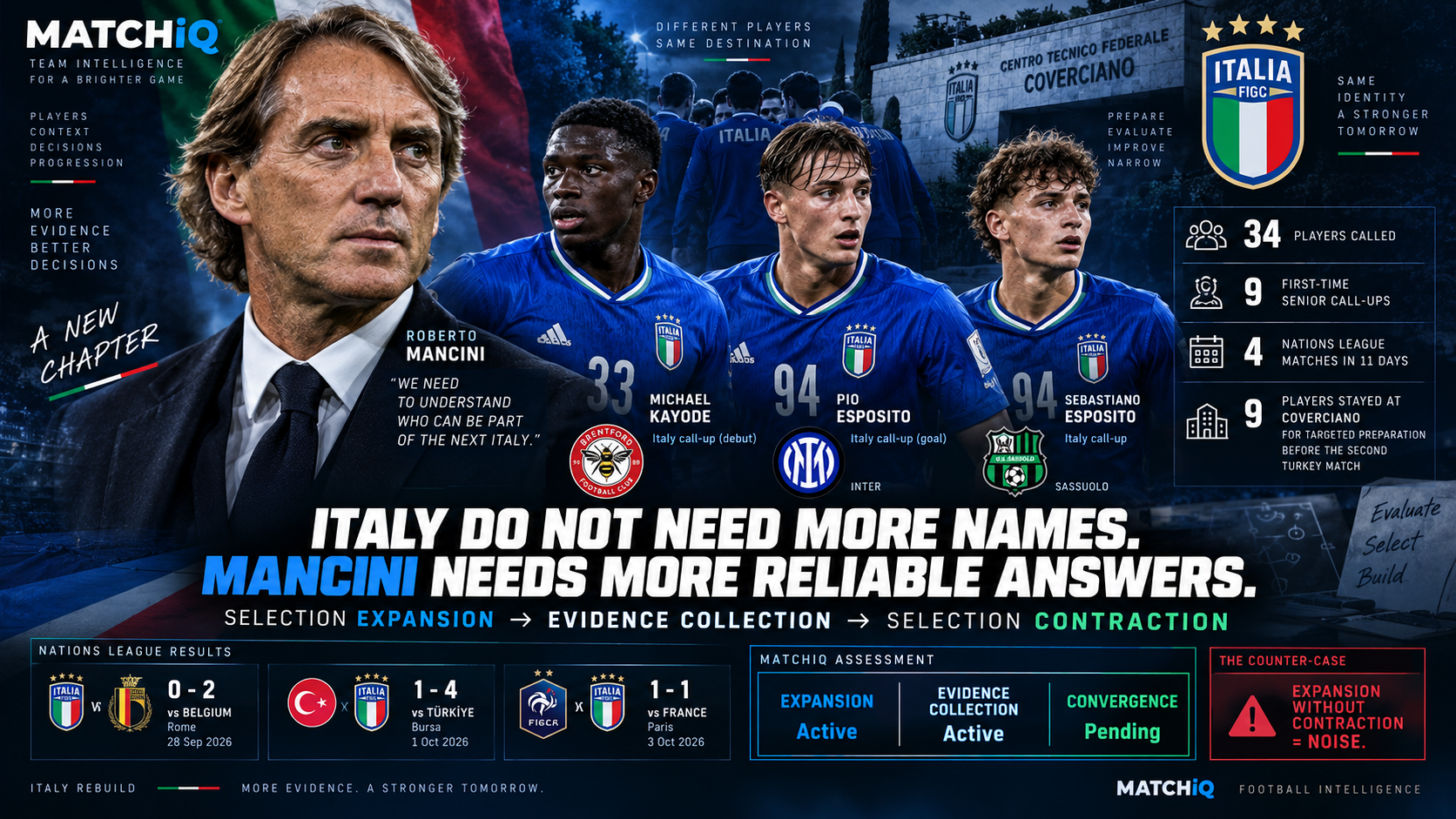
Thirty-four players.
Nine first-time call-ups.
Four Nations League matches in eleven days.
The easiest conclusion is obvious:
Italy do not know who their best players are.
Maybe.
But that is not the most useful read.
Roberto Mancini may be doing something much more deliberate.
He is not trying to lock Italy’s best XI immediately.
He is increasing the amount of evidence available before he starts eliminating options.
That is a different process.
And after another failed World Cup qualification, it may be exactly the process Italy need.
Expand first. Narrow later.
That is the Decision Change.
A 34-Man Squad Is Only Useful If It Produces Better Decisions
Big squads are easy to romanticise.
Fresh start.
New faces.
Competition.
Everyone gets a chance.
But none of those things automatically make a national team better.
Italy’s first squad of Mancini’s second spell contained 34 players.
Nine had never previously been called into the senior national team.
Massimo Pessina.
Daniele Ghilardi.
Michael Kayode.
Eddy Kouadio.
Alessandro Romano.
Issa Doumbia.
Sebastiano Esposito.
Antonio Vergara.
Mohamed Alì Zoma.
That is not a minor refresh.
It is an evaluation exercise.
The important question is not:
How many players did Mancini call?
It is:
How much useful information can he extract before the squad gets smaller again?
Because expansion without eventual contraction is not rebuilding.
It is noise.
Italy Do Not Need More Names
This is where the rebuild can be misunderstood.
Italy are not short of professional footballers.
They are not short of players from major leagues.
They are not short of technically interesting prospects.
The problem is harder.
They need to know which players can survive the specific responsibilities of the next Italy.
That means identifying:
Who can progress the ball under pressure?
Who protects transition space?
Who can defend large spaces?
Who can play inside a front three without needing the system redesigned?
Who remains useful when Italy are losing?
Who can enter a difficult away match and understand the role immediately?
Those answers do not come from reputation.
They come from exposure.
Mancini’s 34-player squad increases the number of players who can be tested against those questions.
That is the value.
Belgium Was The First Filter
Italy’s new cycle began badly.
Belgium won 2–0 in Rome.
The first half was especially uncomfortable.
Italy struggled.
Belgium found spaces.
Donnarumma had to keep the score under control.
Alessandro Romano started in midfield.
Pio Esposito led the line.
Later, Mancini introduced players including Issa Doumbia and Mohamed Alì Zoma.
The result was poor.
But for a rebuild, the result was not the only output.
Belgium gave Mancini a first batch of information.
Who could survive?
Who looked physically ready?
Who understood the speed?
Where did the structure break?
Which young players looked interesting when the game was already difficult?
That is what early-cycle matches are supposed to reveal.
The danger is judging every experiment only by whether the team won.
Italy lost.
But evaluation still happened.
Turkey Changed The Evidence
Three days later, Italy beat Türkiye 4–1.
Now the story could easily flip too far in the other direction.
The rebuild works.
Again, too fast.
But the match did provide something Mancini needed:
positive evidence from new and developing players.
Michael Kayode scored on his senior debut.
Pio Esposito also scored.
Italy’s first-half performance was aggressive, clean and productive.
The difference from Belgium was obvious.
This matters because rebuilding is not only about discovering who fails.
It is about finding which behaviours survive repetition.
Against Türkiye, some of the experiments started producing usable answers. :chatgpt-content-reference{index=”1″}
France Raised The Test Again
Then came France.
Different opponent.
Different pressure.
Different game.
Italy drew 1–1.
That matters more than another comfortable performance against weaker opposition.
Because rebuild evidence becomes more valuable when the environment becomes harder.
A player looking good when Italy dominate tells you something.
A player surviving when France have more of the ball tells you something else.
Italy did not win.
But they stayed competitive.
That gives Mancini another kind of receipt.
Belgium exposed weakness.
Türkiye exposed upside.
France tested resilience.
Three matches.
Three different evidence environments.
That is much more useful than three identical wins.
The Split-Squad Decision Is The Bigger Clue
This is where the 34-player squad starts making more sense.
Before the France match, Mancini did not simply drag the entire squad through the same preparation cycle.
Nine players stayed at Coverciano instead of travelling to Paris.
They followed a specific programme ahead of the second match against Türkiye.
That matters.
Because this is not random rotation.
It is resource allocation.
Mancini is using the size of the squad to create parallel evaluation tracks.
One group prepares for France.
Another prepares specifically for Türkiye.
That gives the staff more controlled information.
It also gives more players a realistic chance to enter meaningful football rather than simply sitting on the bench waiting.
This is where squad expansion becomes an operational tool.
Not just a symbolic fresh start. :chatgpt-content-reference{index=”2″}
The Real Objective Is Not 34 Players
This is the part that matters most.
If Italy still have a 34-man uncertainty cloud six months from now, the experiment has failed.
The point of expanding the pool is not to keep expanding it.
The point is to narrow it intelligently.
A rebuild should look like this:
Selection Expansion
More players enter the evaluation pool.
↓
Evidence Collection
Different game states.
Different opponents.
Different responsibilities.
Different combinations.
↓
Selection Contraction
The weak evidence disappears.
The useful roles become clearer.
The squad becomes smaller.
The hierarchy becomes stronger.
That final step is essential.
Without contraction, expansion is just indecision.
This Is Where Mancini Will Actually Be Judged
Not on whether he called nine new players.
That is easy.
Not on whether one debutant scored.
That is useful, but still a moment.
Not even on whether Italy win tonight.
The harder question is:
Does Mancini become more certain after collecting more evidence?
Does the November squad get cleaner?
Do some players disappear?
Do others return because their role has become clear?
Do first-choice relationships begin to repeat?
Does Italy start distinguishing between:
interesting player,
useful player,
and essential player?
That is the real rebuild.
Good evaluation should create exclusion.
Eventually, somebody has to lose the competition.
There Is A Strong Counter-Case
A 34-player squad can also be a warning sign.
Maybe Mancini is not increasing evaluation bandwidth.
Maybe he simply does not know what he wants yet.
Those are not the same thing.
Large squads can produce bad information too.
Too many combinations.
Too little repetition.
Players receiving one game and disappearing.
Roles changing constantly.
No stable partnerships.
No hierarchy.
If that happens, Italy may accumulate appearances without accumulating knowledge.
That is the Red Team case.
And it is serious.
Because international football gives you very little training time.
If you test too many things simultaneously, you can create noise faster than you create evidence.
Expansion Has A Cost
Every new player creates another variable.
Change the right-back.
Change the No.6.
Change the winger.
Change the striker.
Now when the team improves or declines, what caused it?
One player?
The combination?
The opponent?
The tactical instruction?
The game state?
The more variables you change, the harder causality becomes.
That is why Mancini eventually has to stop expanding.
At some point, Italy need repetition.
The same midfield.
The same build-up rules.
The same pressing relationships.
The same attacking connections.
Otherwise the evaluation never reaches convergence.
The 4–1 Turkey Win Must Not Become A Shortcut
This is another risk.
A big win creates emotional certainty.
Kayode scores.
Pio Esposito scores.
Italy look fluid.
Everyone wants the new players to become the answer immediately.
That would defeat the purpose of the process.
One good performance should increase probability.
Not end evaluation.
Kayode scoring on debut is evidence.
It is not ownership.
One attacking performance from Pio Esposito is evidence.
It is not automatic first-choice status.
A rebuild becomes dangerous when milestones get mistaken for conclusions.
The whole point of a wide evaluation pool is to stop that from happening.
The Second Turkey Match Is A Better Test Than It Looks
Italy face Türkiye again in Bologna.
Same opponent.
Different context.
That is useful.
Because now Mancini can test repetition.
The first match already supplied information.
The second asks:
Can the same advantages be reproduced?
And because nine players stayed behind at Coverciano for specific preparation, another layer appears:
Does targeted preparation create better evidence than simple rotation?
Watch who starts.
Watch who gets meaningful minutes.
Watch whether the players who were protected from the France trip actually gain responsibility.
Watch whether Kayode’s first performance turns into repeat trust.
Watch whether the attacking structure that produced four goals survives.
That tells us much more than another list of debuts.
Mancini Is Not Building An XI Yet
This is the biggest conceptual shift.
Fans naturally want a best XI.
Goalkeeper.
Back four.
Midfield three.
Front three.
Done.
But Italy are too early in this cycle for that to be the most important output.
Mancini first needs something else:
a reliable decision pool.
Players whose strengths are known.
Weaknesses understood.
Roles identifiable.
Game-state value documented.
Only then does narrowing become intelligent.
Otherwise the “best XI” is simply the eleven names with the strongest reputation.
Italy have already tried living on reputation.
It was not enough.
MATCHIQ Decision Change
Before this window, the obvious Italy question was:
Who should Mancini build around?
The 34-man squad changes that.
Mancini is not answering the final selection question yet.
He is expanding the evidence base from which that answer will eventually come.
Belgium gave negative evidence.
Türkiye gave positive evidence.
France gave resilience evidence.
The split training groups are giving targeted preparation evidence.
The next step is no longer:
Call more players.
It is:
Start converting observations into exclusions.
That is where the rebuild becomes real.
Previous State
Italy had failed to qualify for another World Cup.
The senior hierarchy required reassessment.
Mancini returned without a settled post-World Cup core.
New Evidence
A 34-player first squad.
Nine first-time senior call-ups.
Four matches in eleven days.
Italy lost 0–2 to Belgium.
Beat Türkiye 4–1 with debutant Michael Kayode among the scorers.
Drew 1–1 away to France.
Before the France trip, nine players remained at Coverciano on a specific programme ahead of the second Türkiye match.
What Changed
The immediate priority is not identifying Italy’s permanent best XI.
It is increasing evaluation bandwidth.
The question moves from:
Who are Italy’s best players?
to:
Which players generate enough reliable evidence to survive the next selection cut?
MATCHIQ Read
Selection Expansion — Confirmed
Evidence Collection — Active
New-Player Exposure — High
Role Clarity — Developing
Selection Convergence — Not Yet Proven
Permanent Hierarchy — Unresolved
Confidence
High that Mancini is deliberately expanding the evaluation pool.
The 34-player squad and split preparation groups make that clear.
Medium on whether the process will produce useful convergence.
That still needs proof.
Counter-Case
Italy may simply be testing too many players too quickly.
If combinations keep changing and the November squad remains equally broad, expansion may be producing noise rather than clarity.
A rebuild only becomes intelligent when evidence starts removing options.
Next Watch
First:
Italy vs Türkiye.
Which of the nine players retained at Coverciano now receive real responsibility?
Which experiments repeat?
Which disappear?
Then November.
That is the bigger receipt.
Does the 34-player pool contract?
Do the same midfield and defensive partnerships begin returning?
Do Mancini’s choices start becoming easier to predict?
Do some debutants become repeat selections?
Do others disappear?
That is where evaluation turns into hierarchy.
Future Receipt
Current claim:
Mancini’s 34-player Italy squad is best understood as deliberate selection expansion designed to increase evidence before narrowing the team.
What strengthens it:
The squad begins contracting in November, successful roles repeat, and players with weak evidence are removed.
What weakens it:
Italy continue cycling through large numbers of players without stable partnerships, role clarity or a narrowing hierarchy.
What changes the read completely:
A clear core begins emerging from the expanded pool while tactical behaviours remain stable around it.
At that point, we stop tracking:
Selection Expansion.
We start tracking:
Selection Convergence.
Status:
Expansion — Active.
Evidence Collection — Active.
Convergence — Pending.