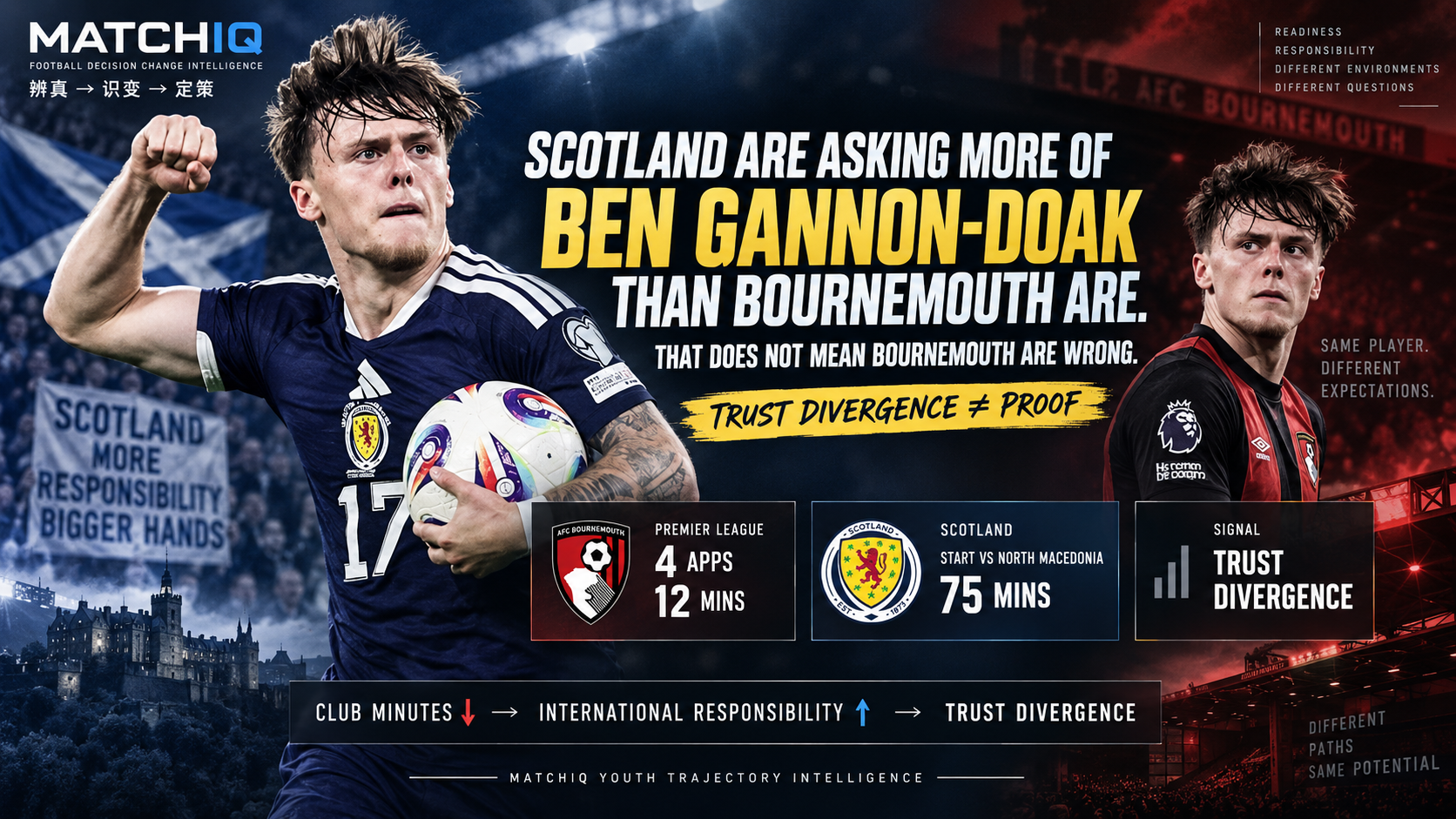
Ben Gannon-Doak has played 12 minutes of Premier League football this season.
For Scotland, he has just started a Nations League match and played 75.
Same player.
Same month.
Very different levels of responsibility.
The easy conclusion is obvious:
Scotland trust him. Bournemouth do not.
Too simple.
The more interesting question is why two environments can look at the same 20-year-old winger and arrive at such different decisions.
Because that gap may tell us more about Gannon-Doak’s development than either selection does on its own.
This is not evidence that Scotland are right.
It is not evidence that Bournemouth are wrong.
The divergence itself is the signal.
Bournemouth Are Barely Using Him In The Premier League
Start with the club evidence.
Gannon-Doak has made four Premier League appearances for Bournemouth this season.
All four have come from the bench.
Total minutes: 12.
That is not a rotation role.
It is barely even an established substitute role.
But this is where the evidence needs discipline.
Bournemouth have not completely frozen him out.
He started their League Cup win over Lincoln City, playing 77 minutes and recording an assist. He also received 20 minutes in the Europa League against Real Sociedad.
So the correct statement is not:
Bournemouth do not trust Gannon-Doak.
It is:
Bournemouth have not yet trusted Gannon-Doak with meaningful Premier League responsibility.
That distinction matters.
Cup minutes tell us the player remains inside the developmental plan.
League minutes tell us where he currently sits when Bournemouth are making their most expensive selection decisions.
Right now, that position is low.
Scotland See Something Different
Now look at the international evidence.
This is not Scotland giving a teenager a ceremonial five-minute cameo.
Gannon-Doak already has 18 senior caps and 965 international minutes.
He started Scotland’s decisive World Cup qualifier against Denmark.
He started against Curaçao before the World Cup.
He started Scotland’s World Cup group match against Brazil.
And now, under a different Scotland manager, he has started again.
That matters.
Because repeated trust is stronger than one selection.
Against North Macedonia, Sébastien Pocognoli brought Gannon-Doak into the starting XI as Scotland chased their first victory under the new coach.
Scotland won 2–0.
Gannon-Doak was not a passenger.
He should have scored from Kieron Bowie’s cutback in the first half.
Early in the second half he drove into the box and initially won a penalty before VAR overturned the decision.
He then attacked again and forced goalkeeper Stole Dimitrievski into a save.
He stayed on until the 75th minute.
That does not mean he dominated the game.
It means Scotland gave him responsibility.
There is a difference.
The Question Is No Longer Whether He Can Play Senior Football
This is where youth coverage often becomes stale.
Gannon-Doak is still 20, so the language stays frozen:
prospect.
youngster.
talent.
potential.
But senior football has already moved beyond that question.
He has 18 Scotland caps.
He played at a World Cup.
Bournemouth paid £20 million to sign him in 2025.
Nobody seriously needs another article asking:
Is Ben Gannon-Doak talented?
That question has expired.
The next question is:
Which environment is currently capable of giving that talent a repeatable function?
Scotland appear to have a clearer answer than Bournemouth.
At least for now.
International Football Can Make A Player Look More Ready Than Club Football
This needs a counterargument immediately.
International trust and club trust are not directly comparable.
Scotland can build specific game plans around a smaller player pool.
A national team may urgently need one particular attribute.
Club football is different.
Bournemouth train together every week.
They have more tactical detail.
More competition for places.
More combinations to maintain.
More matches.
More information about the player.
And Premier League mistakes are expensive.
So it is entirely possible for Scotland to decide:
“We need Gannon-Doak’s directness here.”
while Bournemouth simultaneously decide:
“He is not yet our best solution for this league match.”
Both decisions can be correct.
That is the point.
Youth trajectory should not be judged by one universal ladder.
The same player can be ready for one responsibility and unready for another.
Scotland Are Giving Him A Function
This is what makes the North Macedonia match useful.
Scotland did not simply put Gannon-Doak on the pitch because he is young.
They gave him attacking responsibility.
His game repeatedly involved direct actions toward the opposition box.
He arrived for a chance from Bowie’s cutback.
He attacked the penalty area aggressively enough to force the referee into an initial penalty decision.
He drove at the defence again after the VAR reversal and produced another shot.
The output was imperfect.
One big chance went over.
The penalty disappeared after review.
The shot was saved.
But Youth Trajectory Intelligence should not only record outcomes.
It should record responsibility.
Scotland were asking him to affect the game.
That is more important than whether one action became a goal or assist.
Bournemouth Are Still Asking A Different Question
At Bournemouth, the evidence suggests a different stage.
The club clearly still see enough value to use him in cup and European situations.
But four Premier League cameos totalling 12 minutes tells us something.
Their question does not yet appear to be:
How much can we build around Gannon-Doak?
It is closer to:
When is he ready to earn more league responsibility?
Those are different developmental questions.
And this is where the gap becomes useful.
Scotland are testing output.
Bournemouth are still testing readiness.
One environment is asking:
Can you help us win this game?
The other is still deciding:
When should we trust you with more of ours?
That difference should be tracked.
Not dramatized.
The Dangerous Conclusion Is That Bournemouth Must Be Wrong
This is where the story can go bad quickly.
A player starts for his country.
Barely plays for his club.
So fans conclude the club manager is blind.
Football does not work like that.
Bournemouth see him every day.
They see the training sessions.
The positioning errors.
The pressing detail.
The defensive recovery.
The decision-making after possession is lost.
The combinations that never appear in a highlight reel.
Scotland see a different problem.
They may care less about some weaknesses because the function they need is narrower.
Gannon-Doak’s ability to carry the ball, attack defenders and accelerate transitions may solve a very specific international problem.
That does not mean Bournemouth should automatically give him 70 Premier League minutes next week.
Different environments price the same strengths and weaknesses differently.
That is the more useful interpretation.
But Bournemouth Cannot Ignore The Scotland Evidence Either
The counter-case works both ways.
Club football contains more information.
True.
But repeated international responsibility is still information.
Gannon-Doak has not merely impressed in youth football.
He has now accumulated 18 senior Scotland appearances.
He has started World Cup-level opposition.
He has survived senior international game states.
And a new national-team manager has immediately found a reason to start him.
At some point, club evaluation has to account for that.
Not because international selection proves he should start for Bournemouth.
It does not.
But because repeated external trust raises the cost of treating him like an unknown quantity.
The evidence base is changing.
This Is A Better Youth Trajectory Question
The lazy version is:
Why doesn’t Bournemouth play Ben Gannon-Doak?
The equally lazy opposite version is:
Scotland are overrating him.
Neither tells us much.
The better question is:
Why is his responsibility progressing faster internationally than domestically?
Now we have something worth tracking.
Maybe Scotland’s player pool makes the pathway easier.
Maybe his specific profile solves a national-team problem Bournemouth do not have.
Maybe Bournemouth’s league environment exposes weaknesses Scotland can protect.
Maybe his club minutes are simply lagging behind his actual readiness.
All four are plausible.
The next few months should separate them.
MATCHIQ Decision Change
Before this window, Gannon-Doak’s lack of Premier League minutes could easily be read as a simple readiness signal.
Twelve league minutes. Four substitute appearances. Not trusted yet.
That reading is now too crude.
Scotland are providing a competing data point.
They are not treating him as a player who needs to be protected from senior responsibility.
They are starting him.
They are asking him to attack games.
They have already used him at World Cup level.
So his Bournemouth minutes can no longer be read in isolation.
That is the change.
The question moves from:
Why isn’t he playing more?
to:
Why do Scotland and Bournemouth currently value his readiness differently?
That is a much better problem.
Previous State
Gannon-Doak was receiving extremely limited Premier League minutes at Bournemouth.
The simplest read was that his league role remained developmental.
New Evidence
Scotland started him against North Macedonia.
He played 75 minutes in a 2–0 win.
He generated attacking involvement, including a missed chance, an overturned penalty decision and a shot saved after driving into the area.
This sits on top of an existing senior Scotland record of 18 caps and 965 minutes, including a World Cup start against Brazil.
What Changed
Club minutes are no longer enough to describe his readiness.
There is now a clear responsibility gap between his club and national-team environments.
That gap requires explanation.
MATCHIQ Read
Bournemouth Premier League Trust: Low.
Bournemouth Developmental Trust: Present.
Scotland Selection Trust: High.
Scotland Functional Trust: Increasing.
Role Ownership: Not yet established in either environment.
Counter-Case
Bournemouth have far more information about Gannon-Doak’s weekly performance than Scotland.
Their reluctance to give him Premier League minutes may be completely rational.
International football also allows narrower roles that can hide weaknesses a Premier League club cannot.
Therefore:
Scotland responsibility ≠ proof Bournemouth should start him.
Confidence
Medium-High that the trust gap is real.
Low confidence on which environment is “right”.
That question is not answerable yet.
Next Watch
Do not just count Bournemouth appearances.
Watch the type of minutes.
Does he begin entering Premier League matches when the score is still live?
Does he receive starts?
Does he get a repeatable tactical function?
For Scotland, the next test comes quickly against Slovenia.
Does Pocognoli start him again?
If not, does he still turn to Gannon-Doak when Scotland need direct attacking threat?
That will tell us whether North Macedonia was a one-game solution or the beginning of a real role.
Future Receipt
Current claim:
Ben Gannon-Doak’s international responsibility is currently progressing faster than his Premier League role.
What strengthens it:
Continued Scotland starts or meaningful high-leverage minutes while Bournemouth continue restricting him to short league cameos.
What weakens it:
Bournemouth begin giving him sustained Premier League responsibility, closing the gap between the two environments.
What would change the entire read:
Gannon-Doak starts owning the same repeatable function for both club and country.
At that point, the story stops being about divergent trust.
It becomes about role ownership.
Status:
Trust Divergence — Confirmed.
Cause — Unproven.
Trajectory — Developing.