STATUS: PATHWAY CONTINUITY UNDER TEST
CONFIDENCE: MEDIUM
LAST VERIFIED: 4 Oct 2026
NEXT WATCH: Northern Ireland: can pathway continuity begin producing senior output?
Georgia changed their national-team coach after losing 1–0 to Northern Ireland.
But they did not choose a reset.
Willy Sagnol left after more than five years in charge. His legacy is substantial: Georgia reached their first major tournament under him at EURO 2024 and progressed to the round of 16. But the results that followed deteriorated badly, including five defeats in six 2026 World Cup qualifiers. Reuters
Georgia then made a revealing choice.
They promoted Ramaz Svanadze.
Not an outsider.
Not a coach arriving with a completely different football language.
Svanadze had spent five years working with Georgia’s Under-21 team and received a contract through 2028. Reuters
That does not prove Georgia have found the right successor.
His first two senior matches have produced no goals: 0–0 against Ukraine and 0–1 away to Hungary. UEFA.com
But the appointment itself tells us something.
Georgia changed the coach.
They may be trying to preserve the pathway.
Sagnol changed what Georgia believed was possible
Any analysis of this transition has to start there.
Before Sagnol, Georgia had never reached a major senior international tournament.
Under him, they qualified for EURO 2024.
Then they went further.
They reached the knockout stage before losing to Spain in the round of 16. Reuters
That changed the national team’s baseline.
Georgia were no longer simply an interesting smaller nation with talented individuals.
They had evidence that their best generation could compete on a major stage.
That matters because replacing a coach after historic success creates a difficult decision.
Do you:
replace the whole direction?
Or:
preserve what worked and change the part that stopped working?
Georgia appear to have chosen the second option.
Svanadze is not a normal new coach
This is the key.
Svanadze already knew the Georgian player pipeline.
His Under-21 side produced one of the country’s strongest youth-tournament performances at the 2023 U21 EURO.
Georgia topped a group containing Portugal, Belgium and the Netherlands before reaching the quarter-finals. UEFA.com
The next U21 cycle also reached the play-offs in qualifying for the 2025 tournament. UEFA.com
That does not mean U21 success automatically transfers to senior international football.
It does mean Svanadze enters with something an external coach would have to build:
familiarity.
With players.
With development history.
With the federation.
With the football language younger Georgian internationals have already experienced.
That is why this appointment should not be read only as:
New coach.
It may be:
Same pathway, different level.
Coach succession and system reset are not the same thing
Football often treats managerial change as a total reset.
New coach.
New formation.
New hierarchy.
New principles.
New beginning.
But that is not always the smartest response.
If the underlying player-development pathway is working, changing everything can destroy useful continuity along with the problems.
Georgia’s choice suggests a different idea.
Keep the development language.
Promote someone who already understands it.
Then try to repair the senior-team output.
That is a more specific intervention.
The federation has effectively separated two questions:
Was Sagnol still the right senior coach?
and
Was Georgia’s wider football pathway wrong?
Their decision suggests the answer may have been:
No to the first.
Not necessarily to the second.
That distinction is important.
But continuity can become comfort
This is where the Red Team begins.
Internal promotion sounds coherent.
It does not automatically mean it is correct.
Familiarity has benefits.
It also has risks.
A coach who knows the same players, coaches and institutional ideas may preserve strengths.
He may also preserve blind spots.
And Georgia’s immediate senior problem is not subtle.
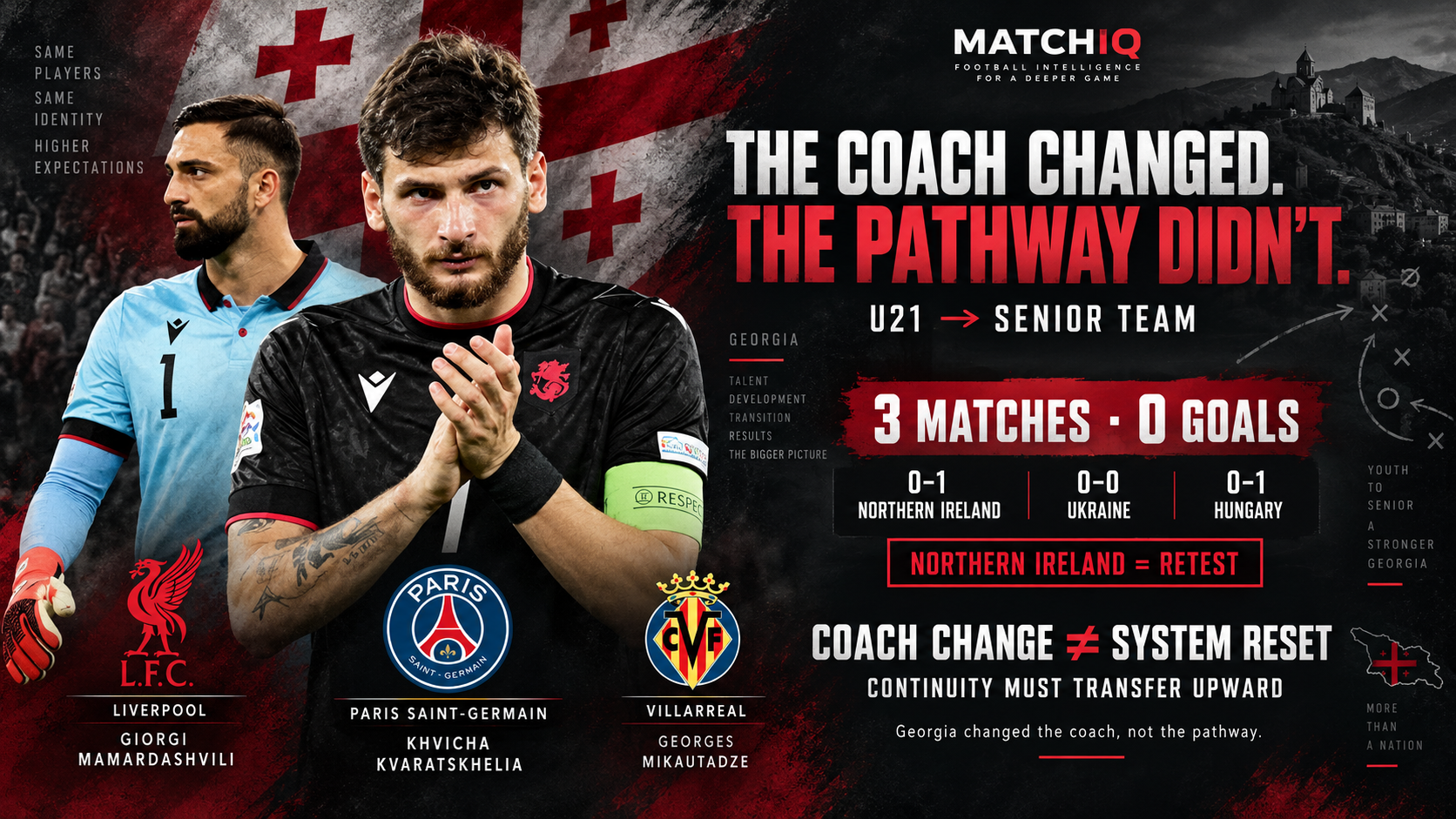
They have played three Nations League matches.
They have scored zero goals.
0–1 Northern Ireland.
0–0 Ukraine.
0–1 Hungary. UEFA.com
So the pathway may be continuous.
The attack currently is not productive.
That means Svanadze cannot succeed simply by making players feel familiar.
He has to turn familiarity into better senior-level behaviour.
The first two matches have not produced a “new-manager bounce”
That may actually help the analysis.
Georgia drew 0–0 with Ukraine in Svanadze’s first match.
Then lost 1–0 to Hungary. UEFA.com
No goals.
No dramatic reaction.
No easy narrative that the coaching change fixed everything.
That keeps the evidence clean.
Because the question now remains open:
What exactly is Svanadze supposed to transfer upward from the U21 level?
Player trust?
Combination patterns?
Pressing habits?
Positional familiarity?
Confidence in younger players?
All are possible.
But until those things improve senior-team output, they remain mechanisms rather than results.
Youth familiarity only matters if it survives senior-level pressure
This is probably the hardest part of the transition.
At U21 level, Svanadze could work with players through a development context.
Senior international football is different.
Opponents are stronger.
Margins are smaller.
Players arrive from different clubs with different tactical habits.
Training time is limited.
And the best Georgian players no longer need development treatment.
They need a structure that maximises their current elite qualities.
That means Svanadze cannot simply bring the U21 team upward.
He has to translate the ideas.
That is a very different job.
Kvaratskhelia and Mikautadze make this an attacking test
Georgia’s senior team already has high-level attacking talent.
So three matches without scoring cannot be explained only by lack of quality.
This creates a sharper question.
Can Svanadze build conditions that give the best attackers better problems to solve?
Not:
receive the ball and beat three defenders.
But:
receive in advantage.
Attack an already destabilised defence.
Find more runners around the box.
Have another option after the first action.
The senior-team challenge is not simply getting talented attackers onto the pitch.
It is reducing how much individual brilliance is required for every dangerous possession.
That is what the next match should reveal.
Northern Ireland gives Georgia an unusually useful comparison
Georgia’s first Nations League match ended in a 1–0 home defeat to Northern Ireland.
That was Sagnol’s final match.
Now, on 5 October, Svanadze takes Georgia to Belfast to face the same opponent. UEFA lists the match at Windsor Park. UEFA.com
This creates an excellent comparison.
Not a perfect experiment.
The venue changes.
Northern Ireland may change personnel.
Georgia may change personnel.
Game state will be different.
But the opponent remains the same.
And the coaching context has changed.
So the question becomes:
Same opponent. Different coach. Does the football change?
That is much more useful than simply asking whether Georgia win.
What should actually be watched?
1. Where does Kvaratskhelia receive?
If he constantly receives wide, static and surrounded, the structure is still asking too much of individual creation.
If he receives between lines, facing forward or after combinations have moved defenders, that is meaningful change.
2. Does Mikautadze receive support?
A striker can be isolated even when a team has possession.
Watch whether Georgia place players close enough to him for combinations and second actions.
If he remains the final destination of disconnected attacks, the coaching change has not solved much.
3. Are combinations faster because the relationships are familiar?
This is where Svanadze’s pathway knowledge should theoretically matter.
Players who know similar concepts should recognise each other’s movements faster.
If the ball still moves slowly and attacks remain individual, the continuity advantage is not transferring.
4. Does Georgia create central access?
Northern Ireland are increasingly comfortable protecting dangerous central spaces.
Georgia cannot simply circulate outside them and call it control.
The real test is whether Svanadze can create more access between midfield and the box.
5. Can Georgia finally turn possession into goals?
This is the simplest test.
Three Nations League games.
Zero goals. UEFA.com
Eventually, structural continuity has to produce output.
Northern Ireland also make the test harder
This is important.
Georgia are not facing a passive benchmark.
Northern Ireland have taken seven points from their opening three matches and have yet to concede. Their latest result was a 3–0 win over Ukraine. UEFA.com
So Georgia’s attacking problem will be tested against a team currently producing repeatable defensive behaviour.
That increases the value of the match.
A goal would matter.
Creating high-quality chances consistently would matter more.
The counter-case: maybe Georgia actually need a bigger reset
This possibility cannot be excluded.
Sagnol’s final period was poor.
The World Cup qualifying campaign deteriorated badly.
The Nations League started badly.
The first two Svanadze matches have not produced a goal.
So continuity may eventually prove too conservative.
Georgia may discover that preserving the same institutional language also preserves limitations that need to be broken.
That is the danger of internal succession.
Sometimes continuity protects identity.
Sometimes it protects inertia.
Right now, we do not know which one Georgia have chosen.
What changed?
Before Sagnol left, Georgia’s question was:
Can the coach who created the breakthrough restore the team?
That question is finished.
Now the question is:
Can the pathway that helped create this generation continue producing senior-level progress under a coach who knows it from inside?
That is a different decision problem.
It shifts attention from personality to infrastructure.
From:
Sagnol vs Svanadze
to:
Reset vs continuity
And that is a much more useful way to evaluate the appointment.
MATCHIQ Verdict
Georgia fired the coach who made history.
But they did not behave like a federation that wanted to erase the history.
They promoted the U21 coach who already understood the players and development pathway.
That is a clear strategic choice.
Coach change without pathway reset.
There is logic in it.
Svanadze’s U21 record gives the decision credibility: Georgia topped their 2023 U21 EURO group and reached the quarter-finals, then later reached the 2025 qualifying play-offs. UEFA.com
But senior football has already exposed the limitation.
Two games under Svanadze.
Zero goals.
The pathway may be familiar.
The senior attack is still unresolved. UEFA.com
So Northern Ireland is not testing whether Svanadze deserves the job after three matches.
It is testing something more useful:
Can internal continuity produce different senior-team behaviour?
If yes, Georgia may have protected one of their biggest advantages while changing the coach.
If not, the appointment risks becoming continuity without progress.
COACH CHANGE ≠ SYSTEM RESET.
CONTINUITY MUST TRANSFER UPWARD.
Know What’s Real. Know What Changed. Know What It Changes.
MATCHIQ Intelligence Record
Previous Structure
Willy Sagnol took Georgia to their first major tournament at EURO 2024 and into the round of 16, but results later deteriorated; Georgia lost five of six 2026 World Cup qualifiers before he was dismissed following the 1–0 Nations League defeat to Northern Ireland. Reuters
New Evidence
- Ramaz Svanadze was promoted after five years with Georgia U21 and signed through 2028. Reuters
- His Georgia U21 team topped their 2023 EURO group and reached the quarter-finals. UEFA.com
- Georgia also reached the play-offs in 2025 U21 EURO qualifying. UEFA.com
- Svanadze’s first two senior matches finished Georgia 0–0 Ukraine and Hungary 1–0 Georgia. UEFA.com
- Georgia have scored zero goals in three Nations League matches. UEFA.com
- Their next match is away to Northern Ireland, the same opponent that defeated Georgia in Sagnol’s final game. UEFA.com
Decision Change
Move from:
“Who replaces Sagnol?”
to:
“Can Georgia preserve the development pathway while improving senior-team output?”
Counter-case
Internal promotion may preserve familiarity without fixing senior-level weaknesses. Two Svanadze matches have produced no goals, so pathway continuity has not yet translated into attacking improvement.
Confidence
MEDIUM
The succession strategy is clear.
Its senior-level effectiveness is not.
Next Watch
Northern Ireland vs Georgia:
Kvaratskhelia receiving zones → Mikautadze support → central access → combination speed → chance quality → first goal under Svanadze
Key question:
Did Georgia change the coach — or actually change the senior-team behaviour?