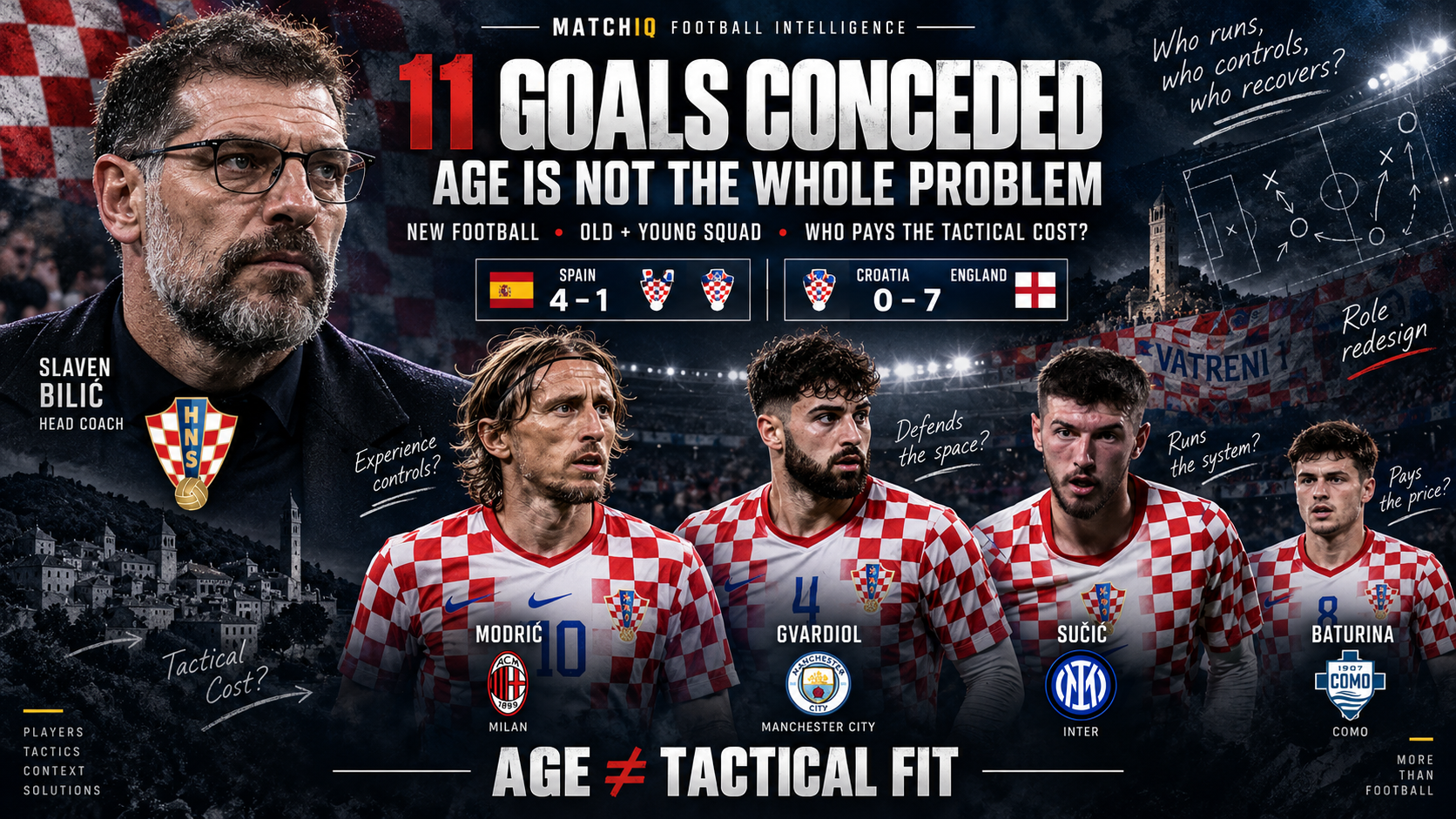
Croatia have conceded 11 goals in their last two matches.
Four against Spain.
Seven against England.
That is enough to make the easiest explanation irresistible:
Croatia are old.
Luka Modrić is 41.
Ivan Perišić is 37.
Mateo Kovačić is 32.
Andrej Kramarić and Ante Budimir are both 35.
The generation that carried Croatia through one of the greatest periods in their football history is clearly closer to the end than the beginning. UEFA’s current squad list confirms that unusually wide age spread. UEFA.com
But “they are old” is not yet a diagnosis.
Because Croatia were old before Slaven Bilić came back.
What changed more recently was the football.
And the more useful question is whether Bilić has increased the physical and structural cost of Croatia’s game faster than the squad architecture can absorb it.
Bilić did not return to preserve the old Croatia
Bilić returned for a second spell 14 years after leaving the national-team job.
His first match back ended in a 2–1 win away to Czechia, with Modrić scoring the first goal of the new era.
Then came a heavily rotated 4–1 defeat to Spain.
Then England arrived in Rijeka and won 7–0 — Croatia’s heaviest defeat. The Guardian
Those results matter.
But Bilić’s stated football matters more.
Under Zlatko Dalić, Croatia often embraced the underdog role.
Protect the game.
Control through midfield.
Wait.
Then attack the right moment.
Bilić wants something more aggressive.
The Guardian’s reporting before the England match described a clear shift: higher pressing, more risk, more players arriving in advanced areas and centre-backs stepping forward with possession instead of automatically waiting for Modrić or Kovačić to drop deep and organise progression. The Guardian
That is not a cosmetic change.
It changes what every player is being asked to pay physically and positionally.
A more aggressive idea creates a more expensive game
Every tactical idea has a cost.
If your defensive line moves higher:
you protect less space behind you.
If more players attack:
you leave fewer players protecting transitions.
If centre-backs step forward:
someone has to secure the space they vacate.
If the press goes higher:
the distances between lines must stay connected.
If the first press is beaten:
the recovery run becomes longer.
None of those are automatically bad decisions.
Modern elite teams live with those risks every week.
The issue is whether Croatia’s current personnel distribution is built to pay for them.
That is where the age question becomes useful.
Not:
Are Croatia too old?
But:
Who is being asked to run, recover and defend large spaces — and are those responsibilities allocated correctly?
That is a much better question.
Spain was the warning, but not the cleanest evidence
Spain beat Croatia 4–1 in Seville.
Lamine Yamal scored twice, while Spain repeatedly attacked Croatia around the box and regained control quickly after Croatia equalised. Reuters
But there is an important limitation.
Bilić rotated heavily for that game. The Guardian
So Spain cannot be treated as perfect evidence that Bilić’s main structure failed.
It showed vulnerability.
It did not isolate the cause.
Different personnel.
World champions as the opponent.
A coach still implementing new ideas.
That should keep confidence controlled.
England was different.
England exposed the cost more violently
England’s 7–0 was not simply clinical finishing.
Their high press and speed repeatedly overwhelmed Croatia’s defensive and midfield structure.
Harry Kane and Bukayo Saka scored twice each.
Jude Bellingham added a goal and three assists.
Anthony Gordon and Morgan Rogers also scored. Reuters described Croatia’s defence as ragged; the Guardian highlighted England’s pressure, mobility and ability to overwhelm Croatia’s midfield. Reuters
That matters because these are precisely the situations a more aggressive Croatia must be able to survive.
If you push higher and take more risks, there are two requirements:
the press has to work,
or
the recovery structure has to work.
If neither works consistently, the tactical idea becomes extremely expensive.
England did not just beat Croatia’s defenders.
They repeatedly created situations in which Croatia had to defend while moving backwards.
That is a completely different physical problem from defending a settled block.
Modrić being 41 is a fact.
Modrić being “the problem” is not.
This distinction has to be protected.
Modrić scored the first goal of Bilić’s second spell against Czechia.
Bilić publicly described him as central to the team after that match. The Guardian
And Croatia’s squad is not simply an old team.
Alongside Modrić, Perišić and Kovačić, it includes:
- Joško Gvardiol — 24
- Petar Sučić — 22
- Martin Baturina — 23
- Luka Vušković — 19
- Franjo Ivanović — 22
- Igor Matanović — 23
There is already a younger layer inside the squad. UEFA.com
So “replace the old players” is too crude.
Croatia’s real problem may be one of role architecture.
Who carries which burden?
Experience should not be asked to do the same job as youth
A veteran can remain elite without being the player you ask to cover the largest distances.
This is where Croatia’s transition becomes interesting.
Modrić can still:
control tempo,
find progression,
receive under pressure,
change the direction of possession,
and make high-level decisions.
What he should not necessarily be asked to do at 41 is solve every transition created by an aggressive pressing structure.
The same principle applies elsewhere.
Experience should be used where experience still creates an advantage.
Younger legs should absorb more of the running cost.
That suggests a different redesign.
Not:
Old players out. Young players in.
But:
Redistribute the expensive jobs.
Bilić may need to separate control from running
Croatia’s midfield identity has historically been built around intelligent control.
Bilić’s new game asks for more disruption.
Those ideas can coexist.
But only if the functions are distributed properly.
A younger midfielder such as Petar Sučić can carry more pressing and recovery responsibility.
Baturina can become more involved in progressive actions.
Gvardiol gives Croatia an athletic defender capable of defending larger spaces.
Vušković represents another younger defensive profile.
Meanwhile, Modrić and Kovačić do not have to disappear.
Their role can become more selective.
The objective should not be to make the old core imitate the younger core.
It should be to make the team use both generations for different problems.
That is squad architecture.
The danger is trying to modernise every player at once
New coaches often arrive with a clear football identity.
That can be positive.
But international football gives very little training time.
Bilić has inherited a squad shaped for years by different habits.
Then he has tried to increase:
pressing,
risk,
defensive line height,
centre-back progression,
and numbers arriving in attack.
That is a lot of behavioural change at once. The Guardian
The question is not whether those ideas are modern.
They are.
The question is whether they can become coordinated fast enough.
Because an aggressive press performed by eleven connected players is a defensive weapon.
An aggressive press performed by six players while five react late is an invitation.
The idea can be correct.
The timing can still be wrong.
Eleven conceded goals do not prove the philosophy has failed
This is the counter-case.
Spain are the reigning world champions.
England have just produced one of their strongest performances under Tuchel.
Croatia rotated heavily against Spain.
And once England established a large lead, game state increased the space and accelerated Croatia’s collapse. The Guardian
So:
11 goals conceded ≠ Bilić’s football is impossible.
That would be classic scoreboard analysis.
The sample is too small.
The opponents are too strong.
The conditions are too noisy.
But 11 goals can still tell us where to look.
And right now the pattern worth investigating is not simply age.
It is what happens when Croatia lose the ball while trying to play a more ambitious game.
The next Spain match is the perfect stress test
Croatia host Spain in Split on 6 October. UEFA.com
That is unusually useful.
Spain just exposed Croatia 4–1.
Now Bilić gets the same opponent again only a week later.
This makes the next match more valuable than another random fixture.
Not because Croatia must win.
Because we can compare behaviour.
1. Does the press become more selective?
Croatia do not need to press Spain everywhere.
Can they identify better triggers instead of constantly paying the physical cost?
2. Who protects the transition?
When centre-backs advance, who occupies the space behind the midfield?
This is one of the clearest structural questions.
3. Where does Modrić defend?
If Croatia reduce the space he must cover and preserve his value in possession, that would indicate role adaptation rather than abandonment.
4. Do the younger players carry more of the running burden?
Sučić, Baturina, Gvardiol and the younger defenders are not simply “the future”.
They may already be necessary for the present structure to work.
5. Does Croatia know when not to be aggressive?
This may be the biggest test.
Bravery is not pressing every moment.
Sometimes tactical maturity is knowing which risk not to take.
This is not really a rebuild-vs-veterans argument
Croatia have a common football problem.
A legendary generation is still useful.
A younger generation is already arriving.
A new coach has changed the intended style.
The difficult part is not choosing one generation.
It is connecting them.
That means the transition should be evaluated by function.
Who controls?
Who presses?
Who covers?
Who advances?
Who protects?
Who creates?
If Bilić can answer those questions clearly, the age profile becomes manageable.
If every player is asked to absorb the same new physical demands, the age profile becomes a weakness.
Age is not destiny.
Role design decides how expensive age becomes.
What changed?
Before Spain and England, Bilić’s return was primarily a philosophical story.
Croatia would become:
braver,
more aggressive,
more dominant,
less comfortable simply waiting for opponents.
After conceding 11 goals in two matches, the question has changed.
Not:
Is Bilić’s idea attractive?
But:
Can this squad execute it without exposing itself faster than it can create advantages?
That is the Decision Change.
The idea is no longer being judged in theory.
The structural cost is now visible.
MATCHIQ Verdict
Croatia conceded 11 goals in two matches.
The easiest conclusion is that the team is too old.
That conclusion is incomplete.
Croatia are not simply old.
They are transitional.
Veterans still carry major technical and leadership value.
Younger players already exist throughout the squad.
What changed most quickly was the football Bilić wants them to play.
Higher pressure.
More risk.
More players forward.
More aggressive progression.
That creates a higher tactical cost.
And right now, Croatia do not look fully organised around who should pay it.
So the answer is not necessarily:
replace Modrić.
It may be:
protect what Modrić still gives you and redistribute the running, pressing and recovery demands around him.
Bilić does not need to abandon the new Croatia.
He may need to slow down how many parts of it he asks the old and new Croatia to become at once.
Because the problem may not be that Croatia’s squad cannot change.
It may be that:
the football changed faster than the squad architecture did.
IDEA CHANGE → ROLE CHANGE → BEHAVIOUR CHANGE.
Know What’s Real. Know What Changed. Know What It Changes.
MATCHIQ Intelligence Record
Previous Context
Croatia’s 7–0 defeat was previously treated as an important counter-case when evaluating England: Croatia’s collapse amplified England’s result, so the score alone could not be treated as clean evidence of Tuchel’s system. The Croatia-side question is now why that collapse happened.
New Evidence
- Bilić returned for a second spell after 14 years away and opened with a 2–1 win over Czechia. The Guardian
- His stated direction is more aggressive: higher pressing, greater risk, more bodies forward and centre-backs stepping into possession. The Guardian
- Croatia then lost 4–1 to Spain. Reuters
- They followed it with a 7–0 defeat to England, their heaviest loss. Reuters
- Croatia’s current squad mixes a veteran core with a significant younger group, so age alone does not describe the whole squad structure. UEFA.com
Decision Change
Move from:
“Croatia are ageing.”
to:
“Is Croatia allocating the physical cost of Bilić’s new football to the right players?”
Counter-case
Two heavy defeats against Spain and England are not enough to prove the new approach is structurally wrong. Spain is elite, Croatia rotated heavily in Seville, and game state amplified the England defeat.
Confidence
MEDIUM
Enough evidence to identify a role-allocation problem worth testing.
Not enough evidence to conclude that Bilić’s philosophy cannot work with this squad.
Next Watch
Croatia vs Spain, 6 October:
pressing triggers → transition protection → Modrić defensive workload → younger-player running burden → centre-back aggression → behaviour after possession loss
The key question:
Can Bilić keep the ambition while reducing the tactical cost?