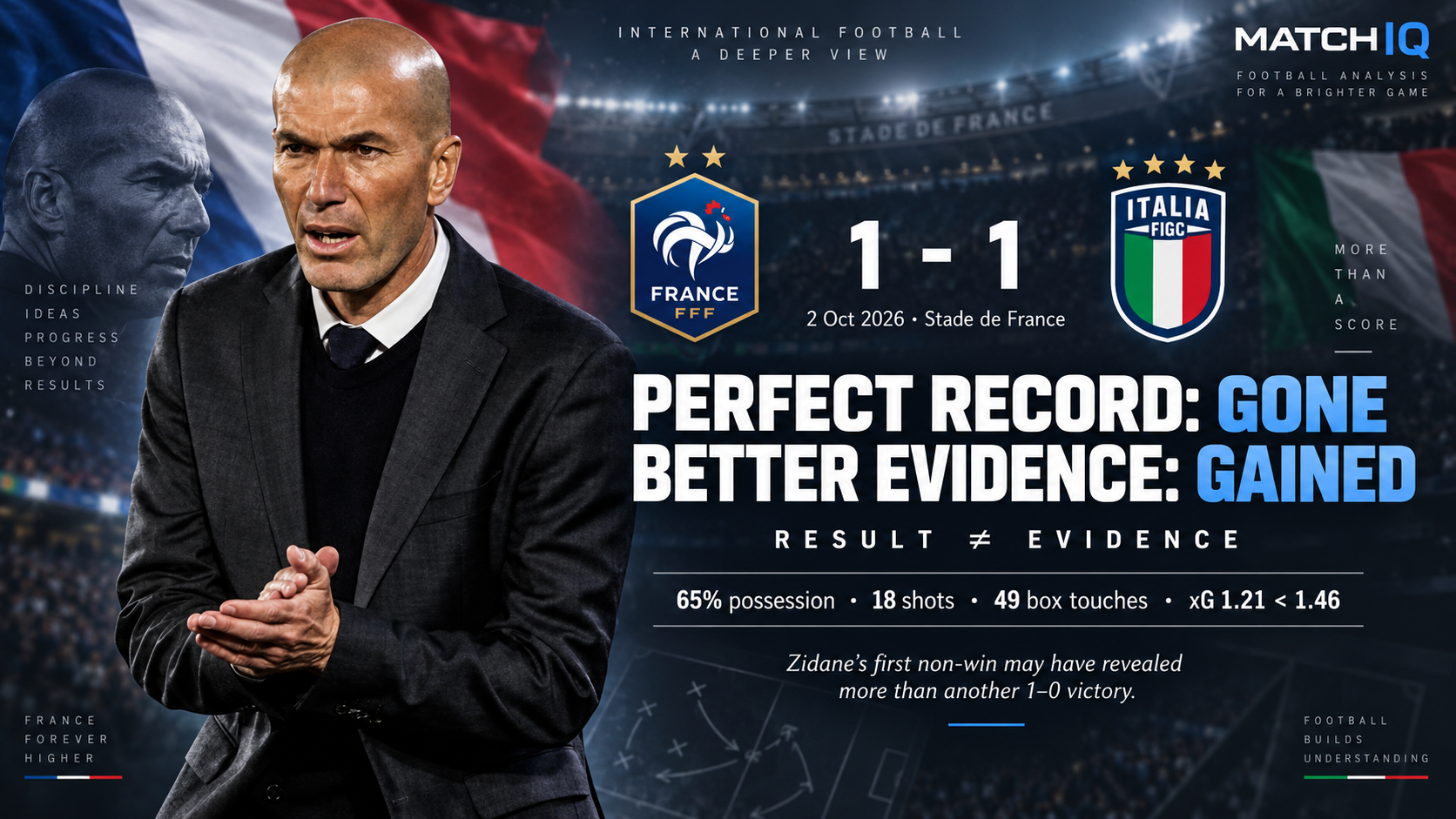
A third consecutive 1–0 victory would have made Zinedine Zidane’s start as France manager look cleaner.
It might not have made it more informative.
France’s 1–1 draw with Italy ended Zidane’s perfect winning start after consecutive 1–0 victories away to Türkiye and Belgium. Michael Olise gave France the lead in the 55th minute before Alessandro Bastoni equalised in the 68th. Dayot Upamecano was later sent off after receiving a second yellow card. France remain unbeaten under Zidane and still lead their Nations League group with seven points.
But the result itself is not the interesting part.
The interesting part is that Italy forced several questions into the open that two narrow victories had allowed France to postpone.
And for a new manager trying to understand his team, that may be more valuable than another clean sheet and another 1–0.
Two wins had established results. They had not established certainty.
Zidane began with two wins from two.
France beat Türkiye 1–0 in his opening match and followed it with another 1–0 victory in Belgium. Against Belgium, Zidane changed nine players from the previous starting XI and France still found a way to win, with Olise scoring late. That was useful evidence of squad depth and adaptability.
It was not, however, proof that France’s structure was already complete.
Low-margin victories can hide uncertainty.
A team can win because its defensive organisation is excellent.
It can win because it controls territory.
It can win because an elite player produces one decisive action.
Or several of those things can happen at once.
The final score does not tell us which explanation is carrying the most weight.
Italy gave France a more revealing test.
France controlled the ball. Italy still created the higher-value chances.
This is the most important contradiction from the match.
France had:
- 65% possession
- 18 shots to Italy’s 14
- 49 touches inside the opposition penalty area to Italy’s 18
- eight shots on target to Italy’s two
Yet FotMob’s Opta-powered numbers gave Italy the higher expected-goals total: 1.46 xG to France’s 1.21.
That distinction matters.
France controlled territory.
France generated volume.
France repeatedly reached attacking areas.
But territorial dominance and chance quality are not the same thing.
Italy were able to produce fewer attacks while still accessing dangerous situations. Reuters noted that the first major opportunity belonged to Moise Kean from inside the six-yard box, while France’s first-half territorial control initially produced relatively little equivalent threat.
This does not mean France attacked badly.
It means the evidence is more complicated than “France dominated and were unlucky.”
Gianluigi Donnarumma had to make important saves after the break. Désiré Doué, Ousmane Dembélé and Eduardo Camavinga all forced interventions, while Olise also threatened repeatedly. France were capable of sustaining pressure.
The unresolved question is whether Zidane can consistently turn that territorial pressure into chances whose quality matches their volume.
That is a much more useful question than whether France can win another match 1–0.
The equaliser exposed a different kind of risk.
Italy’s goal did not emerge from an extended period of domination.
France were attempting to build from the back when Lucas Da Cunha failed to control the ball. Bastoni recovered possession, drove forward and finished past Mike Maignan.
One mistake should not become a verdict on France’s build-up structure.
But it should become evidence.
If Zidane wants France to control possession and construct attacks rather than simply bypass pressure, then security in those situations becomes part of the system.
The relevant question is therefore not:
Did Da Cunha make a mistake?
He did.
The better question is:
When France are pressed during first-phase possession, does the structure consistently give the receiver enough support and enough safe exits?
One error cannot answer that.
It can tell us what to monitor next.
That is exactly what useful match intelligence should do.
Olise is giving Zidane an important solution — and another question.
Olise scored France’s winner against Belgium.
Four days later, he scored again against Italy, this time from a short free-kick routine with Rayan Cherki.
That is positive evidence.
France have another player capable of turning a balanced match with an individual action.
But individual quality can also distort how we evaluate the structure around it.
If Olise continues producing goals from difficult situations, France will win matches that might otherwise remain level.
That is valuable.
It should not automatically be interpreted as proof that the underlying attack is producing enough high-quality chances.
Those are two different conclusions.
MATCHIQ would keep both.
Olise’s influence: increasingly credible.
France’s repeatable chance-generation mechanism: still under evaluation.
There is a legitimate counter-reading: France may simply have deserved to win.
Zidane said afterwards that he was disappointed for his players because he believed France deserved more, while praising their effort and pressing.
There is evidence supporting that interpretation.
France controlled more possession, produced more shots, accumulated far more touches inside Italy’s penalty area and forced Donnarumma into repeated saves. Italy coach Roberto Mancini himself acknowledged France’s greater possession while arguing that Italy restricted the number of clear opportunities conceded.
So the draw should not automatically be classified as deterioration.
But the opposite conclusion — that France were completely dominant and the score was only bad luck — goes too far as well.
Italy’s higher xG matters.
The build-up error matters.
France failing to convert prolonged pressure into separation after going 1–0 ahead matters.
The correct reading can contain both truths:
France showed encouraging control.
Italy exposed areas where that control was less complete than the scoreboard of the previous two matches suggested.
What changed?
Before Italy, Zidane had two competitive matches and two clean-sheet victories.
After Italy, the evidence base is broader.
France have now shown that they can rotate heavily and still compete.
They can press.
They can dominate possession.
They have multiple attacking profiles.
Olise is becoming increasingly important.
But three questions now deserve closer tracking:
1. Chance quality
Can France convert territorial dominance into consistently superior chances rather than primarily superior volume?
2. Build-up security
Can France play through pressure without creating avoidable high-value opportunities for opponents?
3. Game-state control
When France take the lead, can they turn advantage into separation rather than leaving the opponent one action away from returning?
None of those questions require an immediate tactical overhaul.
They require more evidence.
France face Belgium next.
That provides another opportunity to test whether Italy revealed repeatable weaknesses or merely isolated incidents.
MATCHIQ Verdict
Zidane lost his perfect winning record.
He may have gained something more useful.
Another 1–0 victory would have strengthened the record.
The 1–1 draw strengthened the evidence.
France showed that they can control large parts of a high-level international match without necessarily controlling the quality of every decisive moment.
That distinction matters.
Because Zidane’s job is not to build a perfect September and October record.
It is to build a France team whose strengths remain reliable when the margins become much smaller.
Three matches into his tenure, the answer is not complete.
But after Italy, the questions are much clearer.
Know What’s Real. Know What Changed. Know What It Changes.