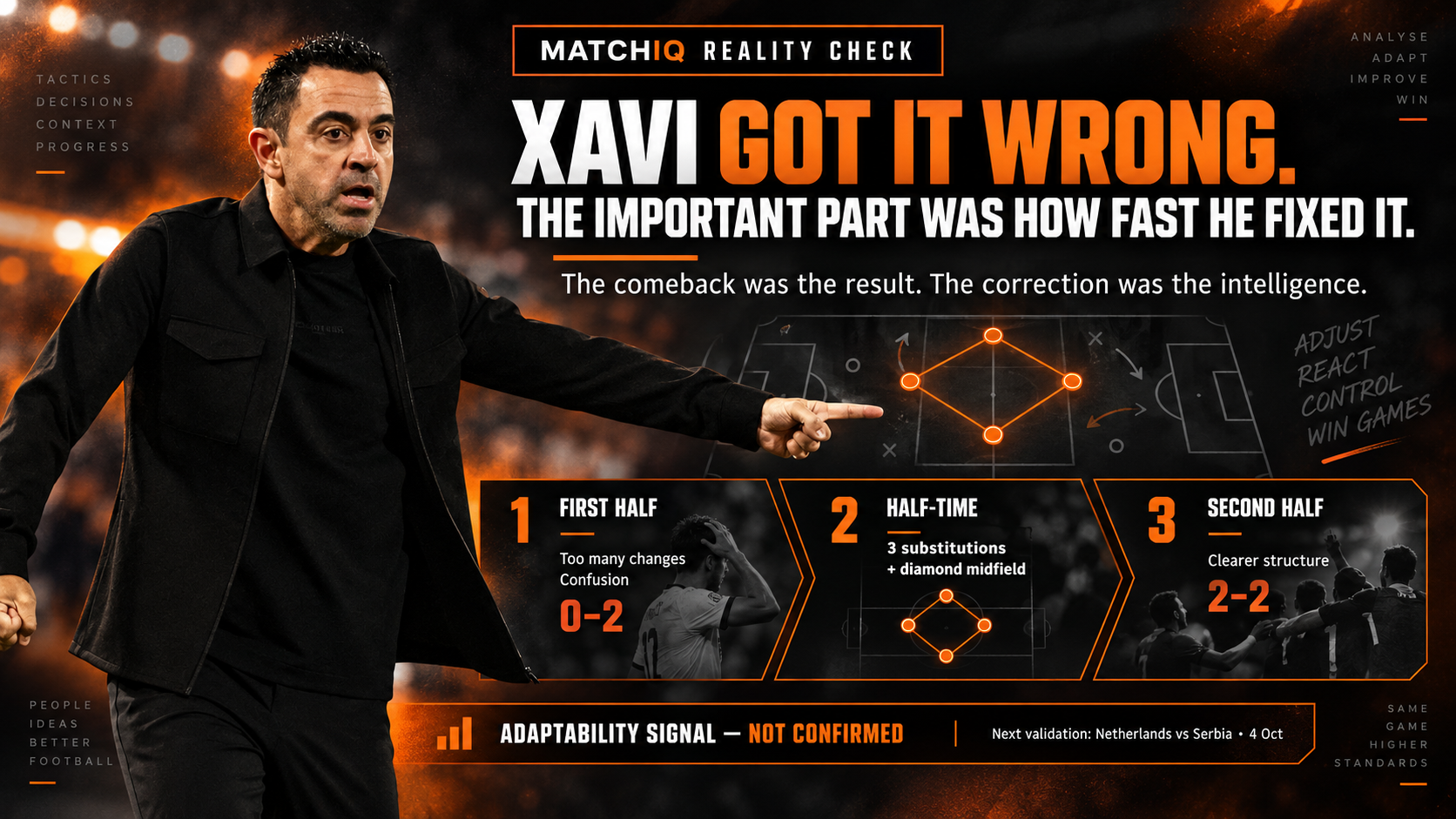
Netherlands went into half-time 2–0 down to Greece.
Bad enough.
But the more interesting part came after the match.
Xavi did not blame the pitch.
Did not blame the players.
Did not hide behind “we were unlucky.”
He basically said:
I changed too much. I confused them.
That matters.
Because coaches are usually very good at explaining why their idea should have worked.
Much less comfortable admitting:
The idea itself made the team worse.
Against Greece, Xavi did.
And then he changed it.
Fast.
That is the part worth keeping.
Reuters reported that Xavi took responsibility for the first-half problems, saying he had made too many changes and left the players confused. At half-time he made three substitutions, moved to a diamond midfield, and Netherlands recovered from 2–0 down to draw 2–2. Reuters
The comeback is the result.
The correction is the intelligence.
The first half was not just “Netherlands started badly”
That description is too soft.
Greece scored twice before half-time through Fotis Ioannidis and Giorgos Masouras. Reuters
Netherlands were not simply missing chances.
They looked unsure.
That distinction matters.
Bad execution is one problem.
Not knowing exactly where you are supposed to be is another.
And Xavi’s own explanation points toward the second.
Too many changes.
Too much information.
Not enough clarity.
That is a useful warning for any new coach.
Especially at international level.
You do not get six weeks on the training ground.
You get a few sessions.
Then a match.
Then another match.
So the smartest tactical idea in the room is useless if the players need fifteen minutes just to understand what it is.
Sometimes “more coaching” creates less football.
This is where Xavi’s first week becomes important
Before Greece, the early story around Xavi had been mostly positive.
Netherlands drew 1–1 with Germany.
Then beat Serbia 2–1.
After those first two games, Xavi said he was happy with the start but still wanted faster ball movement, better use of width, stronger pressing and better exploitation of space. Reuters
That sounded normal.
New coach.
New ideas.
Still building.
Then Greece gave him the first proper stress test.
Because now the question was no longer:
Can Xavi teach his football?
It became:
What happens when his football makes the team worse?
That is a much better test of a coach.
Half-time is where the story changed
Xavi made three substitutions.
Ryan Gravenberch.
Noa Lang.
Tijjani Reijnders.
He also shifted Netherlands into a diamond midfield.
The second half changed.
Virgil van Dijk pulled one back.
Then Reijnders equalised late.
2–2. Reuters
Now, be careful.
It would be very easy to write:
Diamond midfield fixed everything.
We do not know that.
One half is not enough.
Substitutions change energy.
Game state changes.
Greece had a lead to protect.
Netherlands had no choice but to chase.
All of that matters.
But we can still say something narrower.
The team looked clearer after the correction.
And more importantly:
Xavi recognised that the first version was not working.
Then changed the structure before the match was gone.
That is real evidence.
The most impressive thing was not the tactical idea
It was the lack of stubbornness.
This sounds small.
It is not.
Football is full of coaches who spend 70 minutes proving how committed they are to the original plan.
Sometimes the plan is wrong.
Sometimes the spacing is wrong.
Sometimes the players simply do not understand it.
And sometimes the smartest thing a coach can do is say:
Forget it. We are changing.
Xavi did that at half-time.
That does not make him a tactical genius.
Remember:
he created the problem first.
But adaptability is not about never making mistakes.
It is about how quickly the mistake stops costing you.
That is the useful part of Greece 2–2 Netherlands.
The diamond matters less than the clarity
Football conversation loves formations.
4-3-3.
4-2-3-1.
Diamond.
Three at the back.
Fine.
But the graphic is not the game.
What mattered after half-time was probably not just:
there are now four midfielders arranged like this.
The more important question is:
Did the players suddenly know their distances?
Did the passing options become easier to see?
Did the next receiver become clearer?
Did Netherlands stop asking too many players to solve too many things at once?
That is harder to put on a formation graphic.
But it is usually more important.
Because a good structure does not only create space.
It reduces thinking time.
And international football punishes confusion very quickly.
RED TEAM: maybe this was just Greece protecting a lead
This is the uncomfortable counterpoint.
Greece were 2–0 up.
Of course they changed.
Of course Netherlands had more of the ball.
Of course the game tilted.
That does not automatically mean Xavi’s halftime solution was brilliant.
It may simply mean:
Greece dropped.
Netherlands pushed.
The better squad eventually found chances.
Fair.
There is another problem.
A coach should not get too much credit for fixing something he broke himself.
Also fair.
So the conclusion cannot be:
Xavi found Netherlands’ best system.
He has not.
It also cannot be:
The diamond is the answer.
Too early.
The cleaner read is:
Xavi created too much complexity in the first half, recognised it, simplified the structure, and Netherlands improved enough to recover the match.
That is useful.
Nothing more.
Yet.
The real test comes next
Netherlands face Serbia next on 4 October in Eindhoven. UEFA lists that as their next Nations League fixture. UEFA.com
And this is where the Greece game becomes valuable.
Not because Netherlands need to win.
Because now Xavi has information.
He knows what confusion looked like.
He knows what the correction looked like.
So the next question is simple:
Does he start with more clarity?
Does the midfield spacing look cleaner from minute one?
Does the ball move faster?
Do the wide players understand when to stay wide and when to come inside?
Do Netherlands need another emergency rewrite at half-time?
If the answer is no,
then Greece becomes more than a comeback.
It becomes learning evidence.
If the same confusion appears again,
then the comeback starts looking less like adaptability—
and more like repeated self-inflicted damage.
That is the next test.
MATCHIQ Decision
The headline is:
Netherlands came back from 2–0 down.
The more useful story is:
Xavi admitted the first-half setup had confused his own players.
Then he changed it.
Three substitutions.
A diamond midfield.
A clearer second half.
2–2. Reuters
That does not prove Xavi has found the answer.
It proves something smaller.
And more useful.
He was willing to kill his own idea before the idea killed the match.
ORIGINAL QUESTION
Can Xavi install his football quickly enough at international level?
NEW EVIDENCE
First half:
too many changes → confusion → 0–2.
Second half:
three substitutions + structural change → clearer play → 2–2.
WHAT CHANGED
We now have the first strong evidence of Xavi’s in-game adaptability.
WHAT DIDN’T
We still do not know whether the diamond is sustainable or whether Netherlands have found their best midfield structure.
EVIDENCE STRENGTH
Useful.
PROOF?
No.
NEXT VALIDATION
Netherlands vs Serbia — 4 October.
STATUS
Adaptability Signal: Strengthened — Not Confirmed.
The comeback was the result.
The correction was the intelligence.