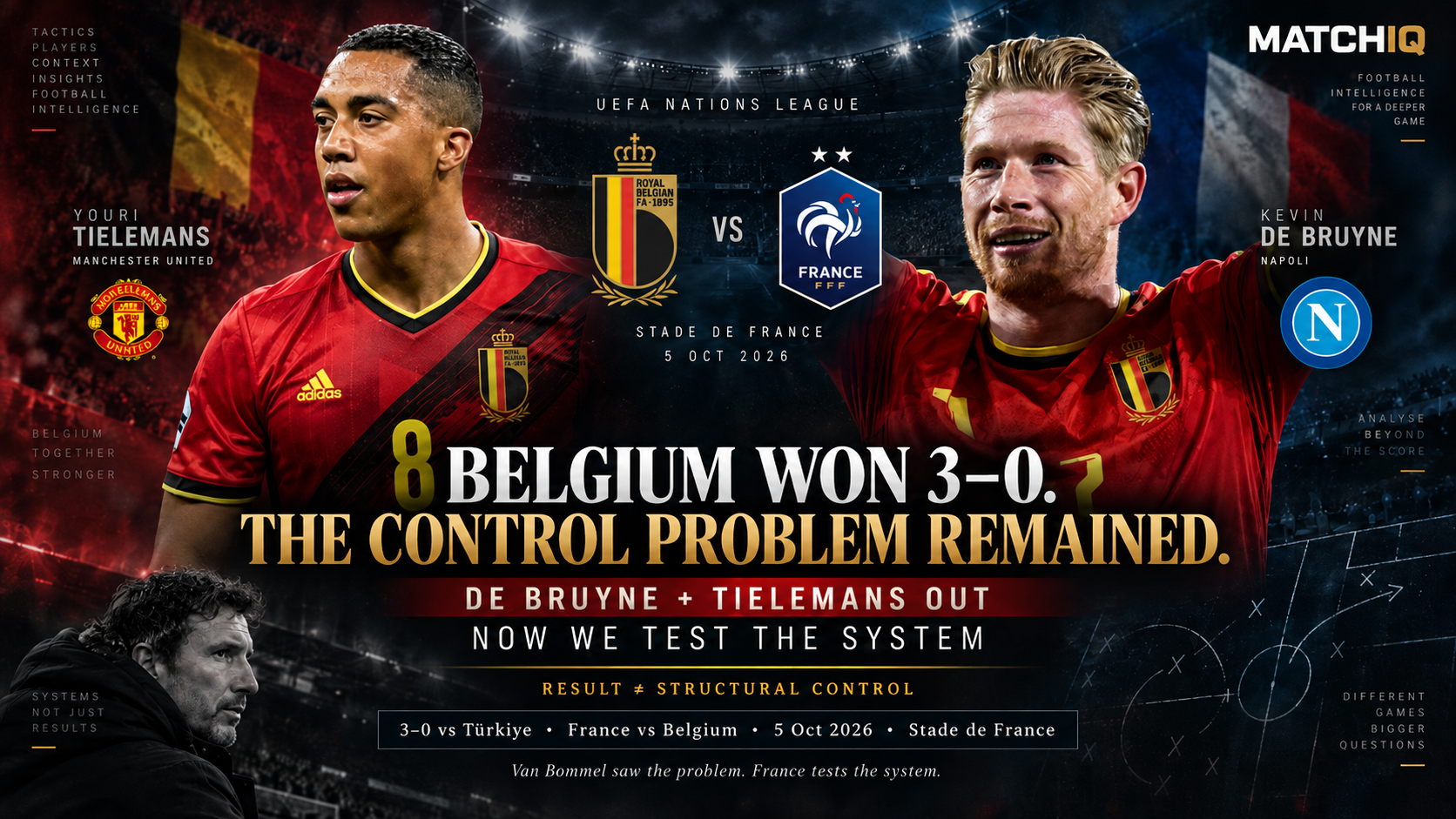
Belgium won 3–0.
That is the result.
Mark van Bommel saw something else.
After Belgium beat Türkiye in Liège, their new coach did not describe a team that had controlled the match from beginning to end. He described a team that had been too loose with the ball, allowed the game to become transitional, and repeatedly gave Türkiye reasons to believe they could stay involved.
His words matter more than the scoreline.
Because Belgium’s next match removes two of the players most capable of solving exactly that problem.
Kevin De Bruyne and captain Youri Tielemans are both suspended for Monday’s Nations League meeting with France at the Stade de France after accumulating yellow cards. De Bruyne leaves the Türkiye match having scored twice. Reuters
Belgium are about to lose two central reference points at the exact moment their coach has identified control as something that still needs work.
That does not prove Belgium depend on them.
It creates the test.
The 3–0 was convincing. The control was not.
Scorelines compress ninety minutes into one number.
That is useful for standings.
It is dangerous for diagnosis.
Belgium scored three times against Türkiye. De Bruyne scored twice, while Romelu Lukaku came from the bench to score his 94th international goal. Van Bommel recorded his second victory from his first three matches in charge. Reuters
A conventional reading is straightforward:
Belgium won comfortably.
Van Bommel’s reading was different.
He said Belgium had been “very sloppy in possession” and explained that the game became too open because his team repeatedly gave the ball away. Before the second goal, he noted that Belgium were struggling to sustain long passing sequences. He described the match as moving back and forth rather than remaining under Belgian control. Reuters
That changes what the 3–0 means.
Belgium proved they could punish Türkiye.
They did not necessarily prove they could control Türkiye.
Those are different capabilities.
A team can be dangerous without being stable.
It can produce decisive moments while still allowing the opponent too many opportunities to remain connected to the game.
Against Türkiye, Belgium had enough quality to make that distinction irrelevant to the final score.
Against France, it may become the entire test.
De Bruyne’s two goals can hide the more important question
De Bruyne scored twice.
That is evidence of his continuing capacity to decide matches.
But individual output can make structural evaluation harder.
If a player turns unstable possession into goals, the scoreboard improves without necessarily proving that the instability has disappeared.
That matters because Van Bommel’s criticism was not about Belgium’s ability to finish opportunities.
It was about what happened between those opportunities.
Can Belgium keep possession long enough to determine where the next phase of the game takes place?
Can they slow the game when it becomes too transitional?
Can they reconnect the midfield after possession is lost?
Can they prevent an opponent from believing the match remains open?
Against Türkiye, Belgium had De Bruyne and Tielemans available while those questions were still appearing.
Against France, both disappear simultaneously. Reuters
That turns an absence list into useful evidence.
France is not testing whether Belgium have replacements
Belgium have midfield alternatives.
UEFA’s registered squad includes Roméo Lavia, Nicolas Raskin, Hans Vanaken and other players capable of occupying central or creative roles. UEFA.com
So the question should not be reduced to:
Who replaces De Bruyne?
or:
Who replaces Tielemans?
That is lineup analysis.
The more useful question is:
Which behaviours survive when both are removed?
This distinction matters.
A replacement can perform well individually without reproducing the same collective control.
Belgium may replace De Bruyne’s position.
They may replace Tielemans’ position.
What France will help test is whether they can replace their functions.
Progression.
Tempo.
Positioning around the ball.
Decision-making when the game accelerates.
The ability to turn possession into control rather than simply another attack.
That is the information Belgium need now.
France already gave Belgium one warning
This is not a theoretical opponent.
France beat Belgium 1–0 in Brussels on September 28.
More importantly, Zidane made nine changes to the side that had previously beaten Türkiye and France still controlled large parts of the contest before Michael Olise scored the late winner. Reuters described France as dominating proceedings despite the heavily rotated team. Reuters
That match already introduced an uncomfortable comparison.
France changed personnel.
Their collective behaviours survived.
Pressing survived.
Territorial ambition survived.
Enough structure survived for an almost completely changed team to remain recognisable.
That does not prove France possess a perfectly transferable system. Their subsequent 1–1 draw with Italy raised its own questions about the difference between territorial control and chance quality.
But Belgium now face an unusually clean test.
France have already demonstrated some ability to preserve behaviour through rotation.
Belgium must now show whether they can do something similar without two of their most influential midfield references.
That is why Monday matters beyond the points.
There is a counter-case
The easiest mistake is to decide the answer before the experiment happens.
Belgium struggling against France would not automatically prove they are dependent on De Bruyne and Tielemans.
France are a strong opponent.
Belgium are playing away.
The schedule has compressed four Nations League matches into ten days, which introduces fatigue and limits training time. De Bruyne and Tielemans are missing simultaneously rather than one at a time, making the disruption larger than a normal rotation test. Reuters
The opposite is also true.
If Belgium perform well without them, one match will not prove the system is independent of its senior midfielders.
Single matches create signals.
They rarely settle structural questions.
So France should not produce a final verdict.
It should move the confidence level.
That is the point.
What should we actually watch?
Not simply the score.
Four behaviours matter more.
1. First-phase progression
Can Belgium move possession from defence into midfield without requiring De Bruyne or Tielemans to repeatedly drop toward the ball?
If progression becomes slower, riskier or more direct, that tells us something about where Belgium’s control currently lives.
2. Tempo control
Türkiye were able to turn stretches of the previous match into the kind of end-to-end contest Van Bommel did not want.
Without De Bruyne and Tielemans, can Belgium recognise when to accelerate and when to kill that momentum?
This may be the most important test.
3. Support around possession
Sloppy possession is not always an individual technical problem.
It can also be structural.
Distances become too large.
Passing options disappear.
The player receiving the ball is forced into a low-percentage decision.
Against France, watch whether Belgium create enough short connections around the ball before blaming individual replacements.
4. Behaviour after losing the ball
If possession breaks down, how quickly can Belgium stop the match becoming transitional?
The answer will tell us whether Van Bommel has started correcting the problem he identified after Türkiye — or whether elite individual quality merely covered it.
This is also a test of Van Bommel
Van Bommel has won two of his opening three matches as Belgium coach. Reuters
But early national-team results can create false certainty.
Training time is limited.
Lineups change.
Opponents change quickly.
The useful measure is not whether every match produces the same eleven players.
It is whether the same football survives different eleven players.
Van Bommel has already stated that Belgium need to eliminate the possession problems that allowed Türkiye to remain connected to the match. Reuters
France now removes two obvious solutions.
That makes the next game more informative.
Not easier.
More informative.
MATCHIQ Verdict
Belgium’s 3–0 win proved they still possess players capable of deciding matches.
It did not prove the structure underneath them is already stable.
Van Bommel effectively said so himself.
Now De Bruyne and Tielemans are unavailable.
France therefore becomes something more useful than another Nations League fixture.
It becomes a dependency test.
If Belgium can progress the ball, regulate tempo and prevent the match becoming chaotic without two of their main midfield references, confidence in Van Bommel’s structure should rise.
If those behaviours deteriorate sharply, the interpretation changes.
Not to:
Belgium cannot play without De Bruyne.
But to:
Belgium’s system may still depend on certain players to provide the control that the structure itself has not yet fully created.
That distinction matters.
Türkiye showed Belgium can punish an opponent.
France may begin to show whether Belgium can control one without the players who normally help control the game.
The 3–0 was the result.
France is the test.
Know What’s Real. Know What Changed. Know What It Changes.
MATCHIQ Intelligence Record
Thesis
Belgium’s 3–0 win over Türkiye demonstrated attacking quality but did not establish structural control. The simultaneous suspensions of De Bruyne and Tielemans make France a high-value test of whether that control is embedded in Van Bommel’s system or still disproportionately supplied by key individuals.
Decisive Evidence
- Belgium beat Türkiye 3–0, with De Bruyne scoring twice and Lukaku adding the third. Reuters
- Van Bommel nevertheless criticised Belgium’s possession as “very sloppy” and said the match became too transitional. Reuters
- De Bruyne and captain Tielemans will both miss France through suspension. Reuters
- France previously beat Belgium 1–0 despite making nine starting changes, providing a relevant comparison for behavioural transfer across personnel. Reuters
- France–Belgium is scheduled for 5 October 2026 at Stade de France. UEFA.com
Counterpoint
One away match against France cannot isolate the effect of two midfield absences. Opponent quality, fatigue, lineup choices and game state will also affect Belgium’s performance.
Confidence
MEDIUM
Reason: the possession-control concern comes directly from Van Bommel and the double suspension creates a strong natural test, but the dependency hypothesis has not yet been tested.
Next Watch
France vs Belgium:
Progression → Tempo → Support Structure → Rest Defence
Do those behaviours survive without De Bruyne and Tielemans?