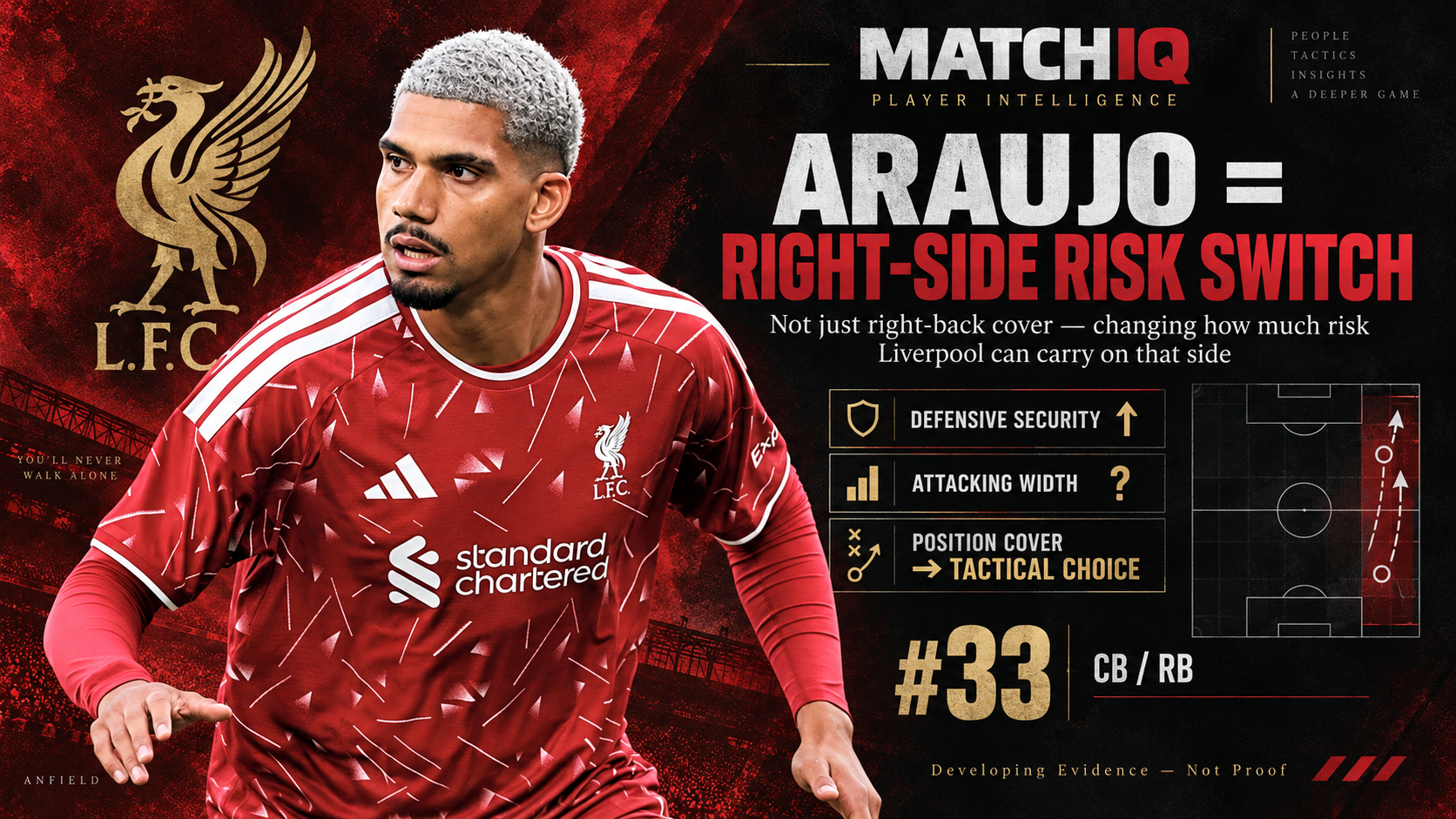
When Ronald Araujo arrived at Liverpool, the easy interpretation was simple:
centre-back reinforcement.
Experienced.
Physical.
Reliable in duels.
Useful insurance while the squad dealt with injuries.
That description is still true.
But after a few matches, it is starting to look too small.
Araujo is still primarily a centre-back.
But Iraola is not using his versatility as if it means:
“If nobody else can play right-back, put him there.”
The more interesting possibility is this:
Araujo is becoming a way for Liverpool to change the risk level of their entire right side.
That is a much bigger tactical idea.
The first important change: he is not only playing there because he has to
Against Ipswich on September 4, Araujo made his first Liverpool start.
He replaced Jeremie Frimpong.
The key detail:
Frimpong was available.
He was on the bench.
So this was not:
“Frimpong is unavailable, so Araujo has to fill in.”
It was a selection choice.
Liverpool won 2–0.
Then Araujo started again against Atletico Madrid.
Then again against Fulham.
Then again against Bournemouth, with Frimpong once more available from the bench.
At that point, calling it a one-off emergency solution becomes less convincing.
This is now a repeated configuration.
And repeated choices are where tactical meaning starts to appear.
Atletico made the question much more interesting
If Araujo at right-back simply meant:
more defensive protection, less attack
then the story would be fairly straightforward.
But against Atletico, that is not what happened.
He contributed an assist.
He helped Liverpool build and attack.
And Liverpool supporters voted him Player of the Match.
That matters because it breaks the lazy binary:
Frimpong = attack
Araujo = defence
It is not that simple.
Araujo will not suddenly become Frimpong.
But Atletico gave us an early signal that Liverpool may be able to choose a more defensive right-back profile without killing the attacking value of that side completely.
That gives Iraola more room to manipulate the game.
The real question is not “Who is Liverpool’s first-choice right-back?”
That is where this story can easily become too basic.
The obvious debate is:
Can Araujo take Frimpong’s place?
Maybe that is not the useful question.
Iraola may not be gaining:
a better right-back.
He may be gaining:
two different versions of the right side.
That distinction matters.
Frimpong pushes the risk forward
Frimpong’s profile is naturally aggressive.
His career has been built around:
width.
vertical running.
overlaps.
high occupation.
final-third presence.
He can stretch the pitch.
He can carry the ball forward.
He can behave more like a wing-back or even an attacker than a conservative full-back.
That gives Liverpool attacking value.
But football does not give you attacking aggression for free.
When a full-back moves higher and earlier, somebody behind him has to pay for that position.
Maybe the right-sided centre-back shifts across.
Maybe the midfielder covers.
Maybe the rest-defence structure changes.
That is the cost.
That is the risk budget.
Araujo keeps more of that budget behind the ball
Araujo comes from a completely different starting point.
He is a centre-back first.
His game is built around:
duels.
physical defending.
aerial security.
covering space.
protecting the box.
So when he plays at right-back, MATCHIQ is less interested in asking:
Can he attack the byline like Frimpong?
The more useful question is:
Can Liverpool keep more defensive security on the right without sacrificing too much attacking function?
Conceptually, that could mean:
wide duel security ↑
back-line protection ↑
aerial security ↑
recovery burden ↓
But possibly also:
natural attacking width ↓
progression responsibility shifts elsewhere
more attacking work for the winger or No.8
That trade-off is the story.
Iraola has already hinted at how he sees it
Iraola has said Liverpool have needed Araujo at both centre-back and right-back.
He has also pointed out that Araujo has played more minutes than expected early in the season.
One detail is especially interesting.
Moving from centre-back to a wider full-back role changes the physical demands.
There is more running.
More repeated wide defending.
More recovery movement.
More exposure to open spaces.
And so far, Araujo has handled it.
That does not sound like a coach describing a player he is simply using as emergency cover.
It sounds more like a coach testing how many structural jobs one defender can carry.
Bradley’s injury explains part of the story — but not all of it
This is where the argument needs pressure-testing.
Conor Bradley’s long-term knee injury clearly matters.
Liverpool have had fewer natural options at right-back.
That gave Araujo an opportunity.
So we should not pretend every right-back minute is proof of a tactical revolution.
Some of it is squad availability.
But availability does not explain everything.
Because Frimpong has been available for several of these matches.
And Iraola still chose Araujo.
That is the interesting part.
Bradley’s absence created the experiment.
Iraola’s repeated selections may be turning it into something more.
This may connect directly to Liverpool’s pressing evolution
There is a second Liverpool hypothesis already on the board:
pressing intensity ↑
coordination evidence ↑
Araujo’s role may connect to that.
Because the most dangerous moment in a high press is not when everyone gets it right.
It is when the first line gets beaten.
If the right-back is already high and the midfield has moved across, Liverpool can suddenly be exposed in transition.
That is where Araujo may matter beyond his own position.
If his presence gives Liverpool more security in the rest defence, then he changes how aggressively the players ahead of him can jump.
That is the deeper idea:
Araujo may not only defend the right side.
He may increase how much risk Liverpool can afford in front of him.
That is what “risk budget” really means.
More security does not automatically mean a better team
This is the other side of the argument.
Suppose Araujo really does make Liverpool safer.
Good.
But what if that safety costs too much?
What if Liverpool lose:
right-side width.
progression.
overlap threat.
final-third occupation.
What if the winger now has to provide all the width alone?
What if the opponent can defend more narrowly because Araujo is less threatening high up the pitch?
Then “safer” might simply mean:
the problem moved from defence to attack.
That is why there is no evidence yet for:
Araujo is Liverpool’s best right-back.
There is also no need to force that conclusion.
The real question is:
Which version of the right side does Liverpool need in this game?
Frimpong and Araujo may not really be competing for the same job
This may be the most important hypothesis to leave behind.
Liverpool may not need:
Araujo vs Frimpong.
They may need:
Araujo OR Frimpong, depending on the risk profile of the match.
For example:
Against a team Liverpool expect to pin back
Frimpong may make more sense.
Liverpool need width.
More runners.
More occupation in the final third.
More attacking pressure.
Against a dangerous transition team
Araujo may become more attractive.
Because the cost of losing the ball is higher.
The priority may shift towards:
duels.
cover.
recovery.
rest defence.
When Liverpool are protecting a lead
You could even imagine:
Frimpong → Araujo
Not because Frimpong played badly.
But because the objective of the game has changed.
From:
create an advantage
to:
protect an advantage.
That is not a hierarchy decision.
That is game-state management.
And if that pattern starts repeating, Liverpool suddenly have a very useful tactical asset.
Bournemouth added another small piece of evidence
Against Bournemouth, Araujo started again while Frimpong was on the bench.
Liverpool won 1–0.
They kept a clean sheet.
That does not prove Araujo at right-back solved the defensive structure.
The clean sheet belongs to the whole team.
And Jeremy Jacquet was the supporter-voted Player of the Match.
So the result cannot simply be credited to Araujo.
But the selection itself still matters.
Iraola had another option.
He stayed with this configuration.
That is stronger evidence than one good individual performance.
Because repeated selection begins to look more like tactical preference.
Manchester City is the next useful test
The next Premier League match against Manchester City should tell us more.
City will ask different questions.
Can Liverpool’s right-back push high?
What happens when the press is beaten?
Who handles the transition behind him?
How does Liverpool protect the right half-space?
Does Iraola want more attacking aggression on that side?
Or more insurance?
If Araujo starts again against City — especially with Frimpong fit and available — the evidence strengthens.
Not because:
Araujo is better than Frimpong.
But because:
Iraola may genuinely be using different right-backs as different risk-management tools.
That would be the real change.
MATCHIQ Decision
When Ronald Araujo arrived, the simplest read was:
experienced centre-back depth.
That needs updating.
ORIGINAL READ
Centre-back reinforcement
NEW EVIDENCE
Repeated right-back starts
Frimpong available from the bench
Atletico Player of the Match + assist
Iraola explicitly values him at CB and RB
WHAT CHANGED
Araujo is moving from:
position cover
towards:
possible tactical risk switch
WHAT HAS NOT BEEN PROVEN
He has not become Liverpool’s permanent first-choice right-back.
And the structure has not yet proved transferable against every type of opponent.
NEXT VALIDATION
When Bradley returns, Frimpong is fully available and the opponent quality rises:
Does Iraola still choose Araujo on purpose?
If the answer keeps becoming yes—
then this stops looking like injury cover.
It becomes tactical choice.
MATCHIQ VERDICT
ROLE: CB → CB / RB tactical option
SIGNAL: Strong
REPEATABILITY: Emerging
INJURY EFFECT: Relevant, but does not fully explain selection
STRUCTURAL HYPOTHESIS: Araujo may lower Liverpool’s right-side risk exposure
BIGGEST TRADE-OFF: Defensive security vs attacking width/progression
NEXT TEST: Manchester City + future selection when Bradley returns
STATUS: Developing Evidence — Not Proof
Versatility is the surface-level story.
Risk management may be the real one.