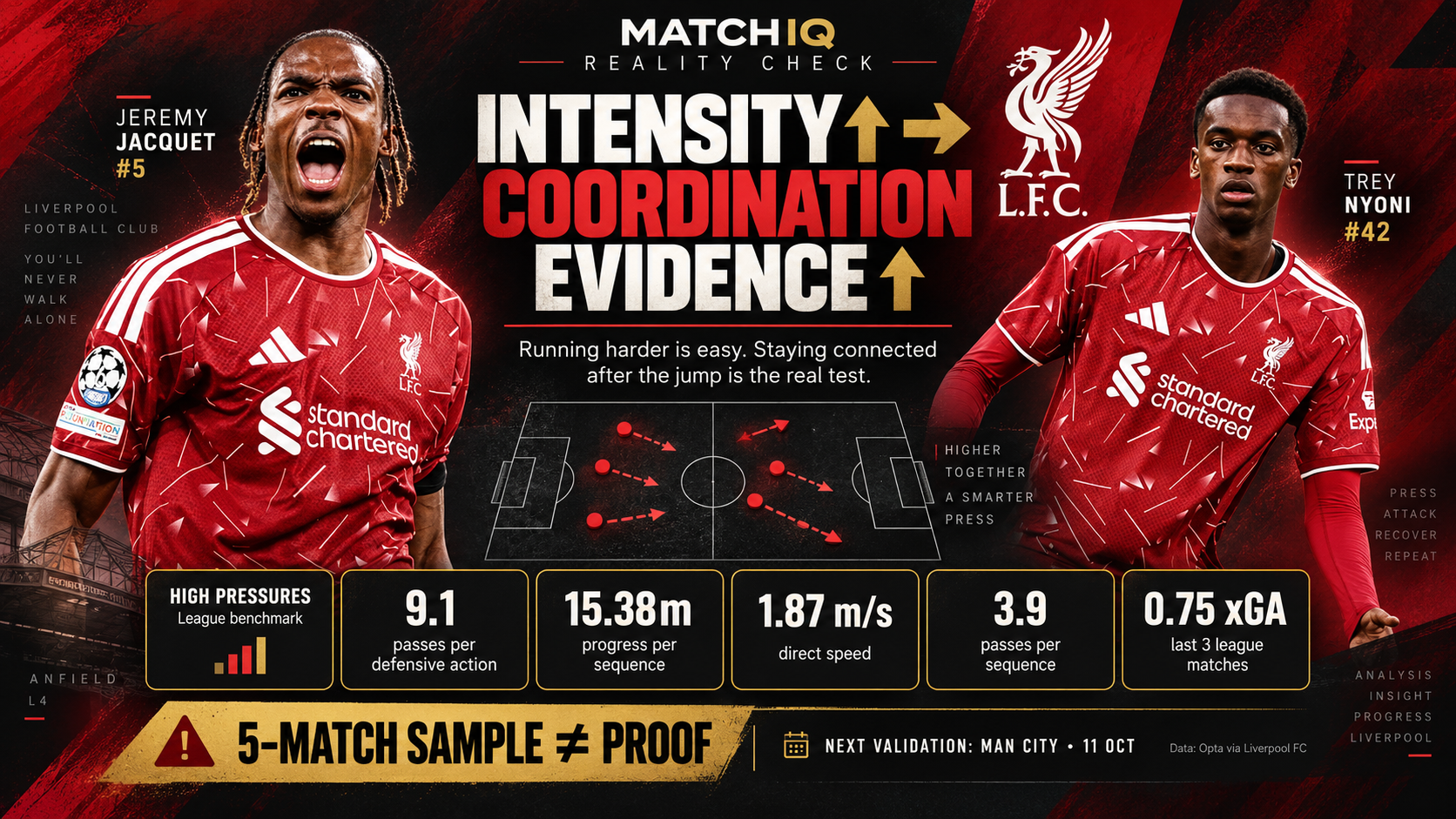
Five games ago, the question was not whether Liverpool would run harder under Andoni Iraola. It was whether all that aggression could become a connected press rather than a collection of sprints. The latest evidence is beginning to change that judgement.
Running harder is the easy part.
New coach.
New energy.
Forward sprints.
Midfield follows.
Red shirts everywhere.
Supporters look at it and think:
There’s intensity again.
But high pressing has one very convenient way of lying to you.
The important question is never simply:
Did someone sprint at the ball?
It is:
What happened to the team after he sprinted?
That was the hypothesis we left on Liverpool earlier this season.
Intensity: up.
Coordination: unproven.
Five Premier League games later, that second line needs updating.
Liverpool are no longer just looking more aggressive
Opta’s numbers from the opening five Premier League matches show Liverpool setting the pace for high-pressure actions when opponents have possession in their own half.
Opponents are also averaging only 9.1 passes before Liverpool attempt a tackle, interception or challenge, a rate that places Iraola’s side among the league’s most aggressive pressing teams.
That does not simply tell us:
Liverpool players are working harder.
It tells us:
opposition build-up sequences are being disrupted more quickly.
Those are different things.
One is an effort statistic.
The other starts to describe match control.
But pressure volume is not the real question
This is where the analysis needs brakes.
Because football has plenty of fake high presses.
The striker goes.
The second player does not.
The midfield stays five metres too deep.
One pass beats the first wave and suddenly—
welcome to forty metres of grass.
So simply counting pressure actions does not tell us whether Liverpool are pressing well.
The better question is:
When Liverpool jump, does the rest of the team still exist behind the jump?
That is where the new evidence becomes more interesting.
Liverpool are not only winning the ball earlier. They are trying to use it earlier too.
Liverpool’s average possession sequence has moved the ball 15.38 metres towards the opposition goal.
Only Manchester United, at 15.44 metres, have progressed further per sequence among Premier League teams in the same sample.
Liverpool’s direct speed has also increased from 1.84 m/s last season to 1.87 m/s, while passes per sequence have fallen from 4.2 to 3.9.
None of those changes looks enormous on its own.
Together, they describe something clearer.
Iraola’s Liverpool do not appear to want:
win it → calm everything down → reset shape → attack later.
They increasingly want:
win it → check whether forward is available immediately.
That matters because the press and the attack are not separate ideas.
A useful high press is not there so an analyst can record:
High turnover: +1.
It exists to attack an opponent before that opponent has recovered its structure.
This is where coordination becomes the real story
If Liverpool simply became faster without becoming better connected, we should expect a predictable trade-off.
More vertical football.
More transitions.
More chances for the opponent to run at an exposed defence.
We saw enough warning signs early in the season to take that risk seriously.
Iraola himself acknowledged issues around Liverpool’s starts, goals conceded and general stability.
So the interesting change is not:
Liverpool are playing more directly.
It is:
Liverpool are playing more directly without continuing to pay the same defensive price.
That is a very different signal.
The last three league matches provide the most important new evidence
Liverpool have kept three consecutive Premier League clean sheets against Ipswich, Fulham and Bournemouth.
Across those matches, their average expected goals against was approximately 0.75 xGA.
Across all five league games, the figure stands at 1.22 xGA, with only a small number of Premier League teams performing better over the same period.
That matters.
Because our earlier concern was simple:
If Liverpool press more aggressively, will the spaces behind the pressure become too large?
The recent run provides the first meaningful counter-evidence:
Liverpool are currently increasing their front-foot aggression while reducing the defensive cost behind it.
That is not proof.
But it is no longer an evidence-free idea either.
Ipswich, Fulham and Bournemouth did not test exactly the same thing
Three clean sheets can make three very different matches look identical.
They were not.
Against Ipswich, Iraola highlighted Liverpool’s aggressive start and the amount of pressure they created, particularly in the opening half.
Fulham offered the opposite lesson.
Liverpool did not concede, but they also struggled to create enough.
That gave us a useful separation:
Defensive control can work.
Attacking creation can still fail.
Those are not contradictions.
Bournemouth created another test.
Iraola admitted Liverpool did not initially match Bournemouth’s intensity and needed time to establish control.
Yet Liverpool still left with a third consecutive league clean sheet.
That does not mean:
Liverpool have solved everything.
The better conclusion is:
Liverpool are beginning to find different ways not to lose their structure.
That is much more interesting.
The player who starts the press gets the camera. The second player usually decides whether it works.
Pressing analysis is often obsessed with the first runner.
The striker attacks the centre-back.
The winger closes the full-back.
It looks aggressive on television.
But the press usually succeeds or fails because of the next movement.
After the first pass:
Who closes the receiver?
Does the midfield arrive?
Does the defensive line move forward?
Who protects the central lane?
If the opponent beats the first player, is the entire middle of the pitch suddenly empty?
Those details do not appear neatly in a running-distance graphic.
But when opponents are finding it harder to complete long possession sequences in their own half and Liverpool’s defensive numbers are improving—
it suggests something important.
The first sprint may finally have a second action behind it.
That is coordination evidence.
Not confirmation.
Evidence.
/redteam: five matches are nowhere near enough
This needs to be said clearly.
Five matches are not enough.
Not close.
There are three obvious reasons.
First:
high-pressure volume does not equal high-pressure quality.
A team can press constantly and still be easy to play through.
Second:
Liverpool have not yet faced enough elite build-up teams to stress the structure at its highest level.
The very best possession teams actively invite pressure.
They want you to jump.
They want the midfielder to leave his zone.
They want the line behind him to become uncomfortable.
Third:
Liverpool’s five-match xGA is 1.22, while the recent three-match stretch sits much lower at 0.75.
That may mean genuine improvement.
It also means the stability we are seeing could still be very new.
So the worst possible conclusion now would be:
IRAOLA’S PRESSING SYSTEM IS SOLVED.
It is not.
The only thing we should upgrade is the hypothesis
Earlier:
Pressing intensity ↑
Coordination ?
Now:
Pressing intensity ↑
Coordination evidence ↑
Notice what is missing.
Not:
Coordination confirmed.
That is the point of Decision History.
MATCHIQ does not need yesterday’s hypothesis to “win”.
New evidence should be allowed to change today’s judgement.
Otherwise this is not intelligence.
It is branding around an old opinion.
Manchester City should be the next real exam
Liverpool’s next Premier League match is against Manchester City at Anfield on October 11.
That should carry much more informational value.
Because a City-level build-up asks a much harsher question:
Are you sure you want to press us?
If Liverpool’s first line jumps and City repeatedly find the free man—
if midfielders are dragged out—
if the back line cannot maintain the distance behind them—
then the encouraging opening-five pressing numbers will need a different interpretation.
But if Liverpool can maintain:
high pressure
→ restrict clean build-up
→ regain possession
→ attack forward quickly
without the defensive transition opening up—
then the hypothesis deserves another upgrade.
That is the test.
Not possession percentage.
Not running distance.
Not whether Liverpool “look energetic”.
MATCHIQ Decision
Five matches have not proved that Liverpool are now a mature pressing machine.
But our judgement has to move.
The Iraola effect is beginning to look like more than:
players running harder.
Liverpool are disrupting opposition build-up earlier.
They are playing more vertically after winning possession.
And over the most recent three league matches, that aggression has coincided with stronger defensive control.
No single number proves much.
The interesting part is that several numbers are beginning to move in the same direction.
Pressure ↑
Verticality ↑
Recent defensive control ↑
If only the first one exists, that is energy.
If all three can survive together—
that starts to look like a system.
So the conclusion today is not:
Liverpool’s press works.
It is:
Liverpool’s press has started to produce evidence beyond intensity.
Running harder is easy.
Running harder without the team falling apart behind you is the part Iraola actually needs to prove.
Now he has some evidence.
Not the answer.
MATCHIQ VERDICT
ORIGINAL HYPOTHESIS: Intensity improved; coordination unproven
NEW EVIDENCE: High-pressure volume + shorter opposition build-up sequences + stronger recent defensive control
WHAT CHANGED: Evidence for collective pressing coordination has strengthened
WHAT DIDN’T CHANGE: Five matches remain far too small a sample for confirmation
BIGGEST RISK: First line beaten → midfield spacing exposed
NEXT VALIDATION: Manchester City, October 11
Liverpool’s press was already becoming more aggressive.
The new evidence is that it may also be becoming more connected.