Thirty years ago, Arsène Wenger arrived at Arsenal.
He officially became an Arsenal employee on 1 October 1996, before taking charge of his first match eleven days later — a 2–0 Premier League win at Blackburn. Arsenal
What followed is familiar.
Twenty-two Premier League seasons.
Three league titles.
A Double in his first full season.
The Invincibles.
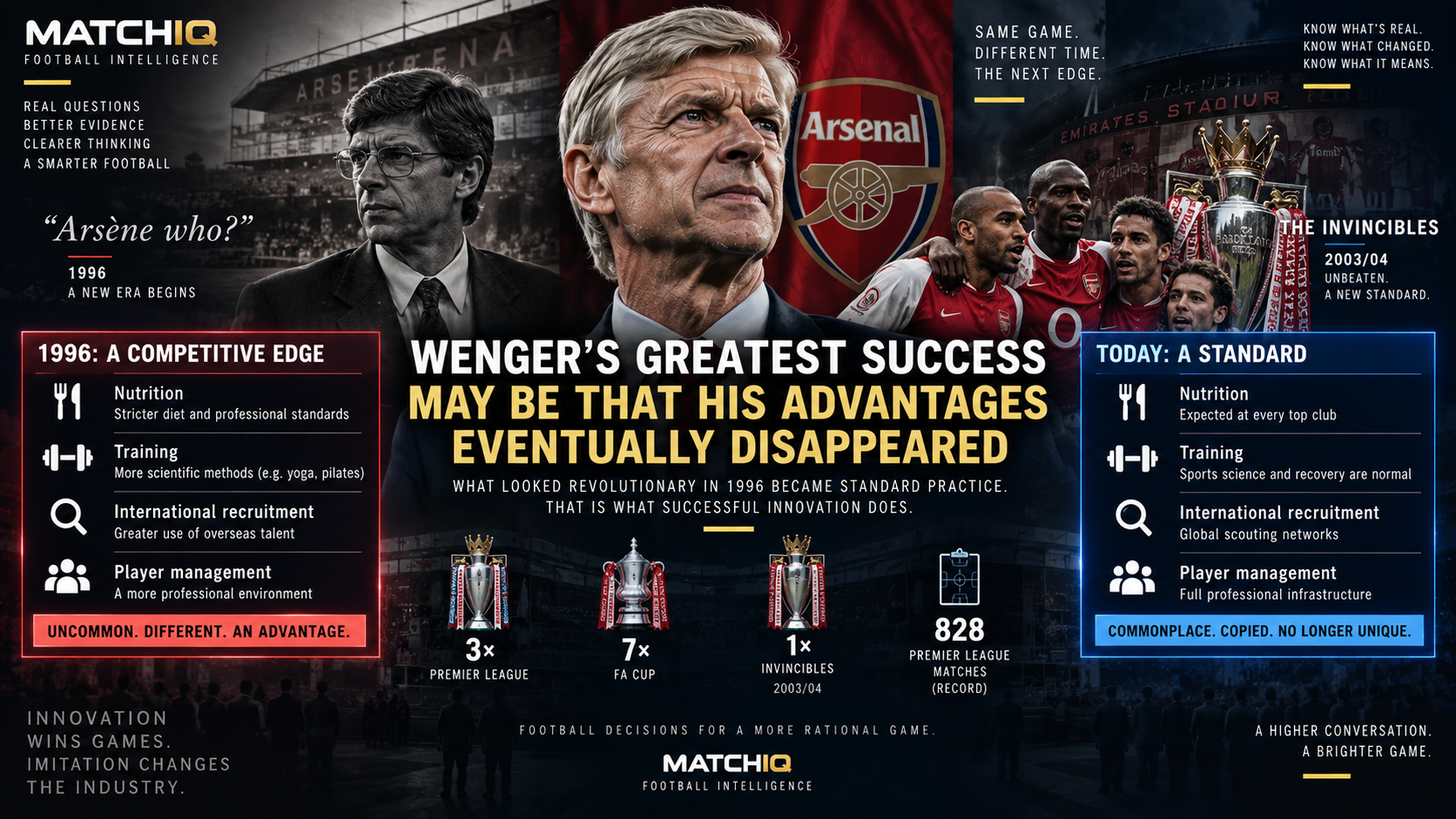
A record 828 Premier League matches as manager. Premier League
Those achievements define Wenger’s legacy.
But MATCHIQ wants to look at something else.
Why do some of Wenger’s most revolutionary ideas no longer look revolutionary at all?
The answer may be:
because they worked.
Today’s common sense was once an edge
Modern elite football assumes players will have:
professional nutrition,
individualised physical preparation,
specialist recovery,
sports-science support,
and carefully controlled training.
Nobody finds that unusual anymore.
But Wenger arrived in an English football environment where those standards were far less established.
Arsenal’s own history credits him with transforming players’ lives away from matches through new training regimes and dietary systems, while the Premier League has highlighted his influence on diet, nutrition and training methods that later became commonplace across the competition. Arsenal
That distinction matters.
Because something can look obvious after everyone has copied it.
It was not necessarily obvious before.
An advantage does not have to begin on the tactics board
Wenger is remembered for attacking football, technical players and teams built around names such as Thierry Henry and Patrick Vieira.
But some of his earliest advantages existed away from the pitch.
Better preparation.
Better physical management.
Better use of overseas talent.
A more professional operating environment.
The Premier League credits Wenger not only with changing how Arsenal played, but also with raising standards through training, diet and international recruitment. His transfer strategy helped Arsenal identify elite players abroad, including Henry and Vieira. Premier League
That is a useful football-business lesson.
Sometimes the thing changing matches does not happen during the 90 minutes.
It happens in:
the training ground,
the dining room,
the scouting department,
and the recruitment meeting.
Recruitment tells the same story
Wenger did not invent international scouting.
That would be too large a claim.
What he did was exploit international knowledge and recruitment opportunities particularly effectively at a time when English football had not yet globalised to the degree we see today.
That gave Arsenal access to talent and value that competitors were not always identifying as effectively. The Premier League has repeatedly cited Wenger’s overseas recruitment as a major part of his impact. Premier League
The edge was not:
foreign players exist.
The edge was:
Arsenal converted international knowledge into football value earlier and more effectively than many competitors.
Then the most interesting thing happened
Everyone learned.
Nutrition improved across the league.
Training became more professional.
International scouting expanded.
Sports science grew.
Recruitment networks globalised.
The practices Wenger helped normalise eventually stopped looking unusual.
The Premier League itself notes that the changes he helped drive in training and nutrition soon became commonplace. Premier League
That creates an important paradox:
The better an innovation works, the more likely competitors are to copy it.
And once enough competitors copy it,
yesterday’s competitive advantage becomes today’s baseline.
Competitive advantage has an expiry date
The pattern is simple.
You discover something others are underusing.
It works.
You win.
People notice.
They copy it.
Eventually everyone has it.
At that point, the method may still be valuable.
But it is no longer differentiating.
That distinction is crucial.
Useful does not automatically mean advantageous.
Wenger’s “lost edge” may actually be proof of success
Usually when an advantage disappears, we think something went wrong.
Wenger is different.
Many of his early edges disappeared precisely because football adopted them.
His methods became normal enough that future generations stopped seeing them as innovation.
The Premier League’s Hall of Fame recognition describes his influence as transformative both on and off the pitch, while his record eventually included three Premier League titles and the unbeaten 2003/04 campaign. Premier League
So part of Wenger’s legacy is not merely:
Arsenal did things differently.
It is:
eventually, everyone else felt they had to do them too.
Winning accelerated the imitation
Innovation without results is easy to dismiss.
Wenger’s first full season changed that.
Arsenal won the 1997/98 Premier League and FA Cup Double, making Wenger the first overseas manager to win the Premier League. Premier League
Suddenly, unusual preparation methods were not just interesting ideas.
They were attached to winning.
And football is very good at copying winners.
Then came further titles in 2001/02 and 2003/04.
In 2003/04, Arsenal went all 38 league matches unbeaten, winning 26 and drawing 12. Premier League
The longer the success continued, the stronger the incentive for everyone else to learn.
That creates the harder problem for every innovator
What happens when the rest of the industry catches up?
You can no longer say:
our nutrition is better.
Everyone has nutrition specialists.
You cannot rely forever on:
we scout internationally.
Everyone does.
You cannot simply say:
we use sports science.
That is expected.
Yesterday’s advantage eventually becomes:
the minimum standard required to compete.
That means leaders have a permanent problem:
They must find the next edge before the old one becomes normal.
RED TEAM: Wenger did not invent modern football alone
This argument should not turn Wenger into a mythical inventor of everything modern in the game.
Many of the ideas he introduced to England were already present elsewhere in European sport and football.
His significance was not that no human had ever considered nutrition, scientific training or international recruitment before him.
It was that he integrated those ideas into a successful Premier League operating model at a time when many were not yet standard in England.
Then he won with them.
That is a much more defensible claim.
And it is more interesting.
The lesson applies directly to football today
Clubs now love announcing their “competitive advantages”.
We have AI scouting.
Good.
Who else has it?
We have a data department.
Good.
Who does not?
We have sports science.
Of course.
We have a set-piece department.
If everyone builds one, what comes next?
We have a multi-club network.
If every major ownership group develops one, where is the differentiation?
The Wenger lesson is simple:
Having a capability is not the same as having an advantage.
Capability ≠ Competitive Advantage
A capability helps you operate.
A competitive advantage helps you outperform others.
The difference is whether competitors can match it.
If every elite club has:
data,
global scouting,
nutrition,
sports science,
AI tools,
and specialist coaching,
then these things remain important.
But they may no longer be a moat.
They become:
entry requirements.
Without them, you fall behind.
With them, you merely stay in the race.
MATCHIQ READ
FACT
Wenger significantly modernised Arsenal’s training, nutrition and professional standards while also exploiting international recruitment effectively. Those changes contributed to immediate success, including the 1997/98 Double. Arsenal
FACT
He later won three Premier League titles, built the unbeaten 2003/04 champions and finished with a record 828 Premier League matches in charge. Premier League
INFERENCE
Many of Wenger’s early differentiators were gradually absorbed by competitors and became standard practice across elite English football.
HYPOTHESIS
One of Wenger’s greatest long-term lessons is that a genuinely effective competitive advantage will eventually be copied.
Which means the leader’s job is never simply:
protect yesterday’s edge.
It is:
find the next one before yesterday’s becomes normal.
What we watch next
Whenever a football club claims:
“This is our competitive advantage.”
MATCHIQ should ask four things:
- Does everyone else already have it?
- How easy is it to copy?
- Does it actually change football outcomes or decision quality?
- What happens when competitors catch up?
Because competitive advantage is rarely permanent.
It is usually:
a lead with an expiry date.
Current Read
EVIDENCE-LED THESIS
Confidence: High
Wenger’s importance was not only that he knew things earlier.
It was that he implemented them successfully enough that competitors had to respond.
And when an entire industry eventually says:
“Of course professional football should work like this.”
that may be the clearest sign that the original innovation succeeded.
The edge disappears.
The standard remains.
And the search for the next advantage begins.