Could Barcola’s Real Value Be Making Wirtz Look Like Wirtz Again?
Bradley Barcola’s Premier League numbers for Liverpool currently read:
3 appearances.
170 minutes.
0 goals.
0 assists. Opta Analyst
If we only look at the scoresheet, not much has happened yet.
But maybe the first useful question about Barcola is not how many goals he scores.
Maybe it is:
Does Liverpool become easier for Florian Wirtz to play in when Barcola is on the pitch?
That is a different way of measuring value.
Barcola will eventually need goals and assists. Liverpool did not sign him simply to make clever runs that never end up on a highlight reel.
But before those numbers arrive, his movement may already be capable of changing the environment around Liverpool’s other attackers.
Wirtz could be the player who benefits most.
Barcola does not only want the ball
The obvious part of Barcola’s game is his ability to carry the ball at defenders.
The less obvious part may matter more here.
At PSG, 50.2% of his off-ball runs while his team had possession were runs in behind. He also created 72 chances from open play in all competitions last season, more than any other PSG player. Opta Analyst
That gives Liverpool two different threats from the same player.
Barcola can stay wide and receive.
Or he can suddenly attack the space behind the defensive line.
Either way, the defender has to react.
Follow him wide?
Drop with the run?
Ask a centre-back to cover?
Narrow the defence?
None of those decisions appears as a goal or assist for Barcola.
But every one of them changes the space available to somebody else.
And that somebody else may be Wirtz.
Wirtz needs space before he needs another statistic
The Wirtz problem at Liverpool has never been as simple as:
He needs to try harder.
He has continued attempting creative actions.
The bigger question is whether Liverpool can regularly put him in the places where those actions become dangerous.
Wirtz is much more threatening when he can receive:
between the lines,
in the half-space,
near the edge of the penalty area,
facing goal.
He becomes much easier to contain when he has to come deeper, receive with his back to goal or turn into an already crowded defensive block.
That is where Barcola could change the picture.
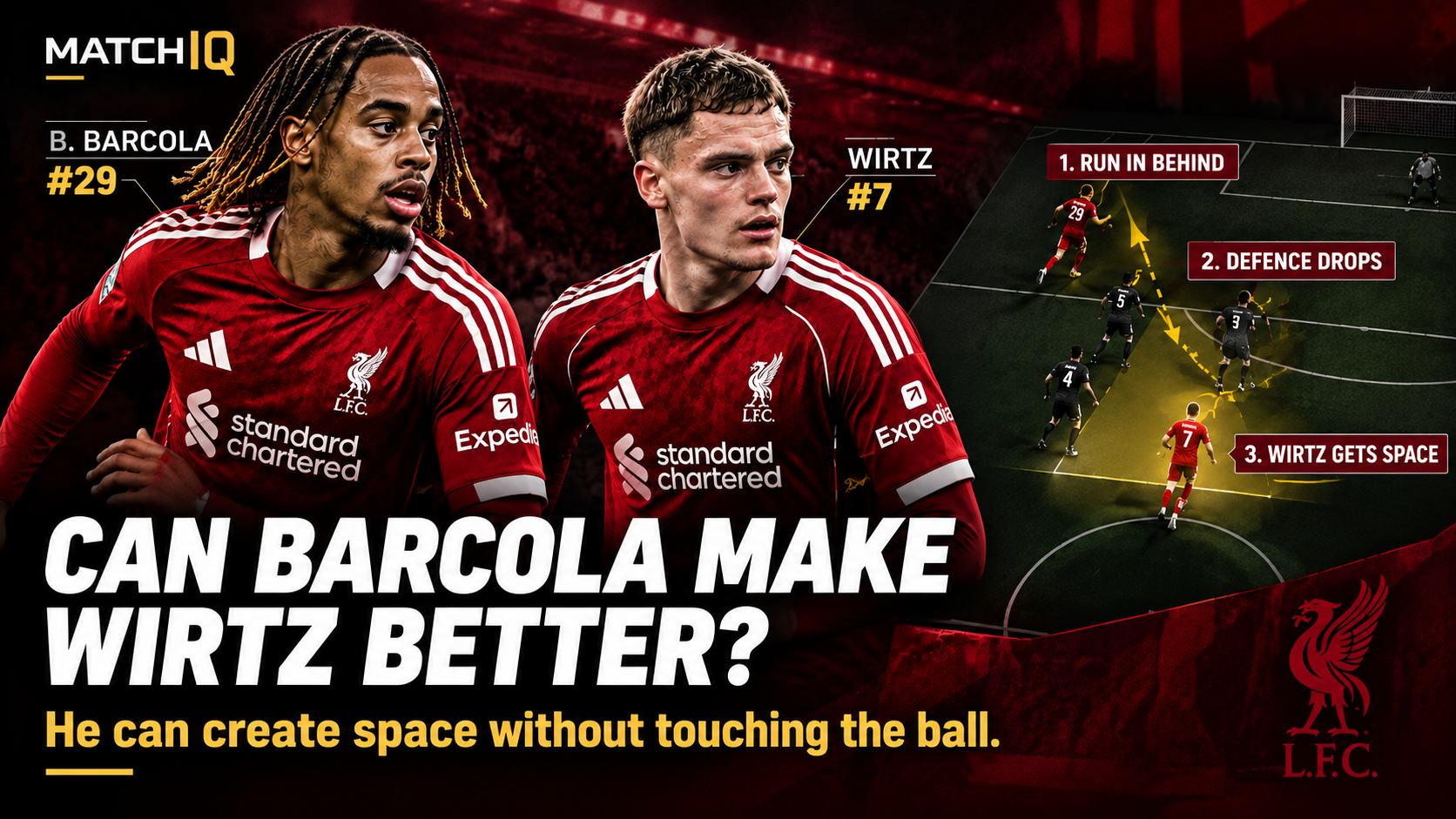
Imagine something very simple.
Barcola attacks the space behind the left-back.
The defender follows.
The centre-back drops a few metres.
Suddenly Wirtz receives inside.
Barcola may never touch the ball.
But the space Wirtz receives in exists partly because somebody else forced the defence to move.
That is the value MATCHIQ wants to track.
Atlético gave us one small glimpse
Liverpool’s Champions League game against Atlético provided an early example of what the connection could look like.
Barcola made his first Liverpool start that night. He was lively before leaving around the hour mark with cramp as Liverpool continued building his fitness. Iraola said afterwards that Barcola had created two very clear chances and confirmed the substitution was not injury-related. Liverpool FC
One attacking sequence was especially interesting.
Wirtz carried the ball forward and released Barcola into a dangerous position.
Barcola did not finish the chance.
So there was no assist for Wirtz.
No goal for Barcola.
Nothing impressive added to either player’s headline statistics.
But structurally, the idea was visible:
Wirtz progresses.
Barcola attacks the space.
The defence retreats.
A chance appears.
One action proves nothing.
But it shows what Liverpool may be trying to build.
The best version of this relationship is not two expensive attackers taking turns with the ball.
It is one player’s movement improving the next player’s decision.
Barcola’s early numbers may mislead us
Right now:
0 goals.
0 assists.
That matters.
Eventually.
But the sample is still tiny.
Barcola arrived without normal pre-season match minutes. Iraola said immediately after the signing that Liverpool had to consider that lack of game time, and after the Atlético match explained that the club was still building Barcola’s physical condition. Liverpool FC
So judging the transfer from 170 Premier League minutes would not tell us much.
A better early question is:
What changes around him when he plays?
Does the defensive line drop more?
Does Wirtz receive higher?
Does Isak get more room between the centre-backs?
Does Liverpool gain another route behind a defence instead of always asking someone to create with the ball at his feet?
Those are earlier signals.
Goals and assists can come later.
Liverpool did not buy three separate attackers
This is where expensive squads are often misunderstood.
Isak is good.
Wirtz is good.
Barcola is good.
That does not automatically mean:
1 + 1 + 1 = 3.
The best attacking units create something closer to:
Barcola makes Wirtz better.
Wirtz makes Barcola better.
Both create better situations for Isak.
That is combination value.
If Barcola runs behind and forces a centre-back deeper, Wirtz may receive more freely.
If Wirtz receives facing forward, Barcola’s next run becomes easier to find.
If the defence starts worrying about both, Isak may suddenly get the one thing every striker wants:
less attention.
That is when Liverpool stop having several expensive attackers and start having an attacking structure.
Barcola may create value without touching the ball
This is probably the easiest part to miss.
Imagine Barcola makes three runs in behind.
He receives none of the passes.
On the fourth attack, does the defender ignore him?
Probably not.
The defender begins dropping earlier.
And that movement creates space somewhere else.
Wirtz receives.
Wirtz finds Isak.
Isak scores.
The statistics might say:
Barcola: 0 goals, 0 assists.
Yet part of the reason the attack worked may have been the threat of his run.
This is not an argument for inventing a new metric called a “hidden assist”.
We do not need another framework.
It is simply a reminder:
Football value does not always begin with the last player to touch the ball.
That is especially important when evaluating a player like Barcola.
RED TEAM: The idea may be completely wrong
There is an obvious problem with this theory.
Barcola and Wirtz have barely played enough football together to prove anything.
There is another issue too.
Both players naturally like accessing the left side.
Opta’s profile of Barcola before the transfer already identified the left flank as his most natural attacking territory. Opta Analyst
That can produce two very different versions of Liverpool.
The good version
Barcola holds width or attacks behind.
Wirtz occupies the inside-left half-space.
One stretches the defence.
The other attacks the space created.
Complementary.
The bad version
Barcola moves inside for the ball.
Wirtz moves towards the same area.
Both want similar spaces.
Liverpool do not create more room.
They simply place another expensive player in the same room.
Congestion.
That is why MATCHIQ is not claiming:
Barcola has unlocked Wirtz.
There is nowhere near enough evidence yet.
Wirtz still has to do his part
There is another danger in this argument.
It could become an excuse for Wirtz.
It should not.
Even if Barcola stretches the defence perfectly, Wirtz still has to:
control the ball cleanly,
turn,
choose the right pass,
execute it,
create chances,
and eventually produce goals and assists himself.
Environment matters.
But environment cannot complete the action for the player.
That remains the lesson from the previous Wirtz analysis.
Liverpool can give him better conditions.
Wirtz still has to look like Wirtz.
MATCHIQ READ
So the current conclusion is deliberately narrow.
Barcola has not yet proven that he improves Wirtz.
But his profile gives Liverpool something that could matter enormously to Wirtz:
a forward who repeatedly threatens the space behind the defence.
At PSG, that behaviour was already a major part of Barcola’s game. He combined frequent runs behind with significant open-play chance creation. Opta Analyst
Liverpool also clearly considered him a major squad priority. Iraola described signing a high-level player for that position as a priority, while Liverpool’s official announcement highlighted Barcola’s ability to operate across the front line. Liverpool FC
So the useful question is no longer:
Is Barcola good?
Or:
Is Wirtz good?
It is:
Do they make each other better?
That is what turns individual talent into team value.
What we watch next
We only need one watchpoint.
When Barcola stays wide or runs behind from the left, does Wirtz receive more often in the left half-space and around the edge of the penalty area while facing goal?
If that starts happening repeatedly—
and Wirtz’s chance creation and final output rise with it—
the hypothesis gets stronger.
If Barcola plays and Wirtz’s receiving positions barely change—
or the two repeatedly occupy the same space—
the hypothesis weakens.
Simple.
No need to wait for Barcola to score ten goals before learning something.
Current Read
HYPOTHESIS
Confidence: Low–Medium
The player profiles fit the idea.
We have seen an early example of the connection.
But Barcola has played only 170 Premier League minutes for Liverpool so far. Opta Analyst
That is nowhere near enough to declare an answer.
For now, Barcola’s most interesting value may not be what appears beside his own name on the scoresheet.
It may be whether his presence gives Wirtz more room to become the player Liverpool thought they were buying.
And if it eventually makes Isak more dangerous too—
then Liverpool did not simply buy another winger.
They bought space.