Ten minutes.
Manchester United 2–0 Brighton.
If you’re a United supporter, this should be the moment when the shoulders finally come down.
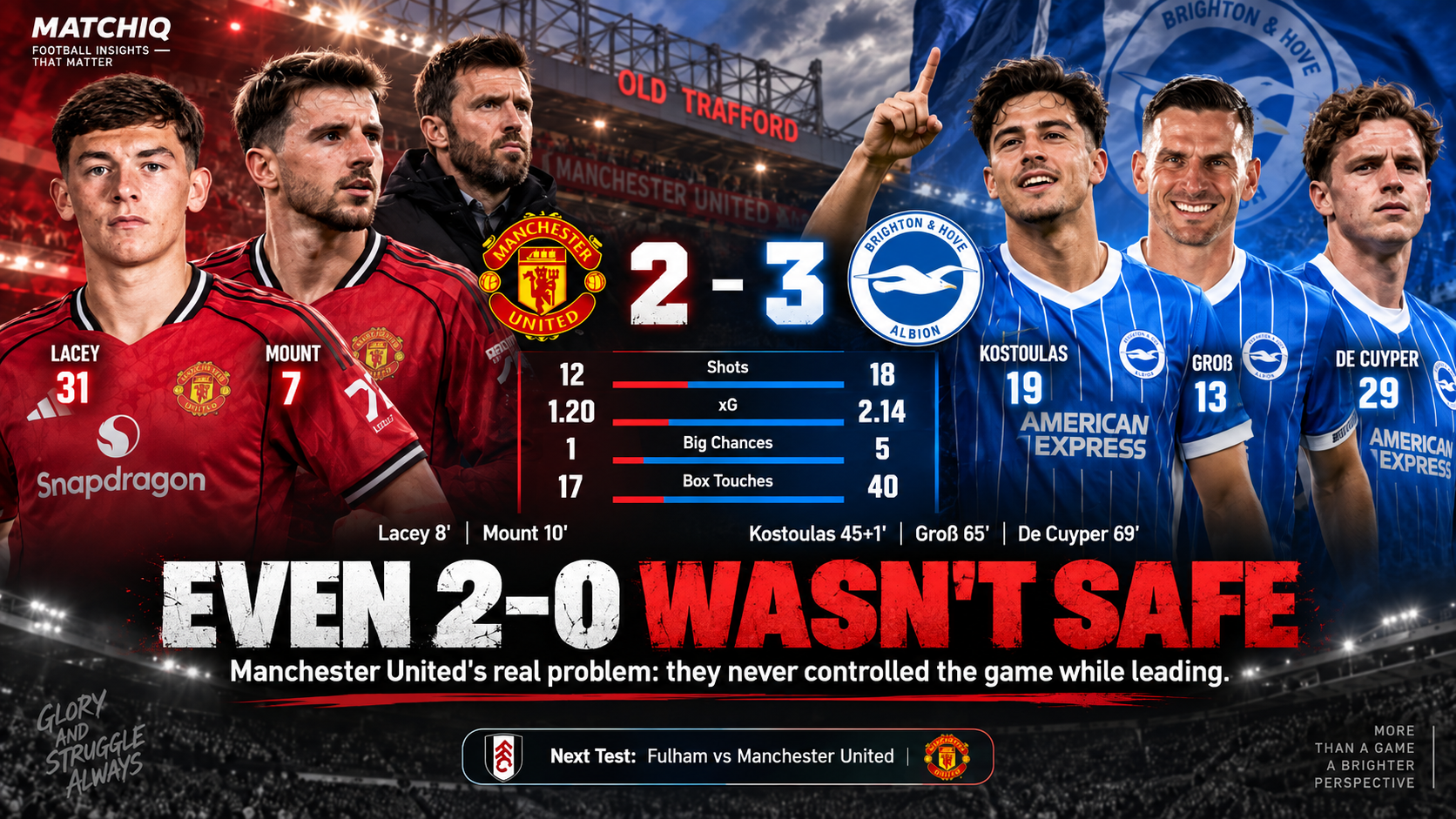
Shea Lacey scored after eight minutes.
Mason Mount added another two minutes later.
Old Trafford.
Two-goal lead.
Surely this is where the match becomes easier.
It didn’t.
45+1′:
2–1.
65′:
2–2.
69′:
2–3.
Manchester United did not merely fail to extend a two-goal lead.
They lost it completely.
But the three goals are not the most worrying part
A 2–0 lead can disappear.
Football is chaotic.
A set piece.
A mistake.
A deflection.
Sometimes the result really is stranger than the performance.
This wasn’t quite that.
Because the underlying numbers do not show a Manchester United side that controlled Brighton and then suffered three random moments.
They show this:
Shots: 12–18
xG: 1.04–2.15
Big Chances: 1–5
Touches in the opposition box: 17–39
Shots inside the box: 6–14
Possession?
Exactly:
50–50.
So while the scoreboard said:
Manchester United are in control,
the match process was saying something completely different:
Brighton are creating the better attacking environment.
That distinction is the story.
Leading is not controlling
Football often encourages us to treat those words as interchangeable.
They aren’t.
A lead is a score state.
Control is whether you can determine:
where the match is played,
how quickly it moves,
which spaces the opponent can access,
how dangerous their possessions become,
and what happens when you recover the ball.
There are many ways to control a match at 2–0.
Keep attacking.
Slow the tempo.
Dominate possession.
Drop slightly deeper and remove transition space.
Any of them can work.
But the effect should be similar:
The opponent’s route back becomes harder.
Against Brighton, the opposite happened.
The longer the game continued,
the more realistic Brighton’s comeback became.
The first Brighton goal changed the test
Charalampos Kostoulas scored in first-half stoppage time.
United still went into the dressing room ahead.
That should have been a useful reset.
Carrick had 15 minutes.
No need to chase.
No need to panic.
Re-establish the structure.
Instead Pascal Gross equalised in the 65th minute.
Four minutes later Maxim De Cuyper made it 3–2.
Four minutes.
That is the danger when game control disappears.
You do not slowly realise the match is slipping.
Sometimes the score catches up with the process before you have time to respond.
And the numbers suggest 3–2 was not some statistical freak
This is the uncomfortable part.
Brighton generated more xG.
They created five big chances to United’s one.
They had 39 touches in the United box compared with 17 at the other end.
Their 14 shots from inside the penalty area more than doubled United’s six.
This was not Brighton scoring three improbable goals from nowhere.
They consistently reached areas from which goals become realistic.
So simply calling this:
“bad luck”
does not work.
Neither does reducing the entire defeat to individual defensive mistakes.
When the opponent keeps entering dangerous territory, an individual error is often only the final event in a longer chain.
Then comes the historical warning
This was the first time in 50 years that Manchester United lost at Old Trafford after holding a two-goal lead.
The previous occurrence came in 1976.
That statistic does not diagnose a tactical problem on its own.
But it tells us something useful:
This is not a normal way for Manchester United to lose at home.
And if a two-goal advantage at Old Trafford cannot make the match safer, then one question becomes unavoidable:
What exactly is this team using to close games?
Right now, the answer is unclear.
Carrick accepted responsibility
Michael Carrick took responsibility for United’s second-half performance.
That matters.
But identifying a problem and correcting it are different things.
Fortunately, the next test arrives quickly.
Fulham away.
And MATCHIQ now has a clean receipt.
Against Fulham, don’t only watch the result
United could win 3–0.
Great.
But if they take the lead again, something else becomes more useful to track:
What happens during the next 15–20 minutes?
Brighton created a gap between scoreline and process.
The scoreboard favoured Manchester United.
The dangerous actions increasingly favoured Brighton.
Against Fulham, watch whether those two things finally align.
After United score:
Do opposition box entries rise quickly?
Do big chances start shifting towards Fulham?
Can United progress after regaining possession?
Are Carrick’s substitutions managing the game proactively?
Or are they emergency responses after control has already disappeared?
Those questions tell us more than whether the final score reads 1–0 or 3–1.
MATCHIQ RECEIPT
CURRENT STATUS: CONTROL FAILURE SIGNAL
Confirmed:
Manchester United led:
2–0.
Final result:
2–3.
Underlying process:
xG 1.04–2.15
Big Chances 1–5
Box touches 17–39
Shots inside the box 6–14
And Brighton’s comeback was not one sudden freak sequence.
It developed from before halftime and continued into the second half.
We are not yet freezing this claim:
“Manchester United cannot manage leads.”
One game cannot prove that structural conclusion.
What we are freezing is narrower:
Even with a 2–0 advantage, Manchester United failed to establish stable control of the match.
Next validation:
Fulham vs Manchester United
United take a lead and the game stabilises:
SIGNAL WEAKENED / CORRECTED
The same sequence returns:
Lead
→ opponent pressure rises
→ higher-quality chances conceded
→ United retreat
→ reactive substitutions
SIGNAL → REPEATED PATTERN
A 2–0 lead should make a game feel increasingly safe.
Manchester United’s problem against Brighton was simple:
The score was safe.
The match never was.
Know What’s Real.
Know What Changed.
Know What It Changes.
Sources
Manchester United Official Match Report
Manchester United — Michael Carrick Post-Match Press Conference
Reuters — Manchester United 2–3 Brighton
FotMob Match Data