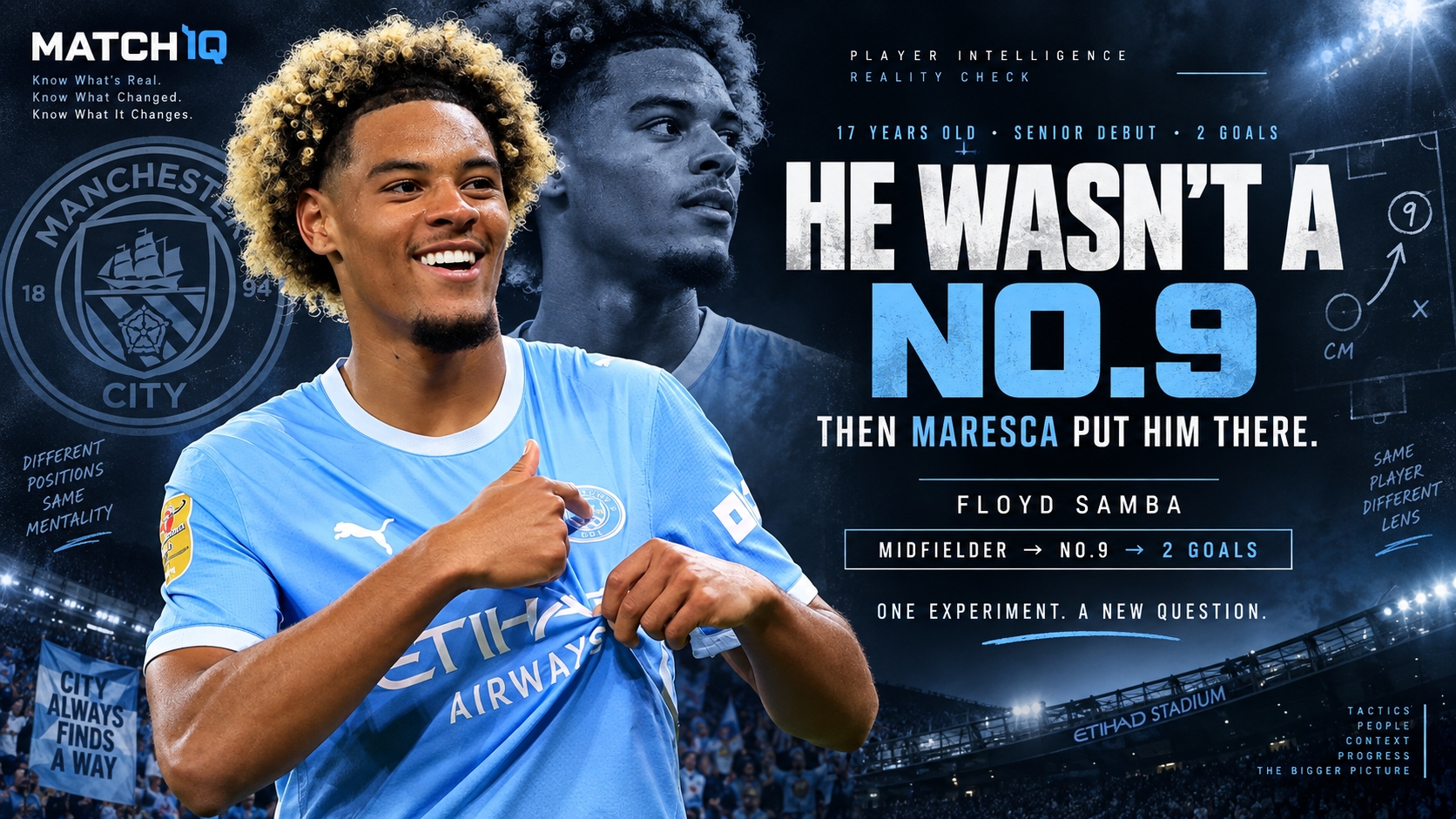
Man City 5–0 Norwich: Floyd Samba Wasn’t a No.9 — Then Maresca Put Him There
Five goals.
Ten changes.
Another comfortable Manchester City cup night.
Normally, that is where the story ends.
Strong squad.
Young players get minutes.
Everyone goes home happy.
But somewhere inside City’s 5–0 win over Norwich, something much more useful happened.
Enzo Maresca took a 17-year-old midfielder who had never played as a No.9 before and asked him to lead the line.
Floyd Samba scored twice.
And suddenly the question changed.
Not:
“Is Floyd Samba a striker?”
He is not — at least not yet.
The better question is:
Why did the experiment work well enough to make Maresca consider doing it again?
Manchester City officially profiled Samba as a midfielder before this game: strong, technical, intelligent, capable of finding pockets, progressing possession, running relentlessly and arriving in the opposition box. In 2025/26 he produced 17 goals and six assists across 24 youth appearances. Manchester City FC
That last detail matters.
He was already a midfielder who liked arriving where goals happen.
Maresca simply moved the starting point.
This really was an experiment
This was not a hidden positional history finally being revealed.
Maresca said afterwards that Samba had played very few games as a No.9. When the coach asked whether he had played there before, Samba told him he had not.
The experiment only began in the days before Norwich. Manchester City FC
That changes how we should read the performance.
If a natural striker scores twice against Championship opposition, good performance.
If a midfielder is moved into an unfamiliar role and immediately produces two different types of striker finish, the tactical question becomes more interesting.
Goal one: the part you cannot fake easily
Nico O’Reilly delivered from deep.
Allan returned the ball into the middle.
Samba appeared in the right central area and guided his header home.
Simple.
Almost boring.
And that is exactly why I like it.
The hardest part of being a striker is not always the finish.
It is arriving in the correct place before everybody else understands where the ball is going. Manchester City FC
Samba did not look like a midfielder visiting the penalty area.
For that moment, he looked comfortable living there.
Goal two showed another side
The second was different.
Rayan Aït-Nouri found him from the right.
Samba received the ball and curled his finish beyond the goalkeeper.
One goal came from No.9 positioning.
The other came from a player comfortable receiving and finishing with the ball in front of him. Manchester City FC
That combination is why this experiment deserves another look.
Not because it proves he is a striker.
Because it suggests his existing midfield qualities might translate forward.
The clues were already there
City’s academy description of Samba is revealing.
Strong.
Technical.
Clever.
Finds pockets.
Runs relentlessly.
Tracks back.
Overloads the box.
Can pass.
Can score.
Read that again, but imagine the player starting ten metres higher.
Suddenly the experiment makes sense. Manchester City FC
A midfielder who naturally attacks the box may already possess one half of a modern forward profile.
The question is whether he can learn the other half:
playing with his back to goal,
occupying centre-backs,
timing runs from the highest line,
receiving under pressure,
and making decisions when space disappears.
Norwich did not answer those questions.
It simply gave City a reason to ask them again.
This is where hype normally goes wrong
Two goals.
17 years old.
Manchester City.
It would be very easy to write:
CITY HAVE FOUND HAALAND’S HEIR.
No.
One Carabao Cup game against Norwich cannot support that.
Maresca himself applied the brakes.
He praised Samba’s finishing, strength, energy and decisions, but immediately reminded everyone that the player is young and must be developed slowly. Manchester City FC
That is important.
The manager is not telling us:
“We discovered our new striker.”
He is telling us:
“This worked.”
Those are very different statements.
Allan matters too
Samba was not the only new decision that paid off.
Allan made his first City start and produced a goal and an assist.
He created Samba’s opener, then scored early in the second half. Manchester City FC
Ryan McAidoo later added the fifth.
So this was not simply City’s senior players crushing Norwich while the kids watched.
Several players outside the normal first-choice structure actually produced the goals.
That gives Maresca something every manager wants:
more usable options.
But Samba is the most interesting case because his option did not exist a week earlier.
That is the Decision Change
Before this match:
Floyd Samba = young Manchester City midfielder.
Then:
Maresca tests Samba at No.9.
Then:
senior debut.
Then:
two goals.
Now:
does Maresca use him there again?
That final arrow is the only one that matters next.
Because development is not proved by a highlight.
It is proved when evidence changes future decisions.
Brighton is now the perfect checkpoint
Manchester City will host Brighton in the fourth round. Manchester City FC
That creates a very clean future test.
If Samba is used as a No.9 again, particularly from the start, then Norwich was not simply a one-night emergency experiment.
If he returns immediately to midfield and the idea disappears, the interpretation changes.
Either outcome is useful.
Because now we have a frozen baseline.
MATCHIQ READ
The best thing Floyd Samba did against Norwich was not score two goals.
It was make a new question worth asking.
Manchester City already knew he could play midfield.
They already knew he could run.
They already knew he could score from deeper positions.
What they did not know was whether those qualities could survive when his starting position moved to the front line.
For one night, they did.
That does not make him a No.9.
It makes him an option that did not clearly exist before.
And sometimes that is how a career changes.
Not because a player suddenly becomes someone else.
But because a coach discovers another way to use what was already there.
MATCHIQ
Know What’s Real. Know What Changed. Know What It Changes.