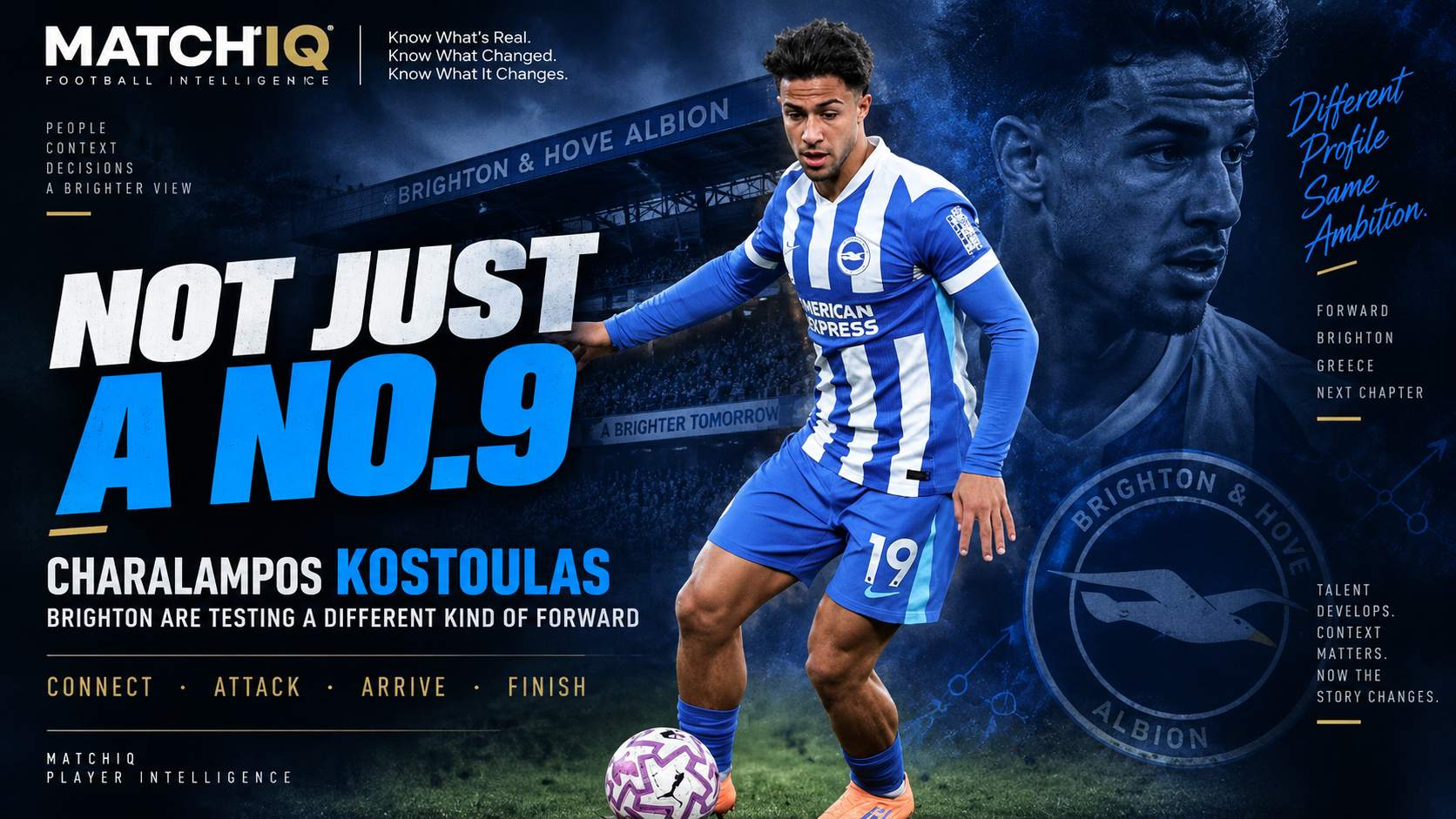
Charalampos Kostoulas Is Not a Traditional No.9 — Brighton Are Testing a New Attacking Answer
Football has a bad habit with young forwards.
If he is tall, scores goals and wears No.19, we immediately put him in the striker box.
Stay central.
Fight centre-backs.
Wait for crosses.
Finish chances.
Charalampos Kostoulas does some of that.
The interesting part is everything else.
Because the more Brighton use him, the less he looks like a striker who simply waits for the game inside the penalty area.
He drops.
He combines.
He presses.
He attacks space.
He gives the ball away and immediately wants it again.
And somehow, after appearing twenty metres deeper a few seconds earlier, he still manages to arrive around the box.
That is why I would not describe him simply as Brighton’s next No.9.
He looks more like a hybrid forward.
And Brighton are beginning to find out what that could become.
The résumé is already unusually serious for a 19-year-old
Kostoulas came through Olympiacos.
But this was not a case of a teenager scoring twenty goals in youth football and immediately getting a Premier League transfer.
At 16 and 17, he was already playing meaningful European knockout football.
Olympiacos won the 2023/24 UEFA Youth League — the first Greek club ever to win a UEFA competition — and Kostoulas scored five times during the campaign. Brighton later recorded his tournament return as five goals and two assists in nine games. UEFA.com
Then came senior football.
In 2024/25 he made 35 appearances for Olympiacos, scored seven goals, added two assists and helped them win the Greek league and cup double.
He was still 17 for much of it. Brighton & Hove Albion
That matters.
Brighton were not buying a player who had only dominated people his own age.
They were buying someone whose first contact with adult football had already begun.
But Brighton did something important: they did not rush the story
This is where young-player analysis often becomes ridiculous.
Huge transfer.
Big reputation.
Then everyone wants the answer after three weeks.
Is he world-class?
Is he a flop?
Can he replace the senior striker?
Brighton were more patient.
Kostoulas made 25 appearances during his first season in England, but the club repeatedly framed that period as adaptation rather than immediate succession planning. Brighton & Hove Albion
And then came Bournemouth in January.
90+1.
Ball drops.
Chest control.
Back to goal.
Bicycle kick.
1–1.
It was the kind of goal designed to destroy reasonable analysis.
Because after seeing that, every football fan wants to skip directly to:
SUPERSTAR.
Premier League later nominated it for January Goal of the Month. Premier League
Wonderful goal.
But one wonderful goal is not the reason I am more interested in him now.
The real question is what type of forward he is
Kostoulas is 1.85m.
He can occupy centre-backs.
He attacks aerial balls.
He clearly enjoys contact.
So the traditional striker characteristics are there.
But Brighton’s own profile described him as capable of playing centre-forward, wing or attacking midfield. Brighton & Hove Albion
That explains a lot.
Because he rarely behaves like a player whose job ends with standing between two centre-backs.
Watch his possessions.
He will often come toward the ball.
Receive.
Connect.
Move it.
Then immediately start another run.
That final part is important.
He does not drop deep because he wants to become a midfielder.
He drops deep so he can become a striker again somewhere else.
That is the difference.
Receive → connect → attack again
This might eventually become his defining pattern.
Some forwards come short and help the build-up.
Useful.
But after passing, they admire their work.
Kostoulas often treats the pass as the beginning of the next action.
He comes toward midfield.
Moves a defender.
Connects with a teammate.
Then attacks the space created by the movement.
It means he can appear twice in one possession:
First as the connector.
Then:
as the finisher.
That gives defenders an uncomfortable decision.
Follow him?
Space opens behind.
Stay?
He may receive between the lines.
That is why I currently prefer the phrase:
Hybrid Forward
rather than simply No.9.
He still remembers where the goal is
There is one danger with technical forwards.
They become so interested in linking play that eventually you wonder:
Mate, weren’t you supposed to score?
Kostoulas has not forgotten.
His game still contains a striker’s instinct for:
loose balls,
second actions,
box entries,
aerial situations,
and shooting quickly when space appears.
The Bournemouth bicycle kick is the ridiculous example.
Yesterday against Arsenal gave us the more useful one.
Arsenal was not just another goal
Brighton beat the reigning Premier League champions 3–0 yesterday.
Kostoulas started.
Not twenty minutes from the bench.
Not a 3–0 cameo.
Started.
Early in the game, Brighton won possession high and his volley was heading toward the far corner before David Raya tipped it away.
For Pascal Groß’s opener, Kostoulas and Chema Andrés were involved in the construction.
Then, just before half-time, Brighton transitioned from Bart Verbruggen.
Space appeared outside the box.
Kostoulas did not hesitate.
Right foot.
The goal matters.
But the decision matters more.
Fabian Hürzeler chose him to start this game.
That is the real signal.
Young players do not develop only because their attributes improve.
They develop when the decisions around them change.
Minutes change.
Role changes.
Teammates trust them differently.
Managers give them more difficult assignments.
Yesterday was one of those checkpoints.
The numbers are now beginning to move too
As of September 20, Brighton’s official season data has Kostoulas at:
10 appearances
6 starts
597 minutes
4 goals
2 assists. Brighton & Hove Albion
That is still a tiny sample.
Important sentence:
tiny sample.
We are not doing the football-internet thing where four goals become a £100m valuation overnight.
But compare the question with twelve months ago.
Then:
Can he adapt to England?
Now:
How much can Brighton actually use him?
That is a meaningful change.
And Greece are making the same decision
The Greek senior team called him up for the first time in November 2025.
The national federation currently records four senior appearances. ΕΠΟ – Ελληνική Ομοσπονδία Ποδοσφαίρου
Again:
four caps do not make him an elite international.
That is not the point.
The progression is:
Youth football.
Olympiacos first team.
Premier League.
Brighton starts.
Senior Greece.
Different coaches, different environments, same thing:
responsibility increasing.
That is what I want to track.
Do not call him the next João Pedro yet
Brighton comparisons are almost unavoidable.
A young forward who can leave the No.9 position?
João Pedro.
Easy.
Too easy.
João Pedro developed into a much more sophisticated creator between the lines.
His ability to manipulate possession, combine in tight spaces and create for others was central to his value.
Kostoulas currently feels more direct.
More physical.
More aggressive.
More interested in attacking the next action.
João Pedro could make an attack more intelligent.
Kostoulas, at this stage, often makes an attack more violent.
That is not better or worse.
It is different.
And different is precisely why this story is useful.
So what still needs proving?
A lot.
And this is where we stop the hype.
1. Finishing repeatability
Bicycle kicks are fun.
Goals against Arsenal are fun.
Top forwards also score boring goals.
Eight-yard rebounds.
Back-post touches.
One-touch finishes after an ugly match.
Can he generate normal goals repeatedly?
That matters far more than a highlight reel.
2. Link play under pressure
Dropping between lines looks easy when there is space.
Doing it with a Premier League centre-back leaning through your back is different.
Can he consistently protect the ball, connect and keep the possession alive?
That determines whether his hybrid profile works every week.
3. Decision quality
Young forwards often have one understandable problem.
They want to make everything happen.
Shoot.
Dribble.
Run.
Again.
Again.
Again.
The next level is knowing which action improves the possession rather than simply making the possession exciting.
4. What happens after opponents adjust?
This is the big one.
Eventually scouting reports change.
Do not let him turn.
Do not follow him too far.
Force him onto certain receiving angles.
Crowd his link-up zones.
Then what?
Elite talent is not revealed when nobody understands you.
It is revealed after they do.
MATCHIQ CURRENT READ
Kostoulas is not a finished Premier League striker.
He does not need to be.
He is 19.
The more useful observation is that Brighton’s question around him appears to be changing.
From:
How do we develop him?
toward:
How do we use him?
That is a much more important transition than four goals.
Because goals fluctuate.
Roles tell you what the people working with the player every day are beginning to believe.
Olympiacos trusted him early.
Greece have started bringing him into the senior team.
Brighton are now giving him starts.
And against the defending champions, he did not look like a kid waiting for his moment.
He looked like part of the plan.
So I would not ask whether Charalampos Kostoulas is Brighton’s next great striker yet.
I would ask something more useful:
What happens if a 1.85m striker with box instinct learns to become equally dangerous outside the box?
Brighton are starting to find out.
MATCHIQ
Know What’s Real. Know What Changed. Know What It Changes.