The scoreboard says:
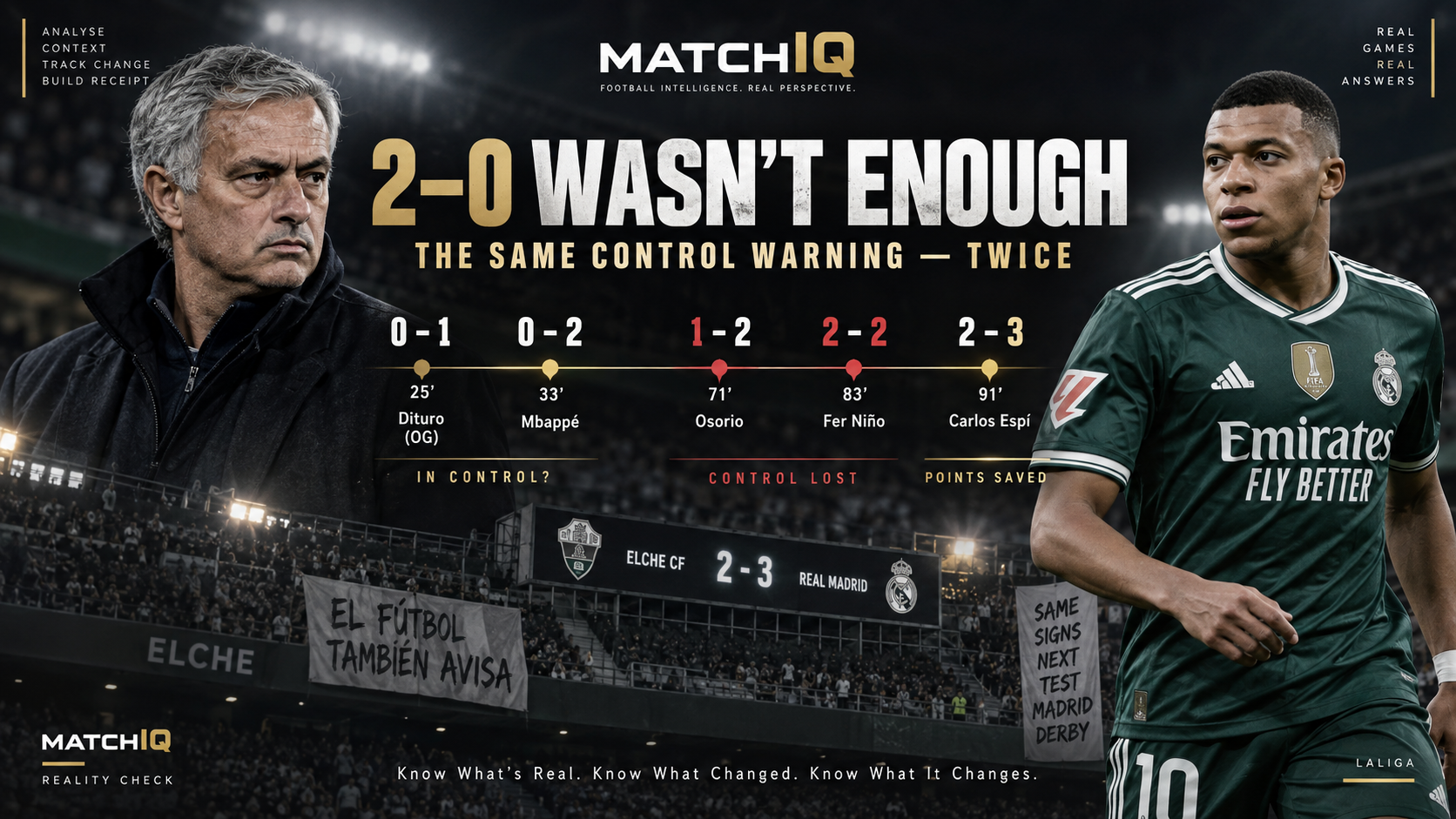
Elche 2–3 Real Madrid.
Three points.
Carlos Espí with a 91st-minute winner.
Move on.
Except that is not the part of this match worth saving.
The more useful question is:
How did a Real Madrid side already leading 2–0 allow the match to become competitive again?
Madrid had done the difficult part.
A Matías Dituro own goal opened the scoring in the 25th minute.
Eight minutes later, Kylian Mbappé made it 2–0.
This should have been the beginning of the end.
Push for three.
If three never arrives, control the tempo.
Control territory.
Make Elche chase.
Instead:
71′ — 2–1.
83′ — 2–2.
Only Espí’s stoppage-time winner prevented a completely different post-match conversation.
The obvious story is:
Madrid survived.
The more important MATCHIQ story appeared before Elche equalised.
Mourinho had already recognised the problem
After the match, José Mourinho focused on Madrid’s failure to finish the contest and the loss of control that followed.
That distinction matters.
Missing an opportunity to make it 3–0 is one problem.
Allowing the entire match state to change because it remains 2–0 is another.
A mature side should still be able to manage possession, territory, tempo and risk when the third goal never arrives.
Madrid did not.
And crucially, Mourinho appeared to recognise that danger while the scoreboard still looked safe.
The score said 2–0.
The match no longer felt under control.
That is the signal.
Rayo had already provided the first warning
One game is noise.
Football changes quickly.
Opponents react.
Teams relax.
But three days earlier, something similar happened against Rayo Vallecano.
Madrid led 3–0 at halftime.
They eventually won 4–1.
Yet Rayo produced a spell of second-half pressure, scored in the 51st minute and forced Madrid to defend a game that had looked finished.
Rayo never turned that spell into a genuine comeback.
Elche did.
Put the two matches together:
Rayo: 3–0 → control drops.
Elche: 2–0 → control drops → 2–2.
Two matches are still not enough to declare a structural weakness.
MATCHIQ will not make that leap.
But they are enough to create a signal worth tracking.
And now comes Atlético
That is what makes Elche immediately relevant.
Madrid’s next fixture:
Atlético Madrid vs Real Madrid.
The Metropolitano.
The Madrid derby.
If Madrid take the lead again, the first question should not simply be whether another goal follows.
Watch what happens to the match itself.
Does pressing intensity drop?
Does territory move towards Madrid’s goal?
Does the opponent begin sustaining possession in dangerous areas?
Does Mourinho again need substitutions to recover control?
If the same sequence appears for a third consecutive league match:
Lead
→ intensity falls
→ territory conceded
→ opponent takes control
→ corrective changes
then Elche becomes more than a dramatic near-collapse.
It starts becoming evidence of something repeatable.
If Madrid correct it against Atlético, that matters too.
MATCHIQ RECEIPT
Current status:
SIGNAL
Not:
PROVEN STRUCTURAL PROBLEM
Next validation:
Atlético Madrid vs Real Madrid
Repeat:
SIGNAL → REPEATED PATTERN
Correction:
SIGNAL → WEAKENED / CORRECTED
The point is not to say:
“We told you so.”
The point is to record the signal before the next test arrives.
Know What’s Real.
Know What Changed.
Know What It Changes.