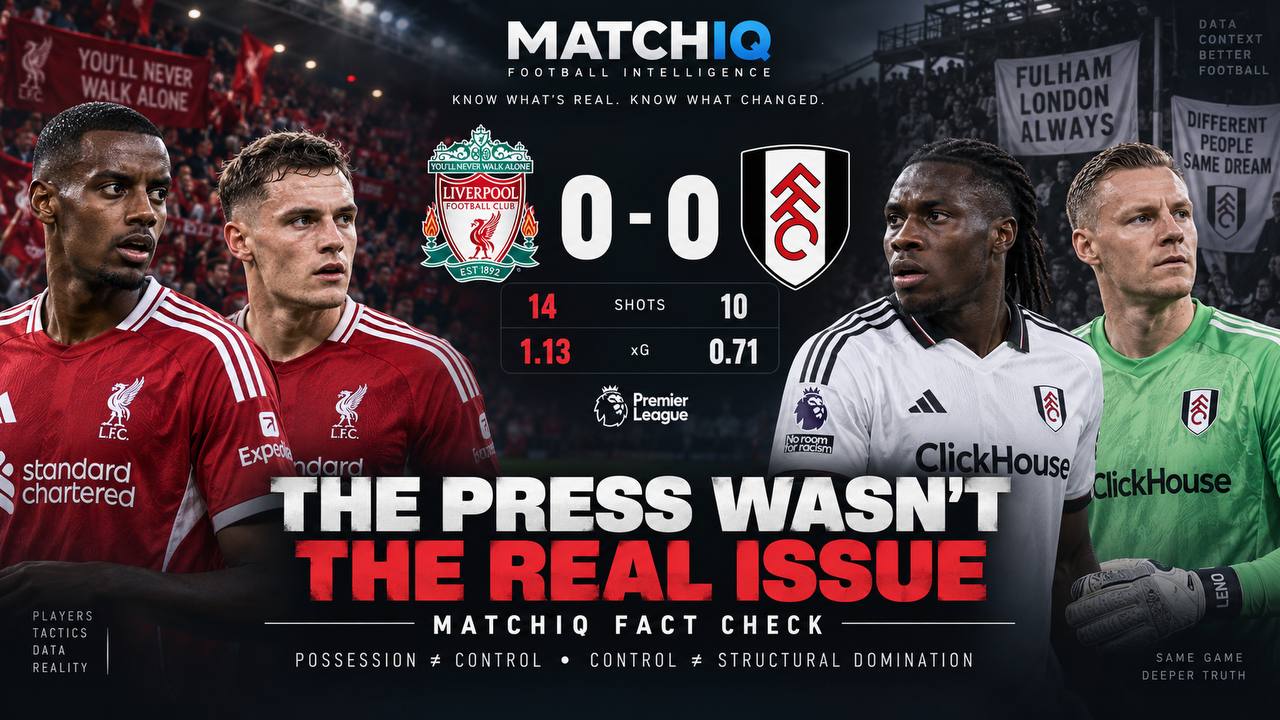
Before kick-off, MATCHIQ framed Liverpool vs Fulham around one question:
How long could Fulham’s press survive?
After 90 minutes, Liverpool had been held 0–0 at Anfield.
The post-match evidence suggests our original question was only partly useful.
Fulham did not need to press Liverpool relentlessly for an entire match. They only needed enough pressure, defensive organisation and counter-attacking threat to prevent Liverpool from turning territorial control into sustained attacking superiority.
Opta’s numbers underline that point.
Liverpool edged the shot count 14–10 and expected goals 1.13–0.71. That is an advantage, but not the profile of a game in which the home side repeatedly dismantled the opponent. Opta also noted that Liverpool “did not do enough to warrant the three points.”
The match itself contained warnings in both directions. Jérémy Jacquet made a goal-line clearance, Alisson was forced into an important save, while Bernd Leno denied Liverpool at the other end. Fulham therefore remained a threat even when Liverpool had periods of greater control.
That changes the MATCHIQ question.
The important issue was not:
Can Fulham press for 90 minutes?
It was:
When Fulham’s pressure drops, can Liverpool punish them?
Against Fulham, the answer was no.
MATCHIQ Signal
Possession ≠ Control.
Control ≠ Structural Domination.
Liverpool were able to move the match forward without consistently forcing Fulham into the kind of defensive disorganisation that creates repeated high-quality chances.
That distinction matters.
A finishing problem occurs when a team creates enough chances but fails to convert them.
A structural problem occurs earlier in the chain:
territory → defensive movement → box access → high-quality chance
Against Fulham, Liverpool never consistently completed that chain.
Reuters described Liverpool as lacking energy and sharpness, while Iraola himself acknowledged the team lacked freshness after the short turnaround from their Champions League match against Atlético Madrid. Liverpool have now drawn three of their first four league games under Iraola.
MATCHIQ Prediction Audit
Pre-Match Frame: Fulham’s pressing endurance would be a central variable.
Post-Match Reality: Fulham did not need continuous pressing to stay competitive.
Audit Verdict:PARTIALLY INVALIDATED
The missing variable was Liverpool’s ability to exploit the moments when Fulham stopped pressing.
That becomes the next signal to track.
MATCHIQ Verdict
The biggest warning was not the 0–0 scoreline.
It was that Liverpool never consistently forced Fulham into structural collapse.
Fulham’s press was not the real issue.
Liverpool’s inability to punish what came after it was.
Know What’s Real. Know What Changed.
Sources: Opta Analyst, Reuters, The Guardian.