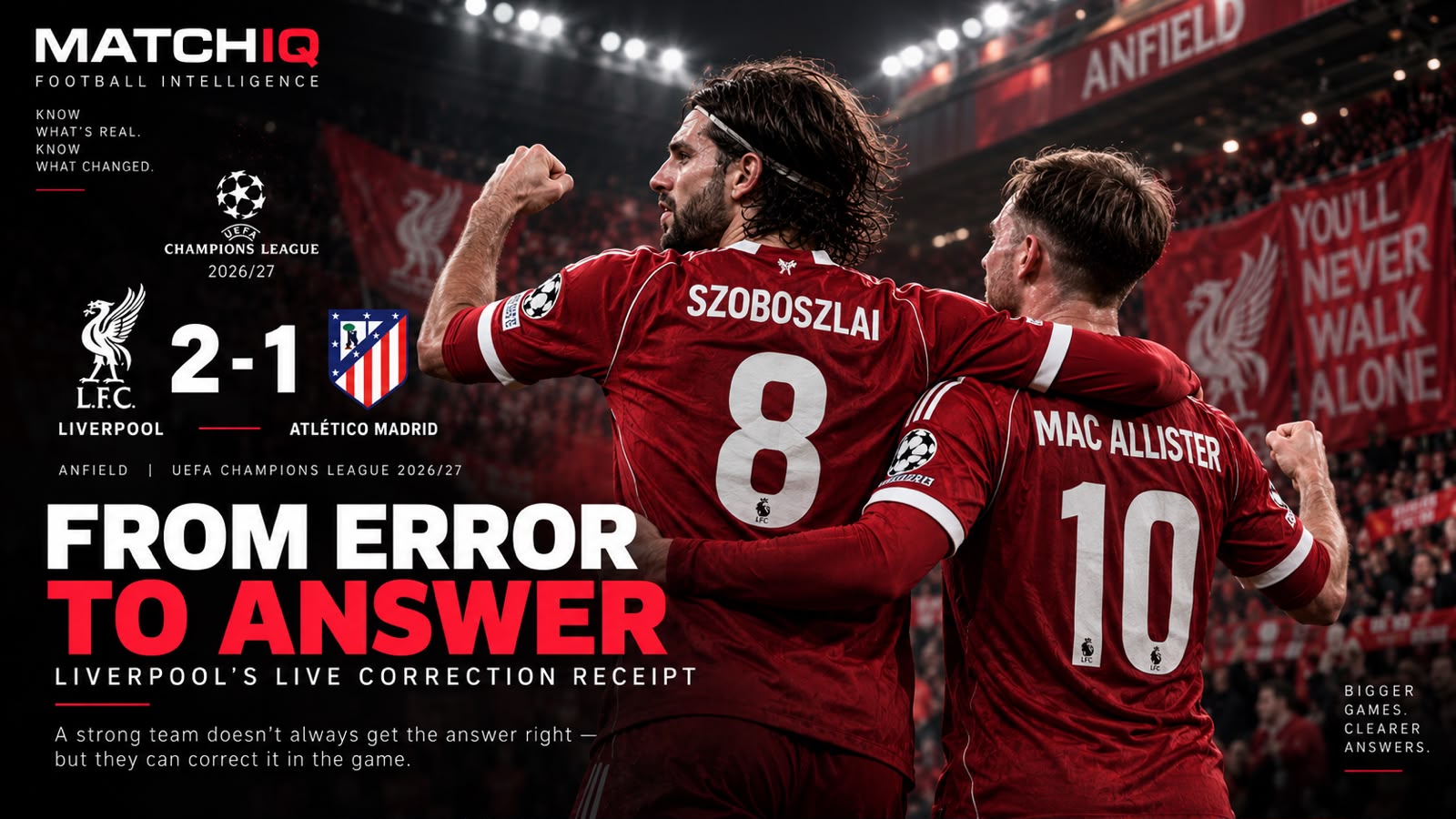
Liverpool opened their 2026/27 Champions League campaign with a 2–1 victory over Atlético Madrid at Anfield.
Marcos Llorente gave Atlético the lead after 17 minutes before Dominik Szoboszlai levelled in the 40th minute and Alexis Mac Allister completed the turnaround five minutes after half-time.
It can easily be framed as another Liverpool comeback.
MATCHIQ sees something more important.
Liverpool began the game with an imperfect answer — and corrected it before the game ended.
CURRENT STATE
Atlético’s opening structure created a problem Liverpool had not fully anticipated.
After the game, Andoni Iraola acknowledged his own responsibility for the difficult start and explained that Liverpool initially struggled to match Atlético correctly.
The consequence arrived quickly.
Llorente scored.
0–1.
STATE CHANGE
Liverpool did not simply continue executing the same plan harder.
The match-ups began to change.
Liverpool gradually moved the contest away from Atlético’s preferred state and back towards a game in which the home side could sustain pressure and create second-phase attacks.
Ronald Araújo helped create Szoboszlai’s equaliser.
Then Rio Ngumoha’s work from the flank contributed to a loose ball falling for Mac Allister, who drove Liverpool ahead.
LIVE CORRECTION RECEIPT™
Traditional post-match language would call this resilience, mentality or Anfield spirit.
Those descriptions are not wrong.
They are incomplete.
The more useful question is:
What did Liverpool actually change?
The sequence matters:
Plan A
→ Opponent Response
→ Problem Detected
→ Live Correction
→ New Match State
→ Result
MATCHIQ defines that evidence as a:
LIVE CORRECTION RECEIPT™
It does not prove Liverpool are already a complete side.
It proves something else:
Problems are beginning to be solved before the next match arrives.
THE NUMBERS
Liverpool finished with 14 shots and 1.68 expected goals.
Atlético produced nine shots and 0.81 xG.
So although Atlético scored first, the underlying chance production does not support the idea that they controlled the entire contest.
Liverpool’s comeback was accompanied by a genuine change in attacking output.
THE WARNING
The opening goal should not disappear simply because Liverpool won.
The early structural recognition remains a concern.
Against an even more dangerous transition side, one incorrect match-up may create a bigger punishment.
Therefore the MATCHIQ conclusion is not:
Liverpool have solved the problem.
It is:
Liverpool are beginning to show that they can solve problems.
That distinction matters.
MATCHIQ VERDICT
Signal Rating: 8.4/10
KEEP
Second-phase attacks, Szoboszlai’s forward arrivals and Mac Allister’s threat from range.
ITERATE
Early recognition of unfamiliar opposition structures and defensive match-ups.
WATCH
Transition protection, Barcola’s physical build-up and the continued development of Iraola’s mechanisms.
Liverpool collected three Champions League points.
But the more valuable receipt came from somewhere else:
When their first answer was wrong, they showed they could rewrite it before the match was over.
Know What’s Real.
Know What Changed.
— MATCHIQ Football Intelligence
Sources, data definition and verification boundary | 10 September 2026
- Liverpool official match report — supports the 2–1 result, scoring order, Araújo’s role in the equaliser, Ngumoha’s role before the winner, Barcola’s first start and Gakpo’s absence.
- Iraola official post-match conference — supports his responsibility for the start, Atlético using a structure not previously seen that season, and Liverpool initially failing to match it correctly.
- Opta Analyst match data — supports Liverpool’s 14 shots and 1.68 xG against nine shots and 0.81 xG.
Source scope: Official material supports the match events and Iraola’s public account of the opening match-up problem; Opta supports the statistics used in the article. LIVE CORRECTION RECEIPT is MATCHIQ tactical INFERENCE from that evidence, not a conclusion stated by the club or Opta. Shot and xG definitions can differ by provider, so the figures should be read as the Opta measure.
Calibration note: Signal Rating 8.4/10 is a legacy editorial rating without a published rubric or calibration sample. It remains for history but is excluded from formal accuracy or confidence reporting.
FACT / INFERENCE / FORECAST / HUMOUR: Result, events, public comments and Opta values are source-backed FACT. The live-correction mechanism and match-state change are MATCHIQ INFERENCE. Repeatability against different opposition structures remains an OPEN FORECAST. This addendum contains no HUMOUR.
Reality Delta
Previous state: The article supplied match and xG details without sources, provider definition or a Next Check.
New evidence: The official report, manager conference and Opta data now map to the claims.
Material change: The opening match-up problem has manager-statement support and the exact figures have provider attribution.
No change: One successful comeback does not prove that early structural recognition is solved.
Impact: LIVE CORRECTION moves from observation to SUPPORTED SIGNAL while the overall system remains WATCH.
Confidence boundary: The precise match-up changes remain tactical interpretation and 8.4/10 has no measurement meaning.
Next Check: Against LASK in the next Champions League match, record first problem detection, adjustment time, post-adjustment chance difference, transition concessions and result; strengthen the trend only if a similar correction recurs.
States: Verification — OFFICIAL / OPTA-CORROBORATED. Trend — STRENGTHENING. Lifecycle — RECEIPT 1 / REPEATABILITY OPEN. Editorial decision — WATCH.