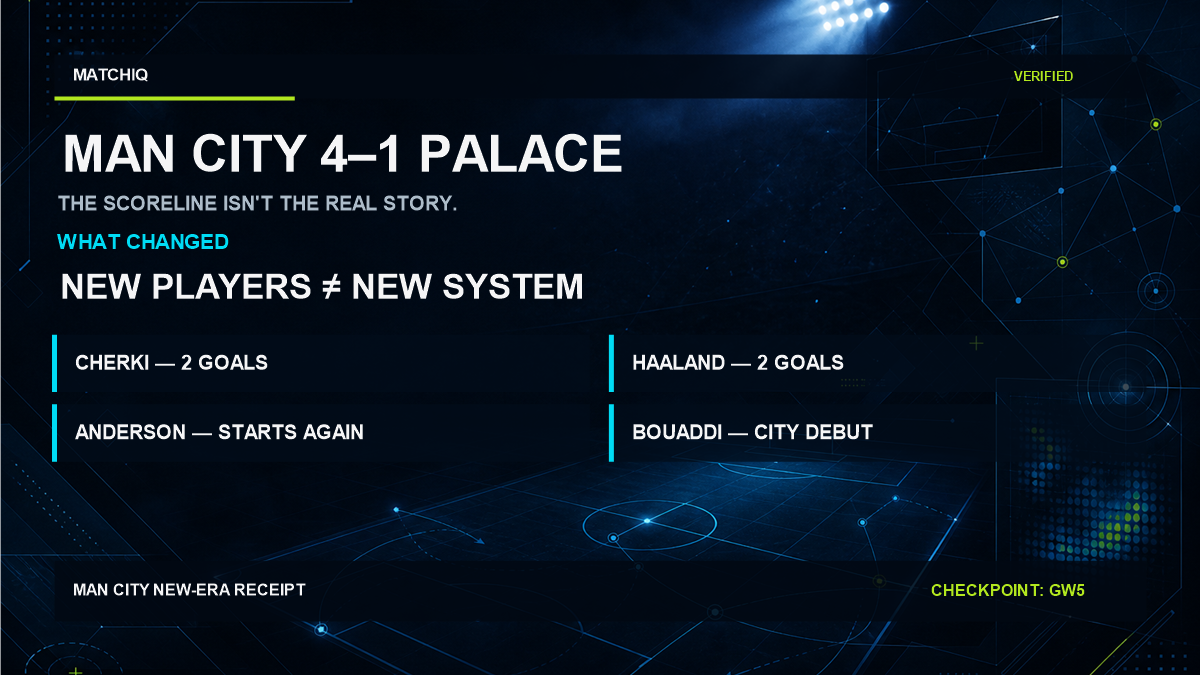
Manchester City beat Crystal Palace 4–1.
The easy story is Cherki two, Haaland two, and two league wins from two. Manchester City FC
MATCHIQ is more interested in a different question:
Is this the first recognisable structure of City’s new cycle?
Cherki had already supplied two assists against Bournemouth before scoring twice at Palace, giving him four direct goal involvements across the opening two league matches. Manchester City FC
Elliot Anderson started again, while Ayyoub Bouaddi came off the bench for his City debut less than 48 hours after joining. Manchester City FC
But what makes this match especially interesting is Maresca’s assessment of Cherki.
He specifically praised the Frenchman’s work without the ball and described his performance as complete both in and out of possession. Manchester City FC
That is the Reality Delta.
WHAT CHANGED
Old City concentrated a large share of decisive creativity around an established elite core.
The real question was never simply:
Who replaces the old core?
It was:
How are the old core’s responsibilities redistributed?
Palace offered the first serious early answer.
Cherki increasingly operates as a final-third breaker and decision-maker.
Foden continues to connect across zones.
Anderson provides another structural midfield layer.
Bouaddi represents a younger layer still being integrated.
That does not mean the system is complete.
It means the transition no longer has to be understood as:
find one new central creator.
Another possibility is emerging:
split the responsibilities across several players.
REALITY DELTA
Old logic:
creative responsibility concentrated around a small mature core
↓
Early Maresca signal:
Cherki / Foden / Anderson + new midfield layers sharing progression, connection and creation
If sustained, that matters more than any single transfer.
WHY CHERKI MATTERS
The two goals drive the headlines.
Maresca’s off-ball praise may matter more.
For a high-freedom attacker to become a genuine system focal point, one question has to be answered:
Is he still part of the structure when his team does not have the ball?
Against Palace, Maresca’s answer was clearly positive.
That is why Cherki may now deserve evaluation not only as a gifted attacker, but as a:
potential system focal point
ANDERSON: CONNECTION, NOT SAVIOUR
Anderson’s post-match line captured the mood:
“Eras come to an end and a new one is starting.” Manchester City FC
It is symbolic.
It is not tactical proof.
The real proof must come from his role.
If Anderson continues to provide connection, coverage and structured progression over the next few matches, his value may lie less in becoming the next superstar and more in helping the new network function.
INFERENCE
Two league matches cannot prove a completed transition.
MATCHIQ therefore does not settle the Palace performance as evidence that Maresca has already rebuilt City.
We classify it as:
EARLY STRUCTURAL SIGNAL
If the next three to five matches continue to show:
Cherki controlling the final third;
Anderson providing midfield connection;
Foden’s positional freedom becoming structured;
Bouaddi entering the rotation;
creative responsibility remaining distributed—
then the label can move toward:
SYSTEM CHANGE
MAN CITY NEW-ERA RECEIPT
Checkpoint: GW5
Track:
Cherki
Goals / Assists / Final-third involvement / Off-ball responsibility
Anderson
Starts / Midfield connection / Progression role
Foden
Positional usage / Creative involvement
Bouaddi
Minutes / Role / Integration speed
Manchester City
Distribution of chance creation / Goals / Points / Control against stronger opposition
MATCHIQ ORIGINAL ANGLE
NEW PLAYERS ≠ NEW SYSTEM
Changing personnel does not automatically create a new tactical structure.
A real system change requires:
**redistributed responsibility
- stable roles
- sustained output
- evidence against stronger opponents**
The 4–1 at Palace is the first signal worth locking.
It is not the conclusion.
VERDICT
FACT: City 4–1 Palace; Cherki and Haaland scored twice each; Anderson started again; Bouaddi debuted.
INFERENCE: City are showing early evidence of redistributed creative responsibility.
FORECAST: If the pattern survives to GW5, Maresca’s “new City” becomes more than an early-season narrative.
Lifecycle: OPEN
Next Check: GW3 → GW5 Settlement
The real question:
Is Maresca simply winning games — or already rewriting Manchester City?
Know What’s Real. Know What Changed.
Source scope and verification boundary | 10 September 2026
Source scope: Manchester City match reporting supports the 4–1 result, scorers and team selection. Club interviews support the quoted assessments of Cherki and Anderson. The claim that creative responsibility is being redistributed is MATCHIQ interpretation, not a club statement.
FACT / INFERENCE / FORECAST / HUMOUR: Result, scorers, selection and attributed comments are FACT. The new-era control structure is MATCHIQ INFERENCE. Persistence to GW5 remains an OPEN FORECAST. This addendum contains no HUMOUR.
Reality Delta
Previous state: Club links appeared inline without a consolidated scope note.
New evidence: Source responsibilities are now explicit.
Material change: Facts, quotes and structural interpretation are separated.
No change: The signal remains early and open.
Impact: The article stays WATCH rather than becoming a settlement.
Confidence boundary: Two league matches cannot establish a durable system change.
Next Check: At GW5, review Cherki final-third involvement, Anderson’s connecting role, Bouaddi minutes and the distribution of creation.
States: Verification — OFFICIAL. Trend — EARLY SIGNAL. Lifecycle — OPEN TO GW5. Editorial decision — WATCH.